JF Ptak Science Books LLC
Alhazen, (pseudonym of Abu
Ali Hasan Ibn al-Haitham), born in Basra, Iraq, and who
lived from 965-1039, was perhaps the greatest of all the great Muslim
physicists, and was also one of the greatest physicists with an interest in
optics of all time. Considered to be “the
father of modern optics”, he was an original thinker and an historian, an overall
scientist, preserving the ancient,
accentuating the modern and creative in his own right.
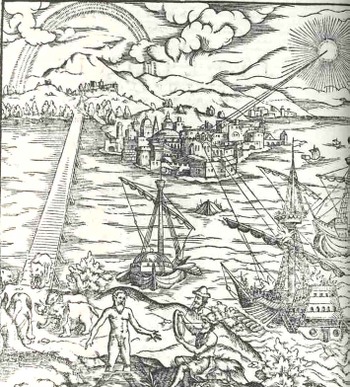
The woodcut illustration—deceptively
complex but rather simple once you focus– from his book Opticae
thesavrvs. Alhazeni Arabis libri septem, nuncprimum editi. Eivsdem liber De
crepvscvlis & nubium ascensionibus… demonstrates a number of optical principles–if
you look hard enough. (The Opticae by the way was about the only one of his 200 or so books to have survived the destructive powers of time and neglect.) In the foreground we see tow examples in the
field of optics of keen interest to Alhazen. The man standing in the puddle up to his knees in water shows the
distortion that occurs due to refraction (an area in which he greatly improved
upon Ptolemy’s understanding) The guy to
the right of naked knee-distorted man is probably using his mirror to keep an
eye out on what was happening behind him (it looks as though the person he’s
spying is not him but someone hiding behind the hillock). This small defensive use of the mirror pales
in comparison to what was happening as a cause of mirrors directly behind
him: the galleons are definitely being
set ablaze by the Archimedean-like use of mirrors in the city on the far side
of the harbor (like Syracuse), and we can see that one of the ships is already
nearly sunken.
elephants ?) is set to exhibit the knowledge of perspective, even though this
is not the best example of receding background– it was through Alhazen
that a very considerable part of that science found its way into Medieval and Renaissance
culture, particularly in the artwork of Ghiberti,
Alberti, Leonardo, and later, Poussin. Roger
Bacon (13th c), Pole Witelo (Vitellio) and most of the other
Medieval Western writers on optics based their optical work primarily on Alhazen’s
work. ‘ (The use and choice of the
elephant on the bridge is a mystery to me, particularly since we don’t see one
on the other side of the bridge, which would’ve been helpful to illuminate the
perspective bit.) The rainbow in the background is there simply
to remind us of the already well-known association of its formation and
light. The
setting sun might also hint at Alhazen’s discussion of the density of
the atmosphere and the relation between it and height—he would go on to discover that origin
and breadth of twilight, the height of the atmosphere, and many other things
back there one thousand years ago. This woodcut
hints at only a few of his great achievements.