JF Ptak Science Books Post #84
Having just finished a short post on human-powered machines (Georg Bockler in the mid 17th century) and with Juneteenth fast approaching, I thought about another sort of human power—slaves. I wanted to make a short post on the conditions in which Africans were taken (sold and stolen) from their home continent to North America (and later just to the United States).
Slavery as an institution in the U.S. existed from 1619-1865, failing, ultimately, with the ratification of the 13th Amendment (the first proposed in 60 years) to the Constitution by the end of 1865. (The African slave trade—though not slavery itself—was outlawed in 1807, by a law passed jointly in the United States of America and the United Kingdom, with the US law taking effect on January 1, 1808.) The amendment was ratified relatively quickly by the legislatures of the necessary three-quarters (27) of the original 36 states in 1865—Mississippi, the last of the original states to ratify the amendment, did so in 1995, 135 years following its initial rejection. Though almost all of the states had ratified the amendment in January and February, it took until December 4th and 6th—months after the crushing failure of the Confederacy—for North Carolina and Georgia to vote for it. (The remaining 9 states voted for the amendment as follows: Oregon California and Florida in 1865; Iowa and New Jersey (which had initially rejected the matter in 1865) in 1866; Texas in 1870; Delaware, the First State, in 1901; Kentucky in 1976; and Mississippi, somehow, in 1995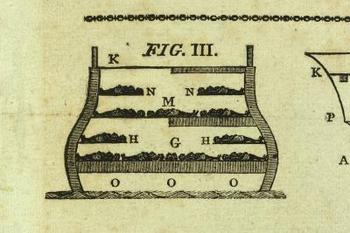
.
The Emancipation Proclamation was issued September 22, 1862, with a three-month long pillow until it took effect on January 1, 1863 . Juneteenth refers to the freeing of the slaves in Texas (at Galveston) with the reading of General Order No. 3, on 19th June 1865. Texas was the last refuge of Southern Slavery, and it all ended on that day.
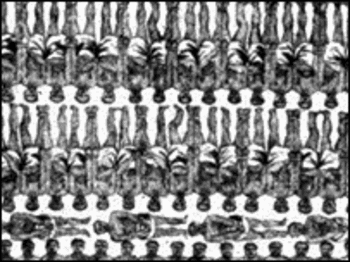
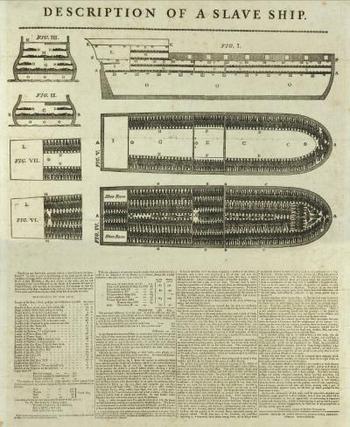
The famous image above (of the British slave ship Brooke) is taken from An Essay on Colonization, particularly applied to the Western Coast of Africa….by Carl Bernhard Wadstrom, printed in London in 1794. Wadstrom (1746-1799) was devoted abolitionist and Swedenbourgian who planned, advocated and practiced (via his relationship with the Nordenskold brothers and the Philanthhropic Society a working agricultural colony on the West coast of Africa) the end of slavery and the return of removed slaves to Africa.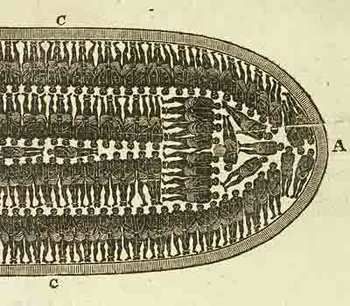
The images pretty much speak for themselves. Though it should be pointed out that this engraving depicts about 480 slaves packed into the modified hold of the Brooke; in reality the Brooke carried between 500 and 650 slaves to America (meaning the conditions were even more crowded than depicted here), losing on average about 125 people to the insufferable and depraved conditions (dysentery, heat, malnutrition, lack of water, scurvy and so on).