 JF Ptak Science Books LLC Post #103
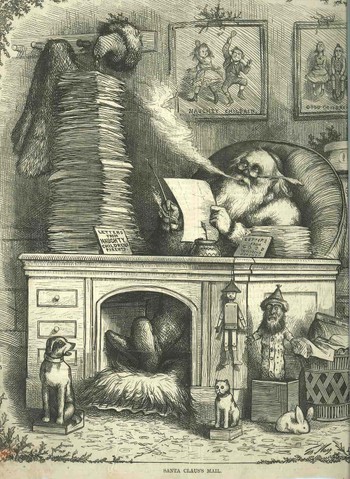
I do love Santa. But I was struck by something in this (30 December 1871) wood engraving—one of the very earliest of the now-recognizable form of Santa, created (his image that is , of course) by the incredibly prolific, and almost-entirely socially responsible (except for Catholics and the Irish) Thomas Nast. (Nast created the standard, iconic image of Santa, plus the Republican elephant, the Democratic donkey, the Tammany tiger, and much more). I’ve never noticed that the letters that Santa is reading are being taken *from* the piles on his desk, and that they are not from children, but from their parents.
What? How does this work out? Were the “naughty” children being ratted out by their parents? Does Santa really need to be told all of this? And who on earth really is deserving of a lump of coal, anyway? I’m guessing though that this was simply a warning cartoon to children, saying to them that they’d better damn well be good or a letter will be going out to Santa in the afternoon mail.
On the other hand this would make more sense if the cartoon wasn’t published five days after Christmas.
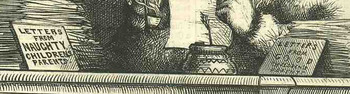
These questions aside, the lesson yet again for me is to look very closely when looking at complex images like this—especially when you think that you already know what you’re looking at.
Listen: this is especially poignant when you think that you’re looking at not much at all. Having an antiquarian map (and print) shop puts me into contact with all manner of printed images. As a result of this I have seen many thousands of images of important buildings in this and that city. What I’ve found most interesting are the in situ images of the buildings, the structures as they were in the time of the artist, and situate din a street scene, showing other buildings, and other aspects of city life.
It is all of this other stuff that can be extremely compelling, and sometimes, shocking, weird, odd, unexpected. I have found that in big scenes of big buildings in big streets that the artist sometimes takes a little creative licenses with the people inhabiting the scene. Sometimes it takes a magnifying glass to reveal the artist’s (or engraver’s) secrets and whimsies, but often the oddments are plainly there, just simply overwhelmed by everything else in the world that is happening.
Take for example the following two engravings, both by Giuseppe Zocchi (1711-1767) who was commissioned by he Marchise Andre Gerini at mid century to record the greatest of Florentine landmarks. The first shown here is the Veduta della Piazza della SS Nunziata Statua Equeftre di Ferdinando Primo, Fonti, e Loggie Laterali. 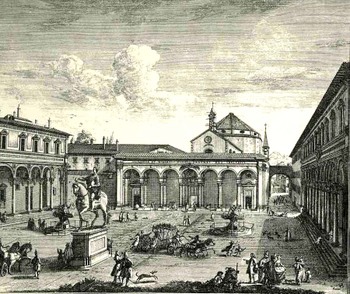
It would’ve been easier certainly to leave the plaza empty, but Zocchi doesn’t, filling in the empty spaces with several dozen people, most of whom are really rather busy. In addition to royal coaches and animated discussions, we can find a number of unusual images. There is a very curious sub-scene of a women with three children, one of whom seems to be falling, or leaping, the woman holding her hand straight out in front of her. Directly above them we can see a man pulling a small carriage with another person in it. Is this person a child? Are they elderly? Infirmed? And what about the (probably elderly) figure who we can half see, leaning their back against the equestrian statue, holding a staff? Why bother adding half of figure (from the rear)? Why on earth did Zocchi choose to add
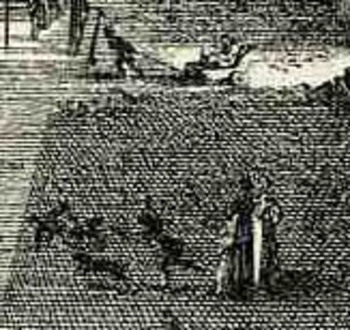
characters like these when it would be substantially easier to show a gent walking with a stick? Is the artist expressing a little semi-invisible artistic freedom, or just using his powers of observation to make the commissioned part of the art more interesting? Or perhaps Zocchi has nothing whatsoever to do with these tiny figures—perhaps it is all the work of the engraver, who was responsible for translating Zocchi’s paintings into metal, adding these figures as he went?
I think it is fascinating! Perhaps what the story is here is that these were really just simple street scene, common street life, and the artist simply included them in the work? That would make them 18th century snapshots of common life in Florence, something that wasn’t ordinarily captured by very many artists at all.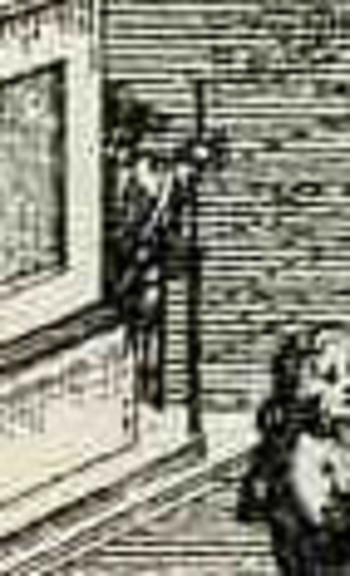
Is it possible to collect all of these odd images—uncommon people, children playing (nameable?) games in the street, sellers of bits and pieces, people pushing homemade wagons, unusual modes of conveyance—and have a little bit of an unintended societal X-Ray of common life
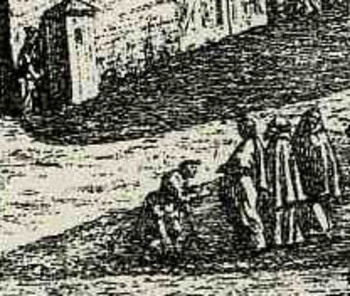
Let’s look at another example from Zocchi: Veduta del Reale Palazzo de Pitti Abitazione de Regnanti Sourani. Here we can see a rather long royal procession across a problematic grassy area, with most of the people not caring the least bit for the splendor. As a matter of fact most of the people in the foreground of the image look to be homeless travelers, one of whom at the extreme bottom right) has a dog
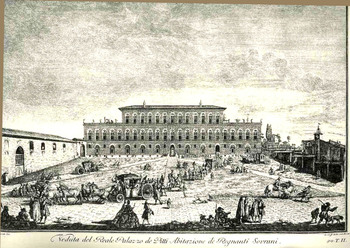
on a leash, a backpack, and seems to be accompanied by a child. Scurrying over to the left of the image, right before the procession, we can see a person on their knees seemingly begging for money from a more wealthy-looking group. And above them is a singular little structure with a person entering—is this a guard’s shack, or a public convenience? Probably it is the former as there is a very heavy door in a fortified wall just to its right (with some high weeds growing up against the wall as well). 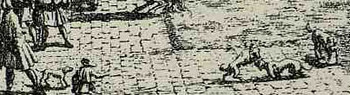
Why does the artist include this minutiae? Why weeds? Why the beggars, the homeless with children, the lazy? Why did he include those dogs play fighting right in the middle of the scene?
I think it is fantastic, and to me it is ultimately far more interesting looking for these bits than it is to see just another image of the Pitti.