JF Ptak Science Books LLC Post #131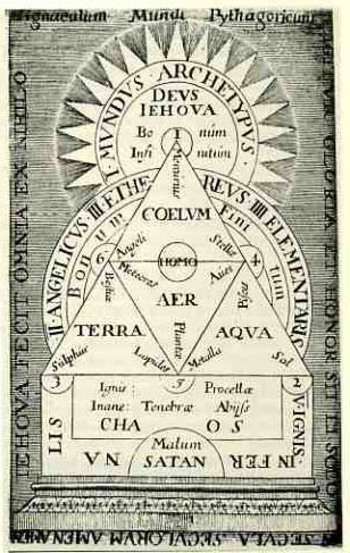
This lovely and relatively simple Pythagorian organizational chart of “all things” (from the Mundus Archetypus to the layering of chaos upon the Inferno of Satan) appears in William Cooper’s work The Philosophical epitaph of W.C. Esquire : for a memento mori on his tomb-stone, vvith three hieroglyphical scutcheons and their philosophical motto’s and explanation : with the philosophical Mercury, nature of seed and life, and growth of metalls,and a discovery of the immortal liquor alchahest : the salt of tartar volatized and other elixirs with their differences. Also, A brief of the golden calf, the worlds idol : discovering the rarest miracle in nature… With a catalogue of chymical books (and printed in 1673).
If we look beyond this pretty organizational fons pietatis we find, under the bulk of this usually-unusable book, a great source for the history of chemistry. William Cooper, a true believer in the philosopher’s stone and all things alchemical, and a rather accomplished scholar in these early fields (the “Esquire” at the end of his name comes from nothing at all, though the man did translate a number of alchemical texts from the Latin into English), tacked the most important element of his book on at the very end of its long title. The “catalogue of chymical books” as it turns out is the earliest bibliography of English-language works in chemistry, as well as works relating to chemistry that were published in the monumentally important Philosophical Transaction of the Royal Society.
At first blush it would seem that the section must’ve come as an afterthought, as the section did not have any pagination, but I think it was simply an early form of bibliography attempted by Cooper. He’d know about such things as Cooper was one of the earliest people to introduce the sale of books by auction into England. He held sales for about 15 years and so was familiar with the importance of representing the continuum of scholarship—plus the fact of course that the man was an advanced scholar, and produce (even for his time) a very good approximation of a modern scholarly work.