JF Ptak Science Books LLC Post 143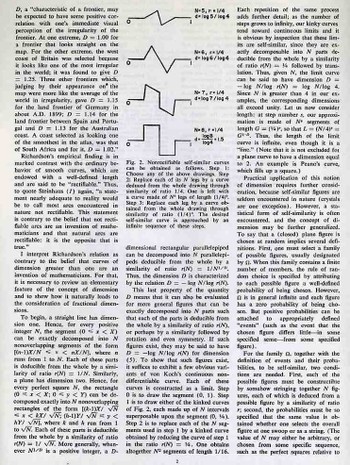
This is the first of a few short essays of the idea of
pre-historic appearances of important ideas. I use the word “pre-historic” in its literal sense—that is, these papers
were published before the concepts that they discussed were recognized and published,
later, in more complete form and of course to greater fame. One will certainly be Gregor Mendl’s paper (Versuche
über Plflanzenhybriden ) published in the obscure Verhandlungen des
naturforschenden Vereines in Brünn, (Brno),
and to be resurrected at the hands of Gregory Bateson thirty-odd years
later. Another example is Vannevar Bush’s
“As We May Think”, published in The Atlantic Monthly in June 1945, and which
was a definite intellectual precursor to the construction of the Internet. A third
Right now, though, I’d like to look at the pre-birth of
fractals in Benoit Mandelbrot’s precursor (1967) paper (and in a weird,
probably not-correct way, scooping himself) to his more famous effort of 1975,
in which he coins the term and fully describes fractals, showing the
measurement of the coastlines behave like a fractal over a range of measurement
scales.
The seminal paper, How Long Is the Coast of Britain? Statistical Self-Similarity and Fractional Dimension, published in Science
magazine in 1967, is an introduction to the concept of fractals (which
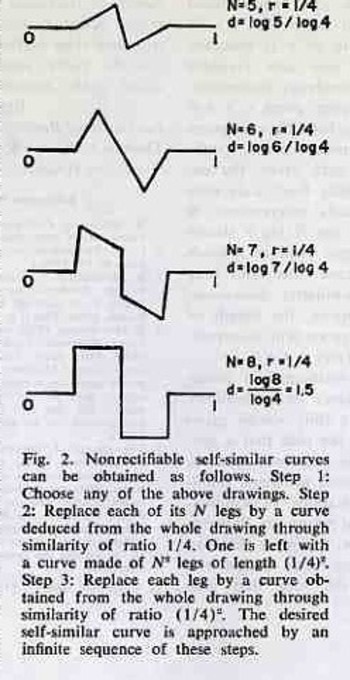
Mandelbrot would name in later in1975), The kernel of it all is found in the Lewis Fry Richardson graphs and
more so in the small illustration on page three of the paper—the peek into the future
world of fractals, seeing a fractal before it was named so.
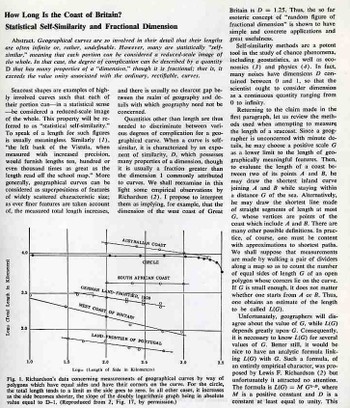
Richardson (a kind of Jevons, Marey-like American figure on the history of 20th century
science) did some very good thinking about the elusive nature of naming such a
thing as the lengths of coastlines and other natural constructions: namely he determined that their measured
length was dependent upon the scale of measurement. That is to say the measured length, L(G), is
ruled the scale of G, approximating the function as L(G)=M(G)1-0
being a self-similar object, which is something that is nearly exactly similar
to a part of itself, or the whole having the same shape of one or more than one
of its parts, and regresses.
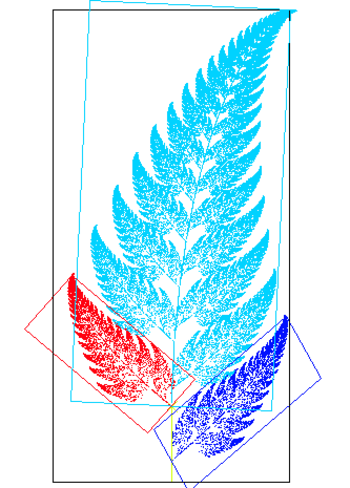
The Mandelbrot Fern (courtesy of http://en.wikipedia.org/wiki/Image:Fractal_fern_explained.png) displaying self-similar properties.