JF Ptak Science Books Post 424
This chart, appearing in The Illustrated London News for 19 December 1942 is in part a righteous propaganda effort, a response to a criticism evidently boiling in the United States about a “failing” in the British effort to prosecute the war. Honestly, I was not aware of this sentiment being hosted in the U.S. in the winter of ’42. The text accompanying this chart explains that the misunderstanding of perception is partly due to British “reticence” concerning their achievements and “an [American] opinion based on ignorance of the true situation”. 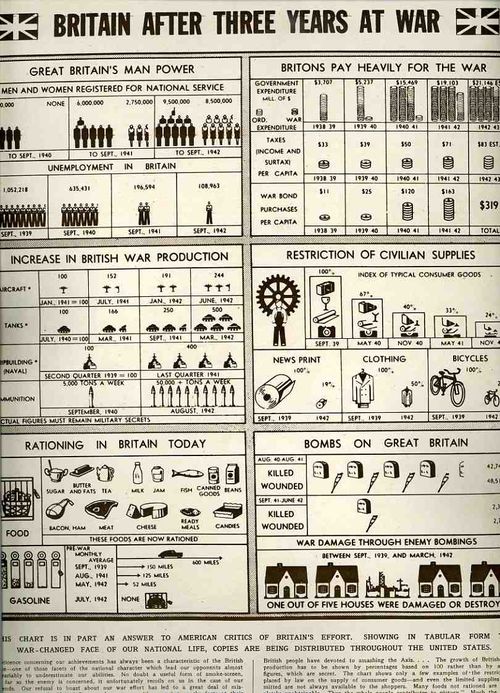
This chart was actually a publication that was distributed “throughout the United States” to alter the public opinion there and to show “in tabular form something of the achievements–and sufferings–of Britain during three years of war. “Those cold figures barely hint at the three years of fighting sacrifice which the British people have devoted to smashing the Axis.”
There are some truly extraordinary figures here: for example, in September 1940 there were 4.2 million men (and no women) registered for national service; by September 1942 the number of men more than doubled, and there were 8.5 million women now registered. Unemployment sunk to 108k in Sept ’42 from 1 million in Sept ’39. War damage (which I’m guessing was in the London area) is listed at 20% of all houses (!?); war deaths from the Battle of Britain and the V-1 raids fell from 42k killed and 48k wounded in the year ending Aug ’41 to 2k killed and wounded in the year ending June ’42 (showing extreme hardship, sacrifice and progress).
Overall the rest of the stats speak for themselves, and I was a little surprised that the British government found it necessary to launch a propaganda effort in the U.S. a year after Pearl Harbor. Eleanor Roosevelt said just before this brochure was issued, Britain has given ten times what we have given, because people there know what it means to be without. There is much more equality of sacrifice in Britain than in this country”. The article finishes: “A more forceful propaganda directed from Britain to the United States and a few more Americans speaking their minds as Mrs. Roosevelt spoke hers, would go a long way–perhaps the whole way–towards removing a possible cause of misunderstanding between the two great nations”.