JF Ptak Science Books LLC Post 481
If I was an alien (of the outer-space variety) looking at the
States, I’d find it difficult not to assume
that the biological units scurrying around the place were not put there to
service the automobile. Cars get born,
then put on display, then selected and driven to their new home. They get washed, and fed, and sometimes have
their own places to sleep at night in their very own structure with their
caretakers housed nearby. They get taken
out for airs in the morning and evening, resting while the humans labor all day
to make enough money for their care and maintenance and feeding. In the evening, they get brought back home
and allowed to rest further. They
respond directly to inputs only and give no unsolicited response: sort of like cats. Fantastically large allowances are made for
cars, humans going so far as to remove life- and atmospheric-sustaining biological
units such as trees and good dirt so that the car can be taken virtually
anywhere in the country on a path made specifically for them. These pathways, which are padded and smooth,
have ancillary bits attached to them so that the humans may walk beside them—houses
and such are all connected to these paths to more easily enable the people to
have access and maintain the car. And,
at the end of the day, humans breathe in the very excrement and excretia
produced by the cars. Placed under a
microscope, the whole thing might resemble a biological unit, the cars being
its very blood, everything else present to contain and move it.
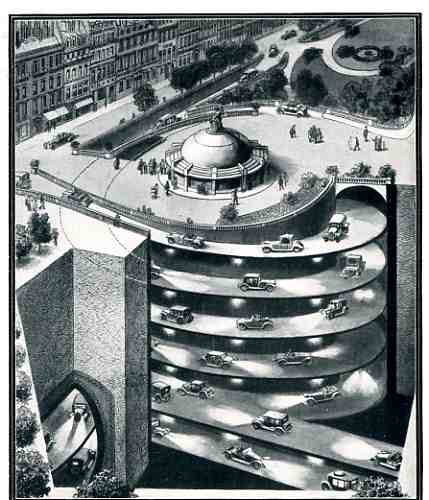
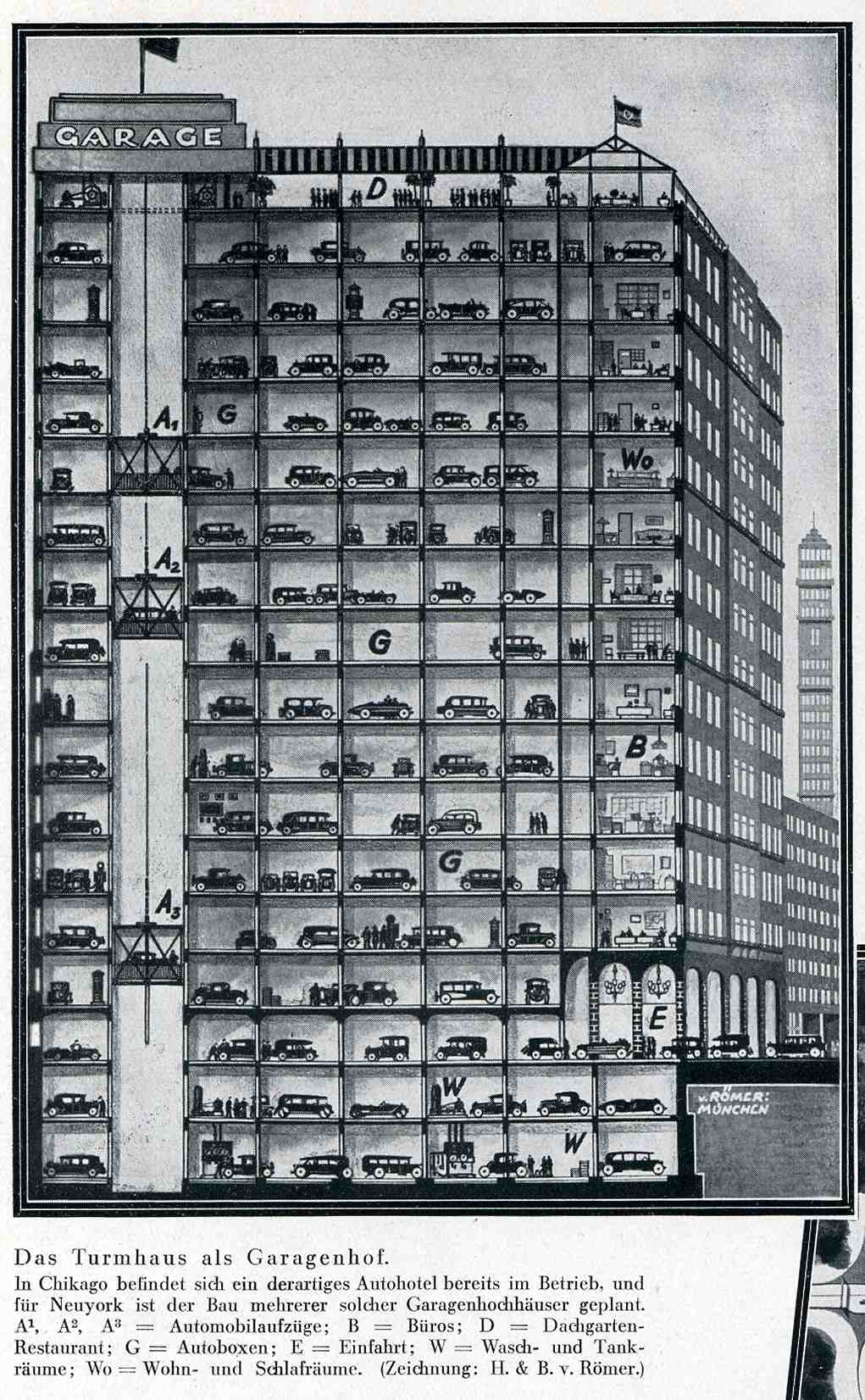
These images from the Illustriete Zeitung (Leipzig, issue
4484, pp 239-240) for November 1930 speak to the exact issue of how to care for
the now ever-present automobile.
Entitled “Wie Bringe Ich Meinen Kraftwagen Unter?”, the short article
(by the engineer Botho von Romer of Munchen) addresses the need of what to do
with cars at bedtime—where do we put them?
One answer was this spectacular carpark (“Garagenhof”) high rise—seventeen
floors of parking (with two more underground), serviced by a variety of
elevators, pointing out that varieties of this structure already existed in
There was also the possibility of vast masses of sunken
garages, their entrance way screwed into the earth leading to tunnels and
networked warehouses where the cars could be safely deposited and removed from
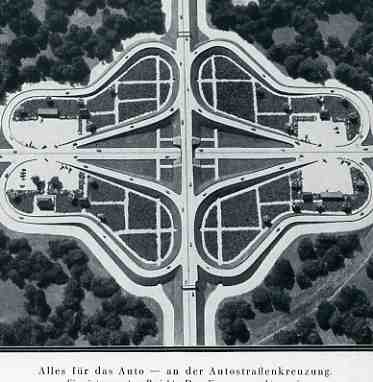
city streets. There were also these two
versions of the simple above-ground garages and parking lots: the apartment block gives over the entire
interior area to individual parking and garages (doing away with any
greenspace), while the massive semi-cloverleaf design is made for nothing else
in mind than to park the cars in the four semi-centers.
By 1930 the production of the automobile had been revolutionized
to such an extent that virtually anyone with a job and less than five kids
could actually afford a car. It is
interesting to note that at the average price of say 30 cents a gallon for
gasoline (in the
that folks 80 years ago were paying pretty more per gallon (adjusted via CPI)
than we are paying now at $1.87/gallon (in my mountain city at the far end of
the pipeline).