JF Ptak Science Books LLC Post 565
Standard illustrations that give a little more than they need to have always been very interesting to me–sometimes this takes the form of completely unnecessary detail in almost-invisible expendable space fillers (as I’ve looked at in this series)
and sometimes it is in the most obvious places.
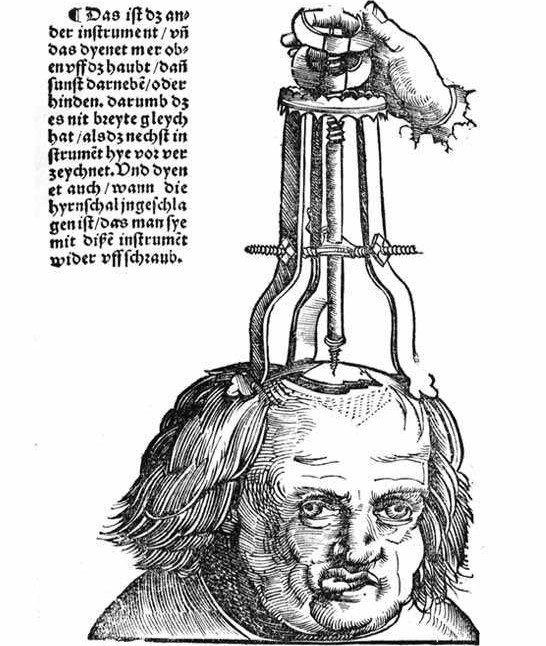
Now, in this remarkable image from Hans von Gersdorff ‘s (who we met earlier in this blog) Feldbuch der Wunderartzney (Fieldbook of Wound Surgery, and printed in 1517) comes an unexpected bit of detail. The machine, the surgical device, operates something like a cork-puller: it is meant to attach to and extract a piece of skull that had become embedded in the brain following a skull fracture. The procedure looks as though it is just beginning–the man’s head has been shaved, the fracture revealed, and the penetration about to begin. The patient looks, well, I’m not so sure exactly what this look means–perhaps nothing, perhaps the man has brain damage.His right eye has drifted, his jaw set off to the the side and is jutting considerably. I suspect that a simple view of the top of the patient’s head would’ve been enough to illustrate the image, but–as seems to be more often than not in the 16th century–the illustrator has included not only the entire head, but has given the head character, history, emotion and dignity. Everything necessary to imbue the surgeon-reader with with the sense of humanity associated with his trade and task.
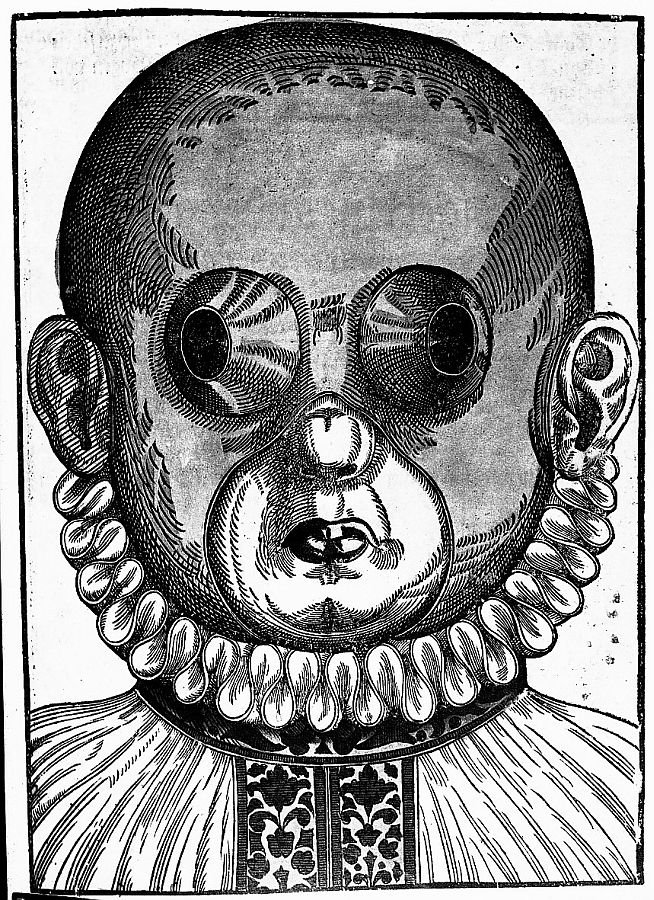
I should think that the same may be said for many of the illustrations from Georg Bartisch’s Augendienst (The Treatment of the Eye, printed in 1583). The woodcut at right is an example of Bartisch’s suggestion for crossed eyes–the mask would be worn for different periods of time, the openings supposedly working to make the eye muscles assume their normal positions. The remedy looks bizarre (and very symmetrical) from our point of view here in its future, but what seems very modern is the careful treatment of the illustration of the patient, who is erect, calm, well dressed and terribly decent.
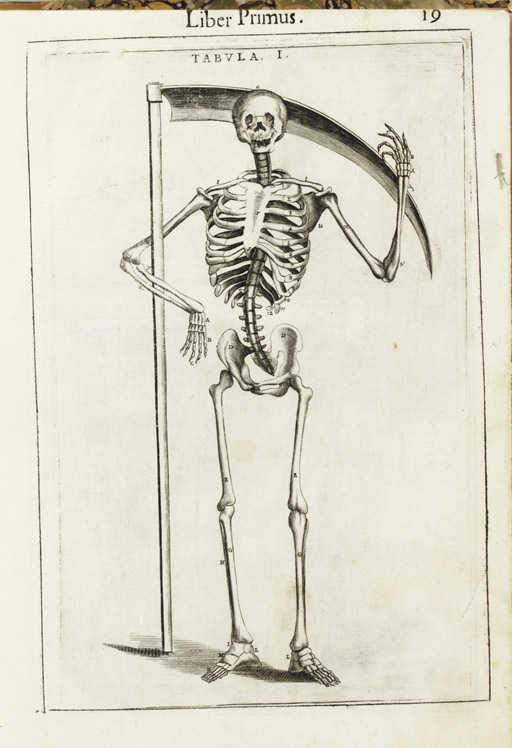
The thread of deeply humanized anatomy runs deep in the 16th and 17th centuries,where human bodies are dissected to show the different levels of our delicate existence. The bodies are not simple cadavers, but seem to have some sort of “liveliness” in their post-living being. This image (below) by Guido Guidi (1508-1569).in his De anatome corporis humani libri
VII.
(printed in Venice in 1611) gives the beckoning skeleton a smile to go along with its timeless gesture for the remembrance of mortality.
Certainly there can be no escaping the modesty of the model
in Alexander Read’s (1580-1641). Somatographia Anthropine, or a Description
of the Body of Man. . .By Artificiall Figures representing the members… (printed
in
in 1616). Even though she is displaying most of her abdomen, this person is still caring for her moral appearance.
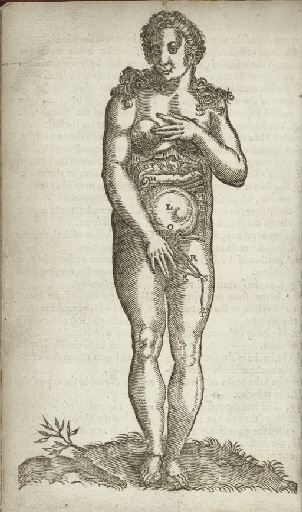
Another example of this modesty can be found in the work of Adriaan
van de Spiegel’s(1578-1625). Opera quae extant omnia (edited by Johannes
vander
in 1645: here we see the nearly full-term foetus ably
displayed, the mother’s skin pulled back as if to form petals to the flower of
the child (helped along by a strategically-placed plant in the foreground).
These images can go on and on–these are just a few scant examples.
Another quick example:
Johannes Remmelin’s (1583-1632) Kleiner Welt Spiegel, das ist,
Abbildung goettlicher Schoepffung an des Menschen Leib…. (printed in Ulm
in 1661) has many illustrations in which the anatomical model seems quite
serene; ambiguous, sometimes, to what is going on, but at the same time looking
inviting, welcoming even.
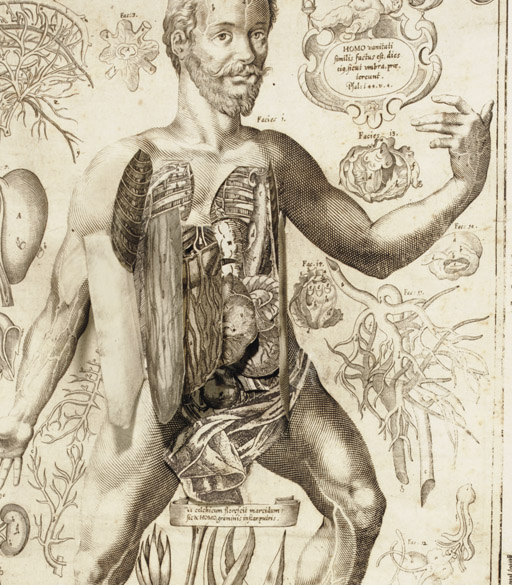
All I’m saying is t hat there seems to be something special going on in these images–certainly a “something” that was lacking in most other (non-artistic) anatomies of the 19th and 20th centuries. Emotion was certainly extracted from the examples of modern and recent-past anatomical studies. I feel a little happier with the artists and physicians who were interested in connecting humanity to these studies than the slabs of Netter and Grey, to say nothing of the Adam and Eve project or deeply modern technologies. A little reminder now and then that there was something else connected to the viscera and bones and muscles and veins might not be too bad.