 I had some lingering thoughts about my post from two days ago which briefly touched on Joyce’s dreamy Finnegan’s Wake (published in 1939, just two years before the author’s death), which led me to the language-creating, never-endingness of one day in his Ulysses* (1922). It is also a novel of time, reprocessing its time-units lile old Zeno, finding halves of time in regressive size and in greater numbers, roiling around like fly-swatted mercury; we never do get to the bottom of time although it does slow it down considerably. It follows a slight but powerful literary history, treating time somewhat like the earlier (earliest?) Poe, and especially like that clock ticking in Dostoyevsky’s Crime and Punishment (1866), where action is laid bar to exhaustive and minute interpretation, waiting for no person.
A little later on comes Ambrose (“Bitter”) Bierce, a crummudeonly misanthrope with a razor eye for criticism for everything beyond himself. My guess is that every other person in the U.S. past the age of 30 has read his Alabama-based “An Occurence at Owl Creek Bridge” (1893) in which a lifetime or so could be lived in the moment that it takes for a man killed by hanging. (I have a feeling that this was a very apt way for Bierce to look at his own life, right up to the moment where he rode into infinity in the Mexican desert.) The prgoression of time is interrupted to tell the tale, everything taking place in the time that it takes to travel eight feet. What I didn’t know when I read the story for the first time was how unusual, groundbreaking, it was for the distortion of time in this way in literature. Monet and Impressionism Inc. were at it for a little from the 1860’s or so, but it seems to me that in literature this fracturing of time was pretty scarce.
These authors were performing experiments with the vast horizon of time, creating a new space in the very slim spectrum that we call the “present”. In another way, Proust’s Remembrance of Things Past explores past action in a way that redefines what we can think of as a “normal” present. Looking forward, too, can have a pulling effect on the present, as we can see in the novels of the future by Jules Verne and H.G. Wells.
Time in physics is the orders-of-magnitude incendiary to this discussion–it is the fundamental, measurable scalar unit from which stuff like motion and energy and fields are derived. Things get really interesting in the history of science once you move through Galileo and Newton and Maxwell and get to the time of Planck and Einstein and Minkowski . Interestingly, the most significant changes occurring in the treatment of time and the definition of the present come in the period from 1865-1915–a particularly fertile period of revolution and modernity, where nearly every discipline undergoes a radical, fundamental change. Everything except political studies, where the only really new thing to come into the fray at that time was the introduction of the concentration camp during the Boer War. Everything else changes in remarkable ways: physics, mathematics, art, music, literature, theater, dance. Astonishing. 
If I was really clever I would find a way for this post to be circuitous, but I can’t, so I’ll just end by saying that I’m out of time.
*I’ve included the first lines of the Joyce novels in the continued reading section, along with a few choice others.
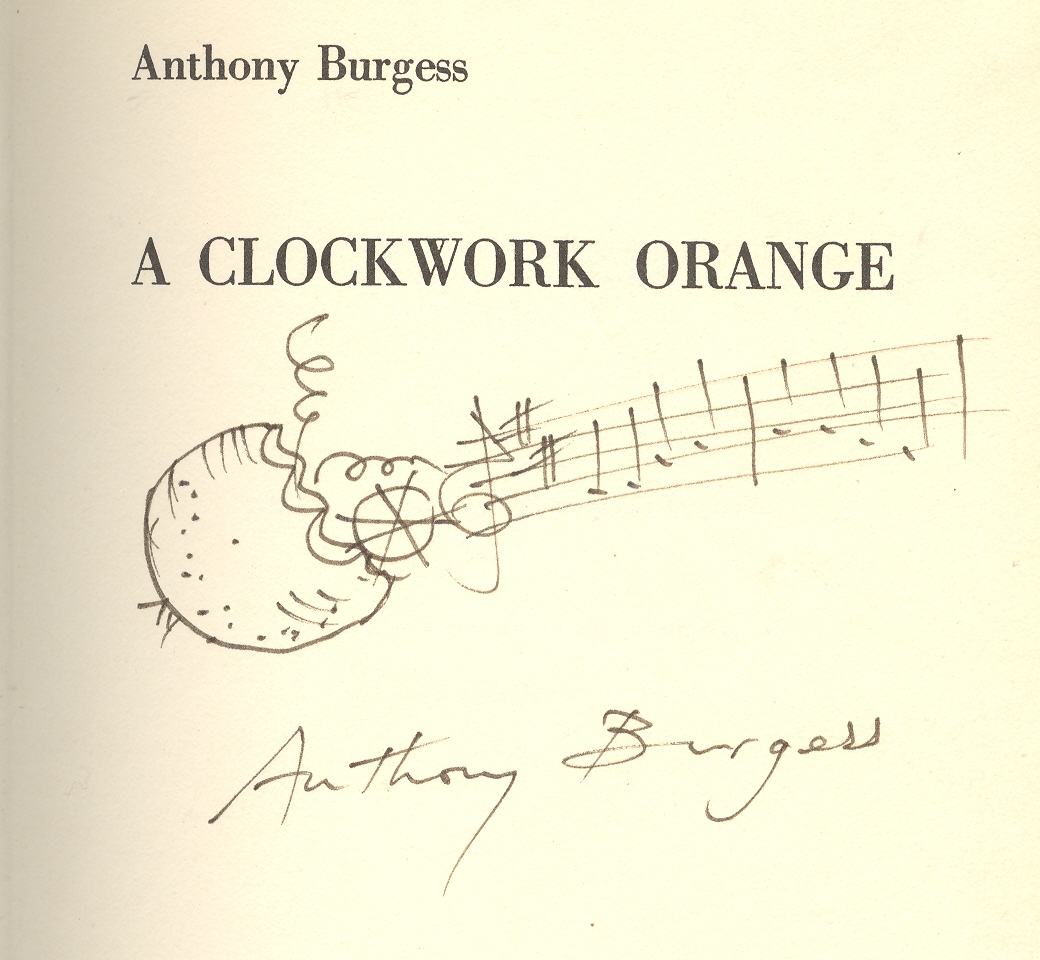
**For several years in the early 1980’s I read all of Anthony Burgess’ novels, collecting them as well. I always liked A Clockwork Orange for its dark humor and inventiveness, and for each of the few times that I met Burgess I had a copy of the book for him to sign. He was always very gracious, signing my books with appropriate flourishes–with music, or Arabic, or whatever was implied by the subject of the book. The exploding orange is far and away my favorite.