JF Ptak Science Books LLC Post 580
Science Store (Blog with Books for Sale)
Yesterday I wrote about leafing through a 1932 issue of the Illustrated
London News, piecing my way around unexpected bits of historical
bric-a-brac, surprising myself with the oddness of it all, until I came
to the reporting of the 1932 German election and the beginning of the
Nazi takeover of Germany. The beginning of the end. So it was like a
bit of enjoyable, entertaining historical surprises until bumping into
the Nazi cancer. But 1932 stuck with me a bit. Thinking about it a
little more, today, I realized that there was much more that the year
had to offer in the way of epochal beginnings, many of which related in
some fashion to the beginning and end of WWII (and particularly to the
May-August 1945 period).
1932 was a very big year in physics,
especially in the sub-atomic world, most of which would result in
Hiroshima and Nagasaki as well as five (!) Nobel prizes. Irene Curie
and Frederick Joliot produced proton emission from alpha-ray irradiated
beryllium in January; James Chadwick discovered the neutron in February
(getting the Nobel physics three years later); that same month E.O.
Lawrence and M.S. Livingston developed the cyclotron (getting the Nobel
in 1939 for it); J.D. Cockroft and ETS Walton produced the conversion
of an element (He) (winning the Nobel in 1959); C.D. Anderson
discovered the positron (receiving the Nobel for it in 1936); Werner
Heisenberg introduced the proton-neutron nuclear model; and H.C. Urey
last in that year discovered deuterium (winning the Nobel in 1934). It
is an astonishing and long series of significant developments for a
single year.
On the seer-ing theoretical part of 1932 came Carl W. Spohr’s “The Final War”, with appeared as a short story in the magazine Astounding Stories.
Spohr’s story involved the creation of a bi-polar world shared by two
superpowers both of whom were kept in check with the threat of Mutually
Assured Destruction–ultimately the MAD scenario fails and the atomic
bombs fly, devastating the earth. The Spohr idea of
scientifically-induced Earth-shredding was preceded by others including
H.G. Wells (in 1912?) and Pierrepont Noyes (1927). (Actually, Noye’s
first edition of his novel depicting nuclear holocaust was sleepily
called “The Pallid Giant”; when re-issued in 1947 he renamed it with
more teeth, Gentlemen You Are Mad. Noyes is also the son of
the founder of the socialistic/semi-utopian Oneida society in upstate
New York. There was a complex of religious pullings going on up there,
not the least of which was the living a new human life in the
post-second-coming of Christ earth, complex marriage, and free love, a
term Noyes’ father coined, and which did not go over well outside the
community. For his part, the younger Noyes settled on a more practical
end to the community’s social and business life, and established a
silver- and flat-ware company that became the world’s largest of its
kind.) Spohr was six years before A.G. Street’s Already Walks Tomorrow,
probably the first science fiction/futuristic depiction of worldwide
apocalypse via environmental disaster and dystopia. It was also in
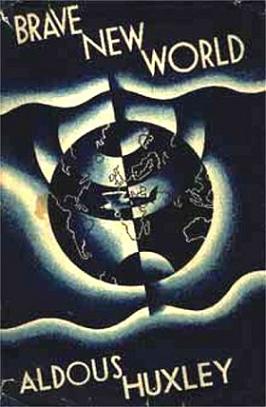
1932 that Aldous Huxley’s Brave New World was published, which
was the first depiction of a nightmarish end to failed and run-agog
utopian planning. (The novel begins in the year 632 A(fter) F(ord),
some years after civilization had been destroyed by war. Ford’s selection here is also ironic because of his heavily-disputed but well-documented anti-semitism and admiration for Hitler*) Huxley’s
novel follows by two years the related work of Laurence Manning and
Fetcher Pratt, whose City of the Living Dead tells another story of Utopian collapse, this time of the brain deadening possibilities of alternative and virtual realities.
On
the political end–in addition to Hitler’s victory in the German
elections–was the Japanese invasion of Manchuria, which may well be
the true place to start the beginning of World War II. In 1933 Fritz
Lang’s movie Das Testament des Dr Mabuse is a thinly-veiled
tale of a brutish criminal organization taking control of the state via
criminal means and is almost immediately banned by the new German
government. The Lang film is basically replaced in the next year by
the primum mobile of Nazi propaganda films Triumf des Willens
by the filmmaker who wouldn’t die, Leni Riefenstahl. Riefenstahl lived
to 101, long past the disgust that she presented so beautifully in her
vile lickspittle hearts-and-minds film. (Few artists have lived to
100; I’m not so sure that any other filmmakers have.)
And so for 1932. This might all be too free-wheeling, but the more I thought about it, the heavier the year seemed to become. Perhaps there is something there.