JF Ptak Science Books Post 632 Blog Bookstore
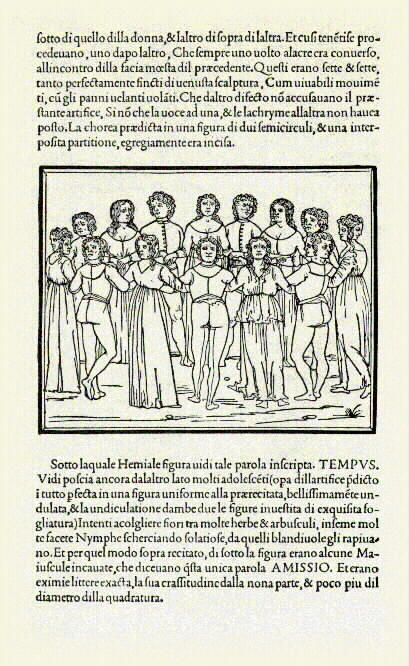
Since I had a go at early illustration earlier today in this blog I thought to write something about a book that is probably one of the most beautifully printed books not only of the Renaissance but of all time. The Hypnerotomachia Poliphili (The Strife of Love in a Dream) by Francesco Colonna was the greatest achievement by the greatest printer of the Renaissance (Aldus Manutius in Venice), a spectacular combination of story and type and design and illustration; an imaginative, secular Humanist self-romance like no other printed to that time. ) See the entire text HERE.)
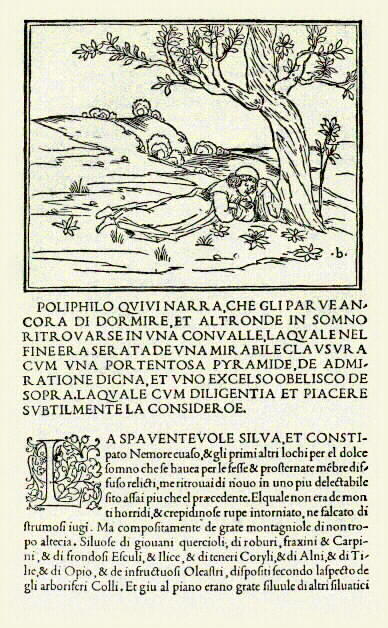
Hypnerotomachia means “the strife of love in a dream”, and the reference to Poliphili refers to the narrator of the story, Poliphilo, telling of the love affair between Polia and Poliphilo—the master text of the whole story though is a description of ancient art and architecture, all told in a wonderful ”macaronic mélange” of Italian and Latin, and which were the “exact accounts” seen in Poliphilo’s dreams about Polia.. It is a modernist book for being printed in the last year of the 15th century (1499), and stands for vitality and grace and superb design, and according to George Painter was the Finnegan’s Wake of the fifteenth century. Painter continues, and writing that “Gutenberg’s forty-two line Bible of 1455 and the Hypnerotomachia of 1499 confront one another from opposite ends of the incunable period with equal and contrasting pre-eminence. The Gutenberg Bible is somberly and sternly German, Gothic, Christian and mediaeval; the Hypnerotomachia is radiantly and graciously Italian, classic, pagan and renascent. These are two supreme masterpieces of the art of printing, and stand at the two poles of human endeavor and desire! “(Cited by Alan Thomas, Fine Books, 1967, pp 71-4).
Martin Lowry in his The World of Aldus Manututus (Ithaca, New York, 1979) makes another interesting statement on this masterpiece: “(Hypnerotomachia) was a linguistic and literary debauch, choked with recondite imagery, erudite periphrases, and exotic verbiage: a work so bizarre that many critics have felt a certain uneasiness at Aldus’ agreeing to print it.”
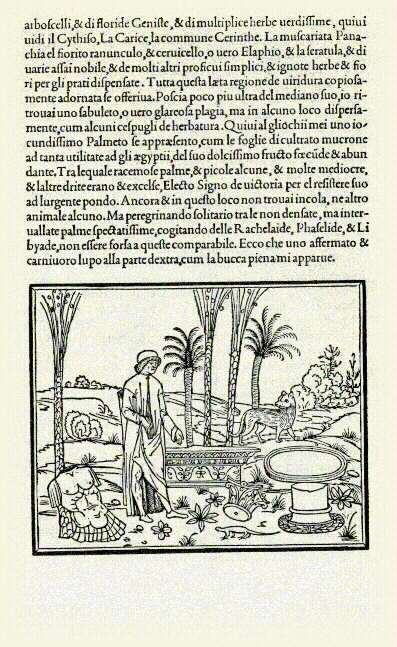
It is truly an astonishing accomplishment, and its significance in the design of type and of the book really cannot be underestimated. As E.P. Goldsmidt stated (in The Printed Book of the Renaissance, 1950, p. 52): “In the North an astonishing proportion of all Renaissance ornament and accessory design can clearly be proved to derive from Colonna…”
The book is summarized here and below: