JF Ptak Science Books LLC Post 705 Blog Bookstore
Finding the Big Bang in a bowl of soapy water.
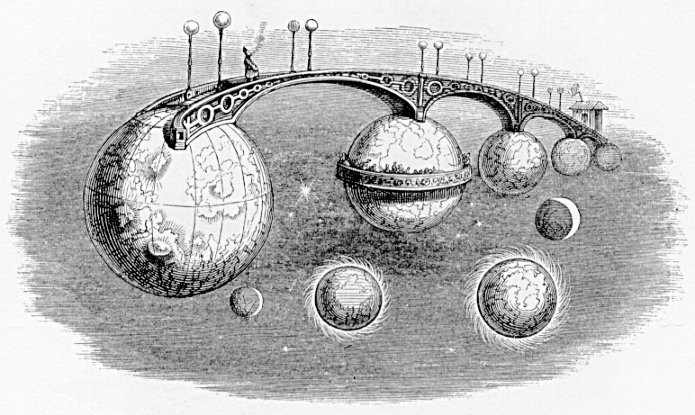
Last year I wrote a little aboutJ.J.Grandville’s interplanetary
bridge connecting some of the planets (and including a balcony constructed of Saturn’s
ring [sic] in an early Victorian Grad Tour solar system walkabout. Grandville (the pseudonym of Jean Ignace Isidore Gérard,
born in 1803 and staggering too quickly out of life in 1847) was an extraordinary
talent working somewhat out and ahead of his time; he had superb visions of the
future, and of the past, and most of them were fantastic and fanciful, though
not without some very stinging social commentary. He has been called a proto-Surrealist and I’d
have to agree, though for me he had a larger production of social commentary in
his work than any of the “real” Surrealists of the 20th
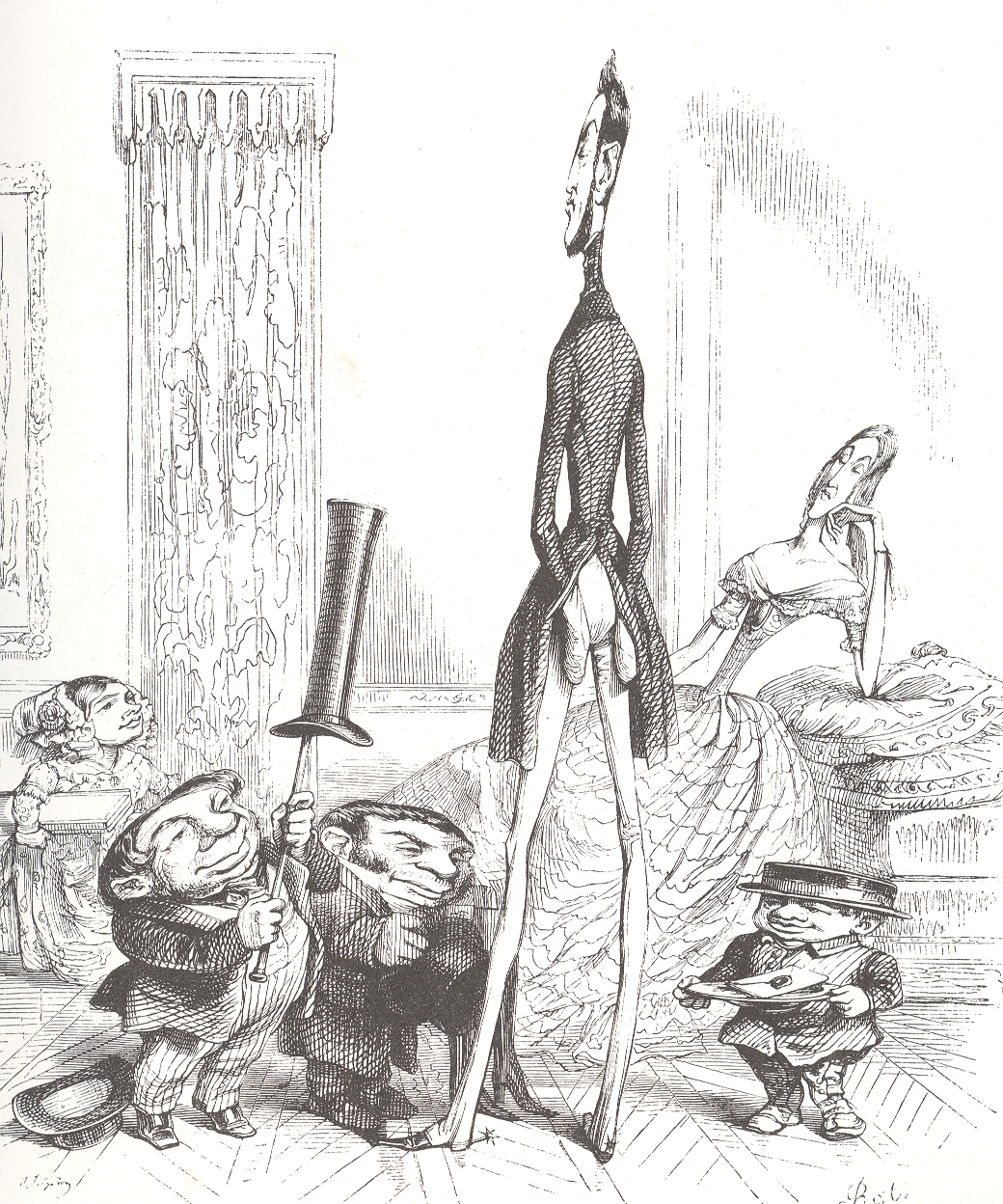
century. For example, in his Un Autre
Monde (“Another World”) he depicts people’s
social stature literally—the taller and thinner, the more socially important;
the shorter and stouter, the more disposable/replaceable; the images are funny,
convincing and wincingly penetrative.
This being said, I have a special interest in the
astronomically-based images that he produced, and so far as I can tell, there
weren’t many of them in his vast output.
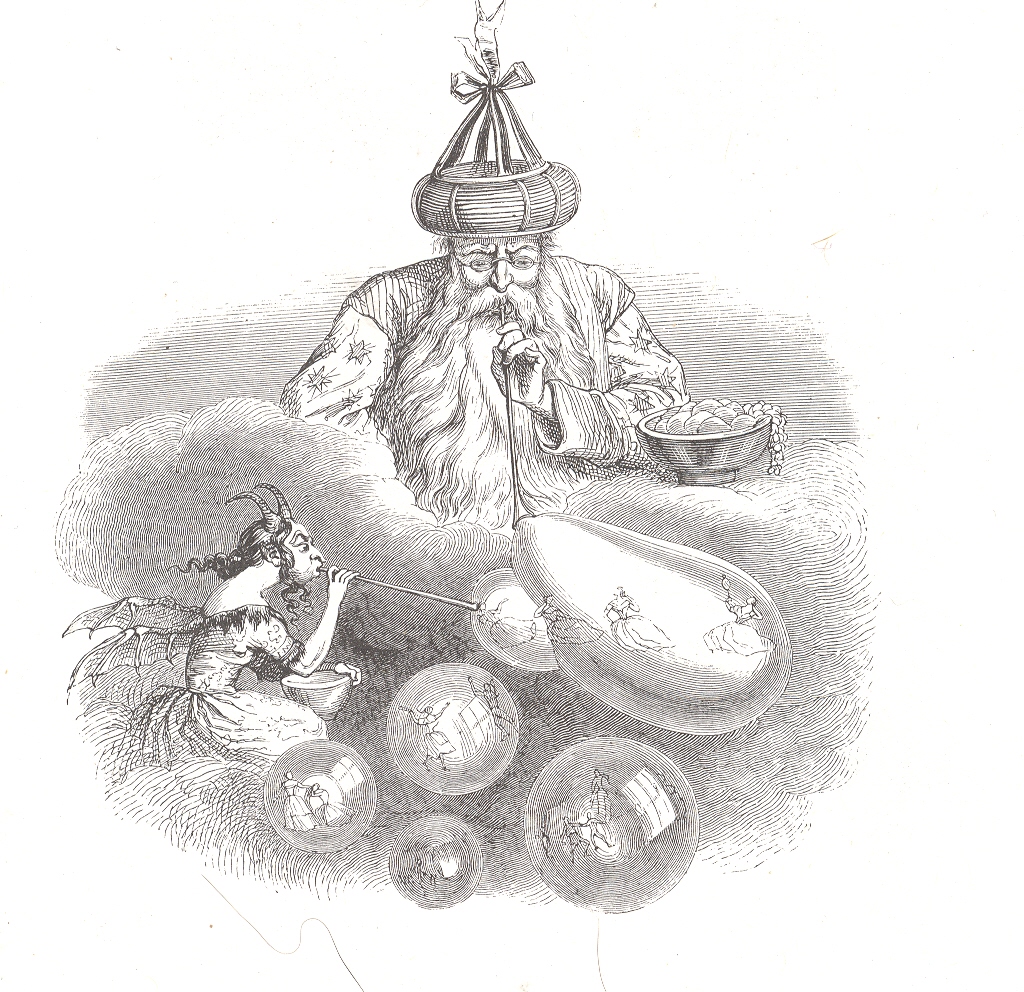
In chapter 25 (“The Mysteries of Infinity”) of Un Autre Monde
Grandville rolls out the great maker of the universe, the Primum Mobile, the
Motive Force, the First Mover. The old scamp was busy and on display for Grandville’s character Hahbble, who
floats around in the cosmos, and comes face-to-face with what in the end is
Einstein’s dice thrower, as much as the great physicist didn’t want him to be,
nor is he subtle (Raffiniert ist der Herr Gott, aber boshaft ist er nicht!) The malicious (“boshaft”) part would be
supplied by someone else looking intent and dangerous, while the great maker turns out to
be a magician who is happily creating the matter of all stuff by making it all out of
bubbles.
(I feel relatively certain that Grandville is the first artist to propose the
bubble theory of cosmology, and he is among a select and restrictive minority
who allocated such a seemingly meaningless activity with the creation of creation. I like its playful nature, though I wonder if
his approach was seen as a deep mockery and perhaps heretically insulting to
the religco-forces that helped and plagued the 19th century. Mostly it seems he was left behind int he appreciation part of acknowledgment, glory faded before his eyes; his work wasn’t necessarily prized during his lifetime, and
he had his share of brutal reviews for his great adventures. Paul St. Victor, art critic, wrote that
Grandville “wanted to dance on the clouds in leaden shoes”and “tried to get to
heaven on a bus”. That’s a tough go. Death did bring him some fame as M. Grandville slept with the worms; publishers used his illustrations mostly without gratuity to any estate, the images showing up all over the place through the end of the 19th century. His cuts were used again and again,the blocks being progressively degrade until the fineness of Grandville’s eye and incision were lost to overuse–it is easy to see the difference in crispness and clarity between the early printngs of his pictures with the later ones, his sharp edges getting rounded by greed and use and time.3)
I imagine this magician to be “almost” infinitely large and
small (what does “almost” infinitely mean?) , blowing bubbles on a large galaxy
scale, the bubbles containing other
galaxies; or smaller yet, other solar systems; and smaller yet, other
planets. And taking it down to the other
extreme, he could be sub-atomic, blowing bubbles of existence and shaping the bumpies
of quantum foam in spacetime, letting loose the primordial bits that would
become molecules that would or would not rise from the unpretty Dirac sea,
living just on the other side of measureable in space and time, shaving
barely-measureable slivers away from Planck length1 and Planck time2. Or maybe the old man is putting the white
into Schwarzchild wormholes.
Maybe he’s just blowing the bubbles of possibility and
chance, and his unacknowledged accomplice is injecting the mote in god’s eye.
Notes:
1. The Planck length 1.616 x 10 -35 (meters) which is the
smallest measureable space in the universe (comprised of Planck’s constant, the
gravitational constant and the speed of light) which in turn leads to
2. Planck
time, which is the amount of time it takes for light to traverse one Planck
length in a vacuum, 5.39 x 10 -44 seconds),
which is basically the smallest measureable unit of time, or for time that
would mean anything.
3. While ill with his own fatal bit, he composed
his own epitaph; Here Lies Grandville;
he loved everything, made everything live, speak and walk, but could not make a
way for himself”.
There’s actually quite
a nice turn of phrase in the wiki article on Grandville—quite nice,
really—which I include here: “Though the
designs of Grandville are occasionally unnatural and absurd, they usually
display keen analysis of character and marvelous inventive ingenuity, and his
humour is always tempered and refined by delicacy of sentiment and a vein of
sober thoughtfulness.” He evidently lived a hard-ish life, not the least of which
were the deaths of his wife and two children in the early 1840’s.
Some of Grandville’s other interesting works include:
Les petites miseres de la vie humaine (The Petty Sorrows of
Human Life) 1843
Un Autre Monde 1844
Cent Proverbes 1845
Jerome paturot 1846
Les Fleurs animees (The Personified Flowers) 1847