JF Ptak Science Books LLC Post 892
DARPA
has had a long-standing Christmas wish—a high-speed, durable, fast, agile tacticly-beautiful
submersible aircraft. Such a thing has
evidently been on the wish list of many agencies in many countries for many
years.
I
found the Royal Navy’s version of the DARPA wish in the 24 January 1920 issue
of The Illustrated London News—the Tessaurian, a dreamable plane capable of
long flight and long trips under the sea, as well as being able to float on the
water and land on dry earth.
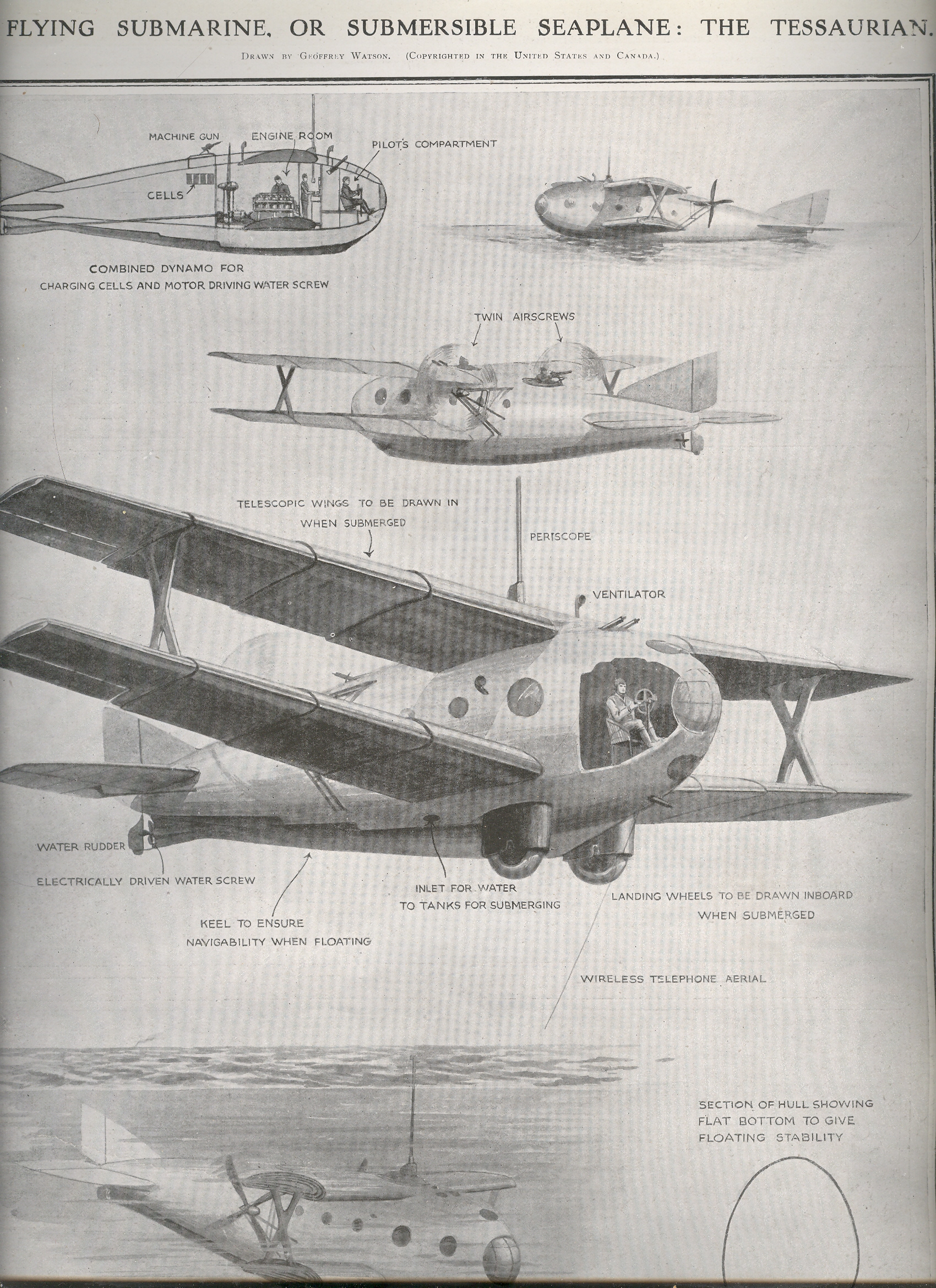
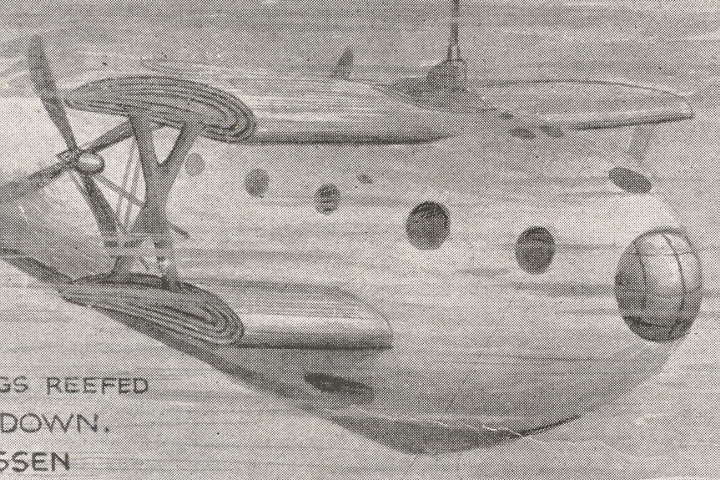
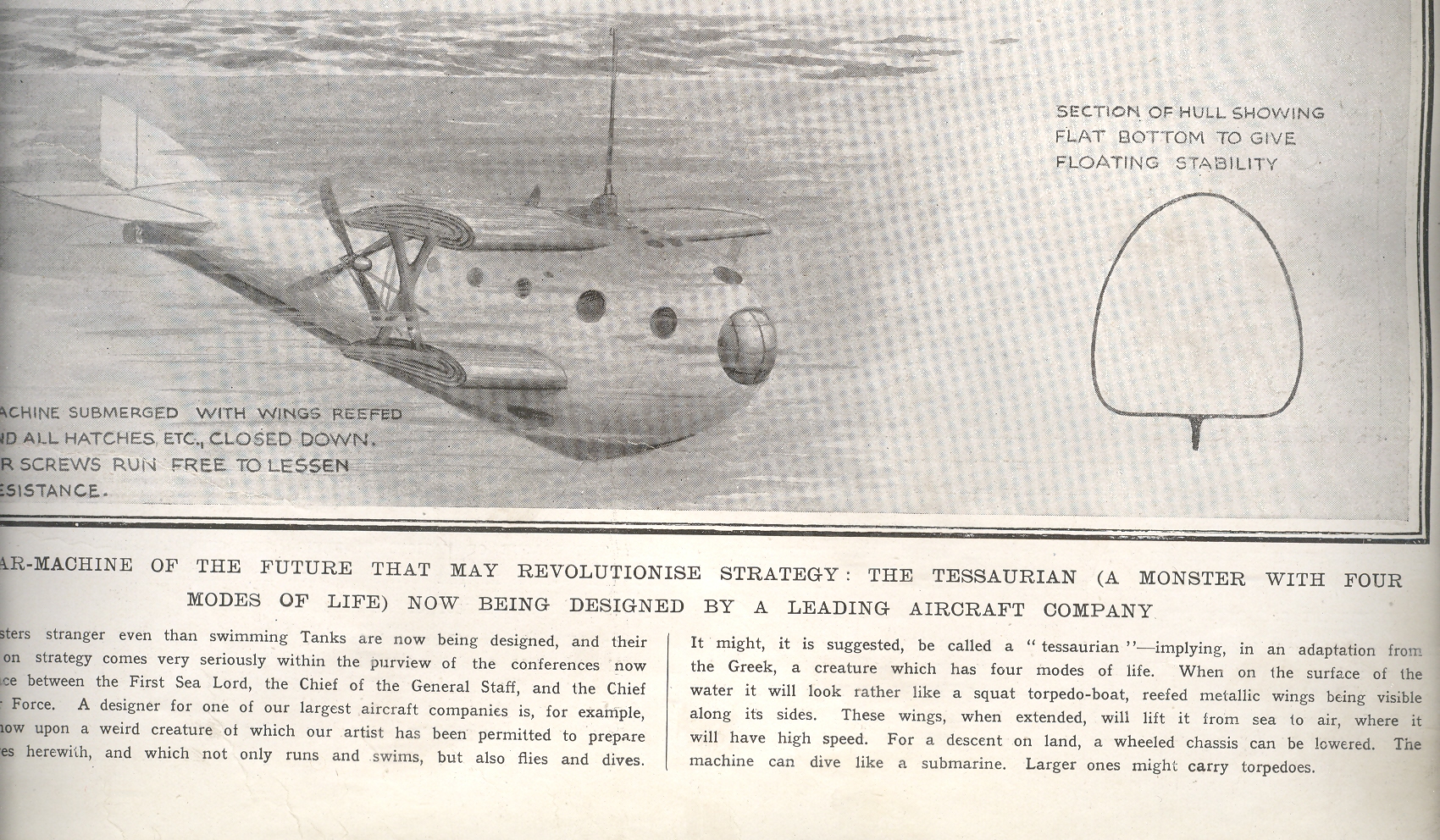
Even the modern Tessaurian has been evasive—certainly
this 1920 version is nothing short of nothing.
The craft just looks too bumpy to do well in any sort of fluid environment,
air or liquid, the thickness of its skin (necessary for the heavy undersea
pressures) looking just too heavy to lift off the ground. Of course the powertrain is suspect, and the
retracted wings don’t look like they would do anything to glide the beast
further underwater, assuming it got there (on purpose) to begin with. Even though I doubt that it could fly, it may
be able to float a bit—I do think that it could sink like a champ.
And
so I reproduce these heady, unacknowledged and unclaimed drawings (“designed by
a leading aircraft company”), as I can’t find anything offhand online that
comes remotely close to its age and concept.
An
undergraduate (!) team (headed by Daniel B. Coltey et alia )at Auburn came up with
the following research paper earlier this year: “Conceptual Design of a
Submersible Tactical Insertion Aircraft” “This…senior design program…the
creation of a conceptual design for a submersible airplane is being undertaken
as a response in part to a challenge by the Defense Advanced Research Projects
Agency (DARPA).” The authors then state the checklist of DARPA’s needs: “The design is expected to be a clandestine,
coastal insertion vehicle with specific abilities of an airplane, surface ship,
and submarine vessel, which would greatly increase the tactical ability of the
aircraft is expected to accommodate eight passengers, including any necessary
equipment and operators, and an additional 2,000 pounds of cargo, and also to
have an unrefueled range of 1,000 nautical miles in cruise flight, 200 nautical
miles surface transit or very low altitude flight, and 24 nautical miles of submerged
travel. The aircraft requirements also include the ability to complete one
tactical transit (1,000 nautical miles airborne, 100 nautical miles surface,
and 12 nautical miles subsurface movement) in a time limit of eight hours. This
concept also addresses challenges in the areas of structural design, effective
propulsion in dual fluid flow regimes, and control surface duality…” I’d want one, too.