JF Ptak Science Books LLC Post 902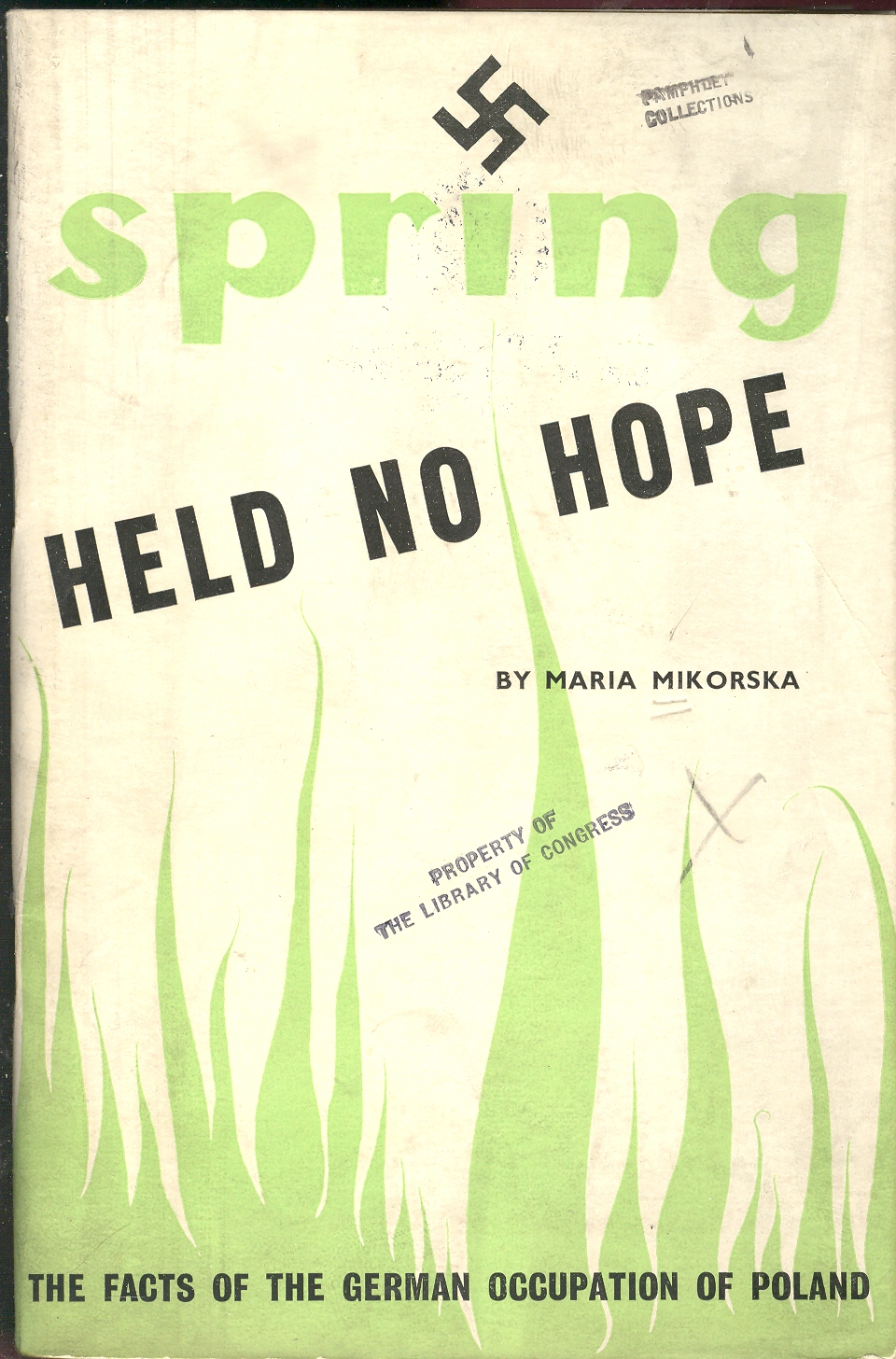
Maria
Mikorska’s Spring Held No Hope,
published in
in June 1941 is a difficult, hard, emotional read, even in the genre of
Holocaust literature. It quickly paints
a documentary history of bestial behavior of the Nazis in
mentioning of the Jewish issue in all of this reportage of inhuman
transportation and treatment of humans, as the reference almost never
occurs.
Reading
though this 52-page pamphlet of terror and horror, I wondered what exactly
happened to the missing reportage of the hunting and killing of the Jews as a
group.. The period of 1939-1941 saw the beginning of the Endlösung der
Judenfrage1 (“The Final
Solution of the Jewish Problem”) in which 90+% of the 3.5 million Polish Jews
alive in the Polish Second Republic were killed and exterminated, the primary
victims of the Nazi Holocaust. At this
point in the war the Nazis were removing Jews from their cities and
establishing regional ghettoes. Once the
Jews were collected in this manner it was easier for the administration of
their extermination.
Getting
back to Spring Held No Hope and the lack of identification of the Jews as a
persecuted group I turn to pp 24 and 25 (illustrated below and clickable).
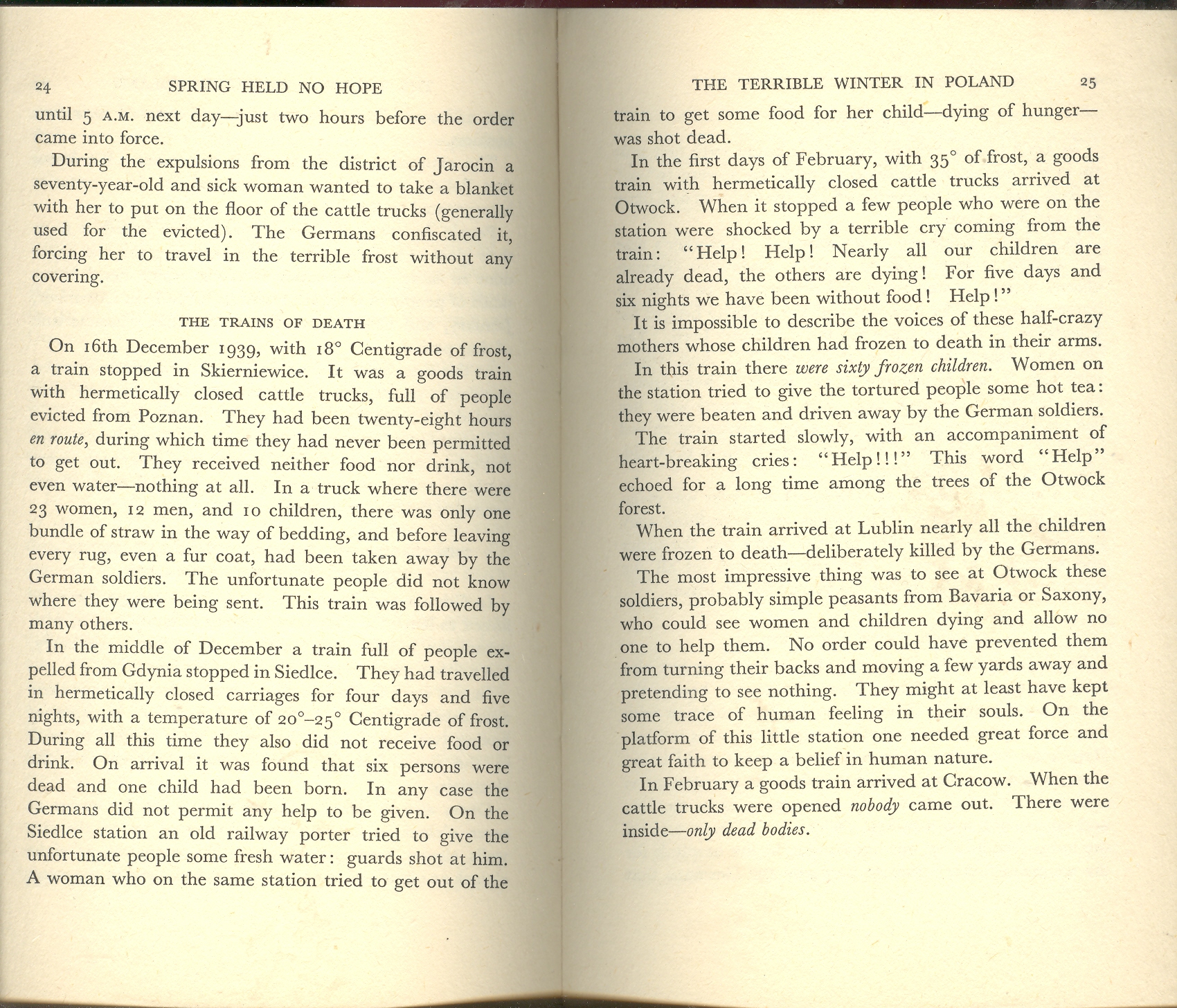
The examples of inhuman transport and the
direct extermination of men, women and children by starvation and hypothermia
mention the cities Jarocin, Gdynia, Siedlice, Skierniewice, Lublin and
Otwock: all of which had large centers
of Jewish populations that were removed by the Germans directly after the
invasion and removed to ghettoes though this fact is not mentioned in this
pamphlet. Ostensibly the collection of Jews was not in an effort to seize
property (as the majority of the Jews in
wealth) but rather to supply labor (being a group with the potential for
hundreds of thousands, if not millions, of humans capable of performing slave
labor). The Jews in Gdynia (for example)
were sent to Siedlice to establish a larger Ghetto immediately after the
invasion; by 1942 the tens of thousands of occupants were either shot and
killed or sent to Treblinka; 2,000 or so remained after this, though most of
them were also soon sent to Treblinka; those remaining were all executed when
the ghetto was completely liquidated on 14 April 1943.
I
am in no way saying that it the murder of Poles during the Nazi occupation was
limited to Jews—the 3.5 million Polish Jews represented 10% of the Polish
population; of the remaining 90%, or 32 million or so Gentile Poles, some 3
million were killed by the Nazis, or about 10% of that population.
These
are horrible stories told by Mikorska—but I’m bothered by the lack of the
recognition of the Jews as the major, featured target in all of this and wonder
if the author suffered an enormous sin of omission. This is far from being a singular event–even the important and highly significant Eisenhower report on the concentration camps of May 1945 does not signify the Jewish people as anything out of the ordinary–and may well be indicative of the general practice of dealing with the Jewish aspect of the Nazi exterminations.
Notes
1.
The name and practiced of the Final Solution was infamously adopted at the
Wannsee conference on 20 January 1942, liquidating the ghettoes and sending the
occupants to the six major concentration camps of Auschwitz, Belzec, Chełmno, Majdanek, Sobibór and Treblinka.
I’ve written elsewhere in this blog on the Holocaust; for more, search “Holocaust” in the Google blogsearch in the left column.