JF Ptak Science Books Post 906
Is it just me, or do the rest of you see Cary Grant at a teeny-tiny table when looking at this aircraft? There’s just something so horribly wonderful about the excesses washing over the passengers of high privilege in this airplane.[Source: The Illustrated London News 21 Dec 1929.]
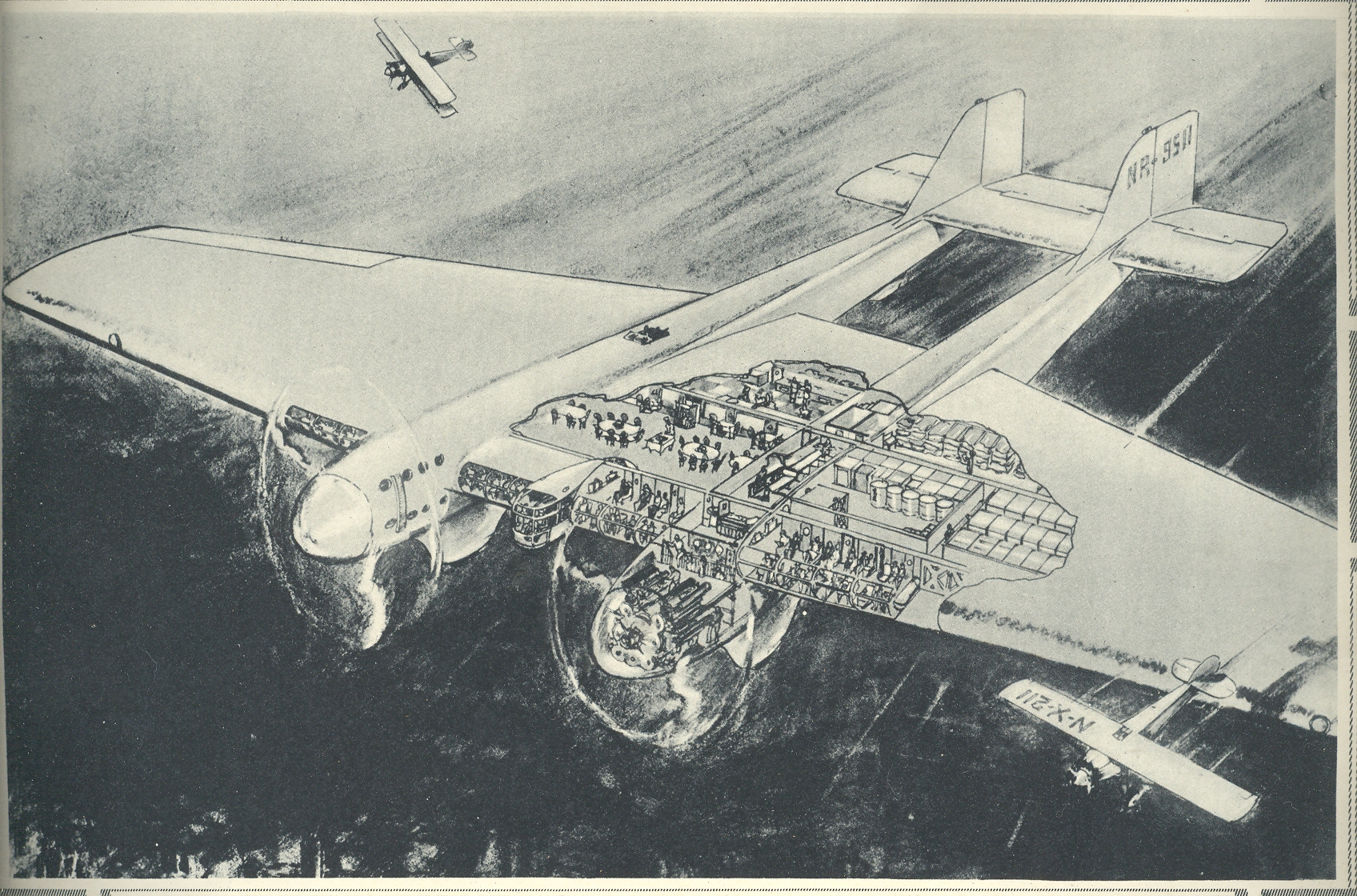
And the airplane has a name—Christmas, named for the man who provided its inspiration, Dr. William Whitney Christmas1–and was a paper plan to produce the world’s largest airplane.
It would’ve been so by leaps and bounds. The Christmas was to have a 262’ wingspan and a gross weight of 142,000 pounds at the time when one of the largest planes aloft—the Patrician Keystone K-78—had a wingspan of 86’ and carried 18 passenger, 2 pilots and an engineer. It also held the world’s record for hauling the heaviest payload, which for some reason was “33 girls”. It was bigger still than the largest thing in the air, Lufthansa’s Dornier DO.X –this was an aircraft capable of moving 60-100 passengers (serviced by a crew of 10-14), a flying boat with 12 (Curtiss Conqueror 610hp) engines on wing sections 157’ long. (Was this a mile-a-minute fuel consumer?) The Dornier plane didn’t last long in service due to operating costs (1929 was a bad year to undertake an expense like this, especially in the hyperinflated Germany) and was in an aviation museum by 19342. (This plane—one of three constructed—was destroyed in a RAF bombing raid in 1943.)
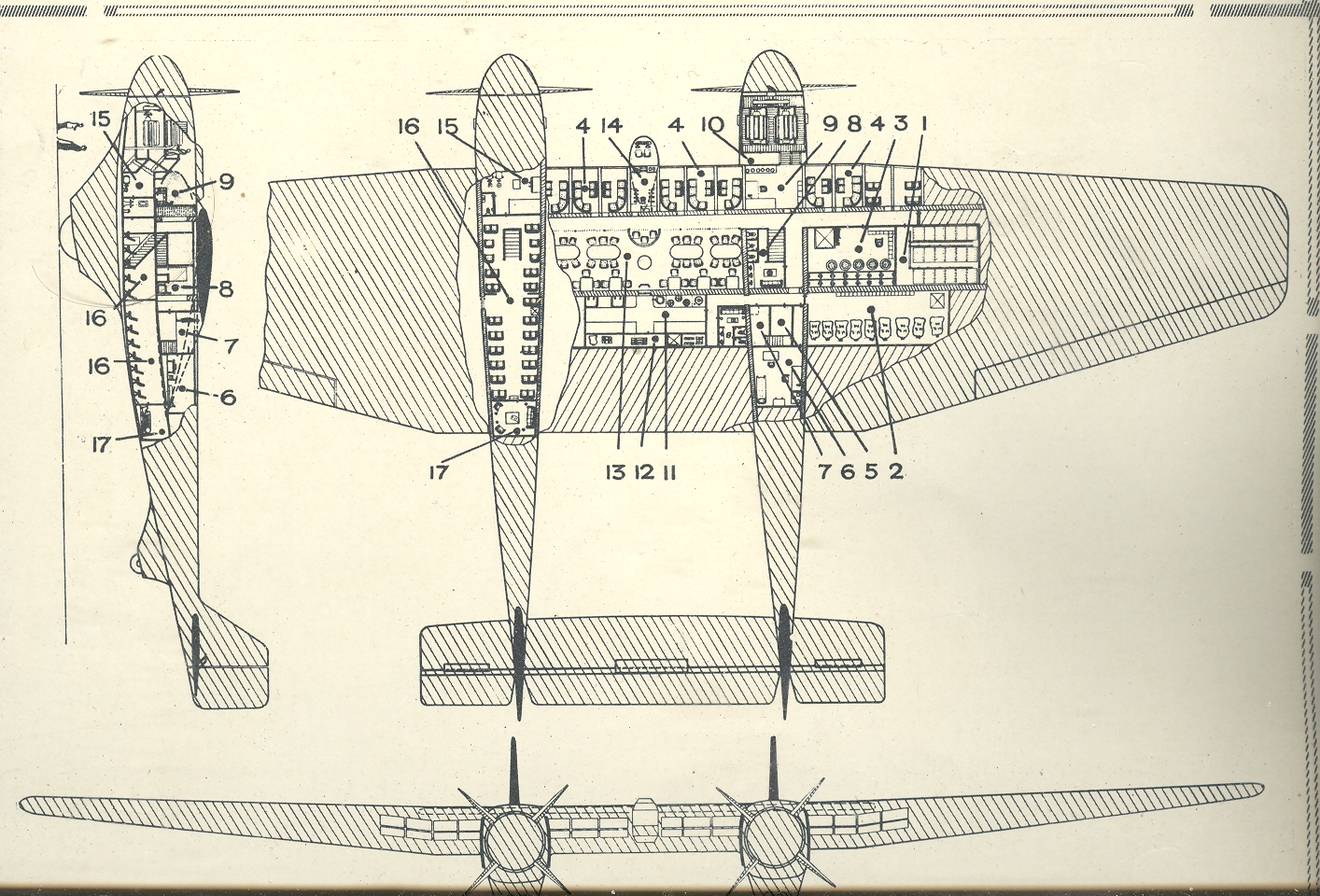
Here’s something extraordinary about the Christmas: it had a dining room (actually, a “dining saloon”) that took up 15% of the plane’s floor plan. There was also the spacious smoking room, the crew and officer quarters, the machinist’s shop, engine room balconies (?), and of course the staterooms that seem to run along most of the front of the plane. The side elevation shows not very much space at all allotted to what must’ve been some massive engines, seeing as how there’s only two four-blade props. (The small lateral cross section shows two people against the plane for scale—these folks must’ve been giants; I figure they should be a little more than 75% of the manikins. I make each prop blade to be about 10 foot (?))
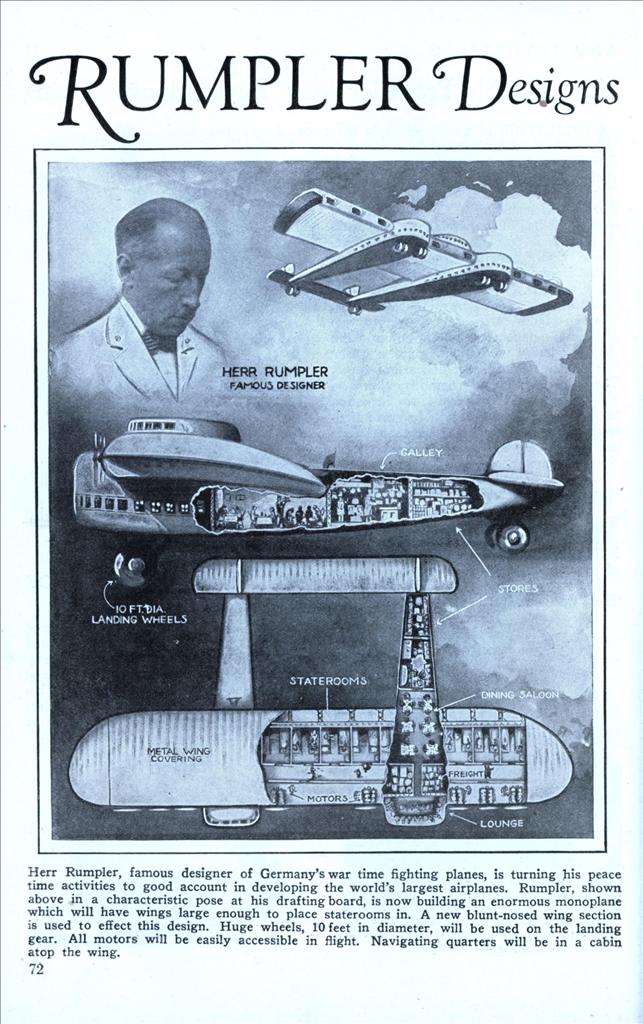
As it turns out this aircraft looks a lot like Edmund Rumpler’s3 (1872-1940) giant. Outfitted with a long row of staterooms along the front edge of the large wing and a huge dining room, it doesn’t seem to be equipped with an area for the engines. Maybe this was an endemic flaw among older fast-thinkers…
Notes:
1. Dr. Christmas (1865-1960) was the third American to fly and was the first to design a plane with aerilons.
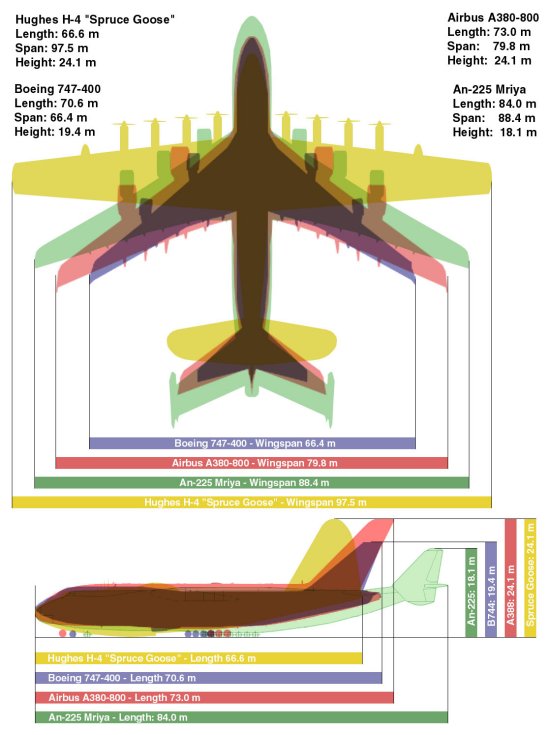
2. Compare this to the Antev An-225, a modern very-,limited-production monster that could haul 1.3 million pounds of cargo, and the 747 (hauling up to 900,000 pounds) and the mammoth Airbus A380—all relatively the same size but with fabulous design and power.
3.Rumpler made very significant aeronautical contributions to the German effort in WWI, as well as designed the first aerodynamic auto—his military planes though during the war were great triumph, partially because they were also Germany’s first mass-production-possible aircraft. This didn’t help him much when Hitler came to power—being Jewish, Rumpler was arrested, and then released by Goering who at least could find a small part of himself to save this one Jew who served Germany so well.
4. Source for the Rumpler image is the wonderful ModernMechanix site here.
Interesting comparison chart for big planes: [Source]