JF Ptak Science Books LLC Post 929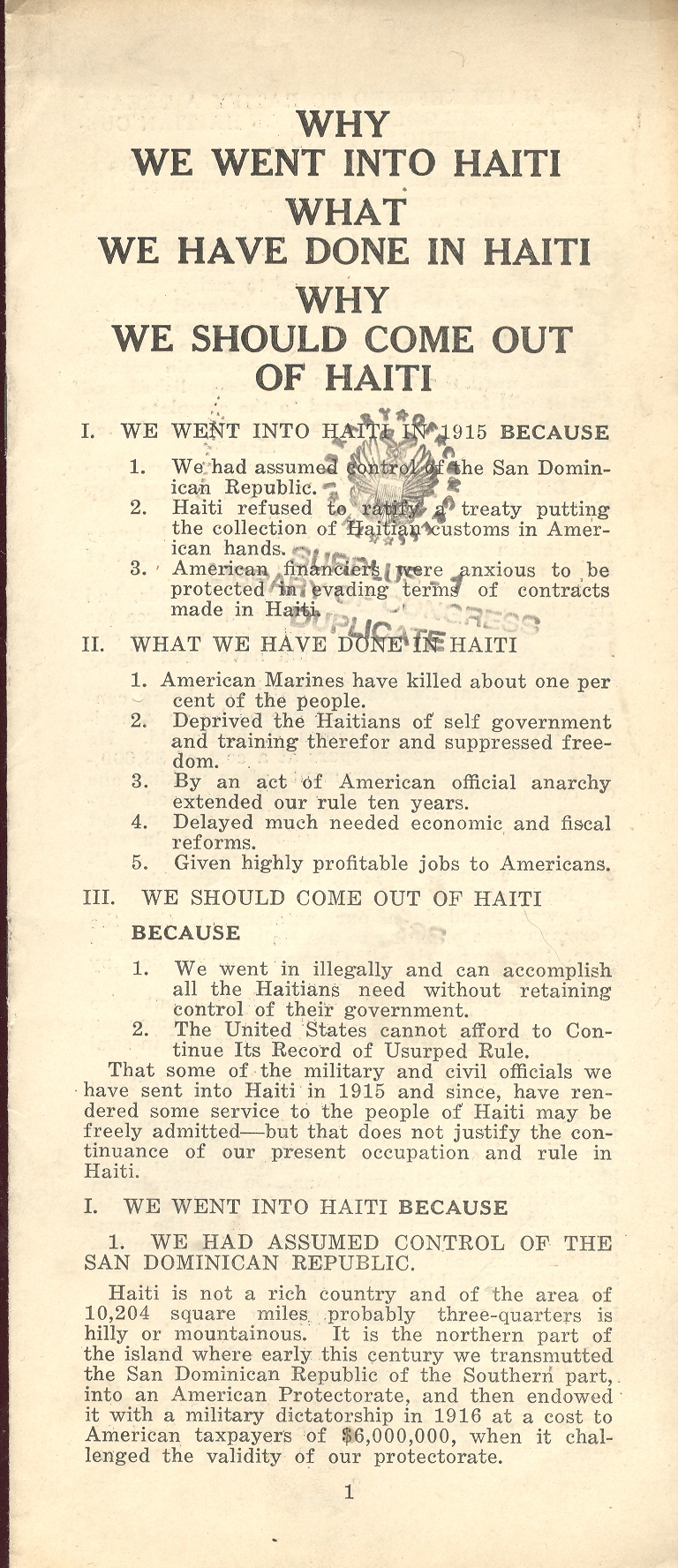
I spent 33 years and four months in active military service and
during that period I spent most of my time as a high class muscle man
for Big Business, for Wall Street and the bankers. In short, I was a
racketeer, a gangster for capitalism.–Marine Corps Major General and two-time Medal of Honor recipient Smedley Butler, from his 1935 book War is a Racket.1
This small pamphlet (reprinted below in continued reading)–printed in 1929 and once owned by H.L. Mencken, and with his annotations–is a gonzo screed against American imperialism in Haiti produced by “The People’s Lobby” and headed by Prof. John Dewey.2
This “intervention”, an extension
of American hegemony in the
known as “The Banana Wars” and a direct relation to Theodore Roosevelt’s corollary
to the Monroe Doctrine (1904), was a movement taken to protect business
interests, infrastructure and investment. And the Haitian debt repayment
structure.
After a series of six failed Haitian
governments in five years, President Woodrow Wilson felt the stinging itch of
capital protection and ordered the occupation of
Marines, all in the guise of preserving peace and order and stability (of the Haitian state. “The urge to
save humanity is always a false front for the urge to rule it.” as Mr.Mencken wrote).
a number of presidents over time, what with the many imperialist interventions
and occasional occupations of
Republic
and
The pamphlet is effective as an
anti-Imperialist proto-gonzo work, though it does leave some gaping holes in
fact and some narrow ones in fiction. Be
that as it may the anonymous author incites indignation with the outrages of
the American occupation, not the least of which is the usurpation of Haitian sovereignty.
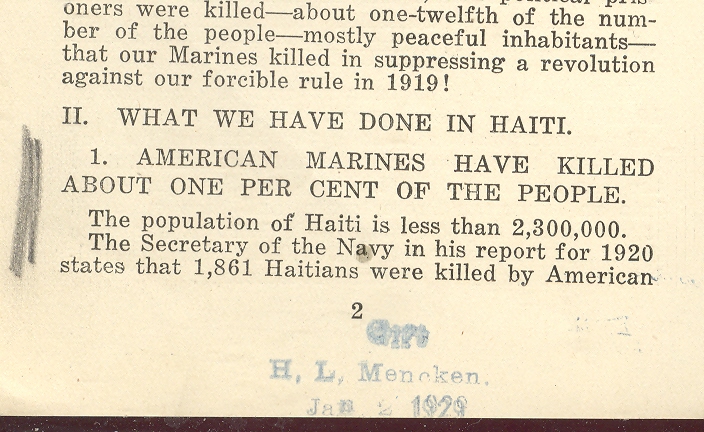
The only annotations of the former owner–Baltimore’s
other great writer, H.L. Mencken– are his characteristic hashmarks in the
margins highlighting the death rate of Haitians killed during the
occupation. According to the pamphlet,
which quotes the report of the Secretary of the Navy (Joseph Daniels) , there
were 1,861 Haitians “killed by American forces in 1919 alone”. The writer makes the acidic point that this
figure represented one percent of the total population of the nation. And that is, perhaps, all that Mr. Mencken3
needed to see.
The occupation of Haiti left broad scars along with the new and vastly improved infrastructure, which was probably just a colonial remnant of the necessities of governance by the occupying force. After all, we needed roads and bridges and such to secure the possession, and it isn’t as though we could role them all up and take them home at the end of the day. They were more cenotaphs to an unwanted and shameful legacy than the betterment of Haiti’s social structure. To close with Mr. Mencken, the flowers that came with the American occupation make us look more for the coffins than anything else.4
Notes:
1. In 1935, Butler wrote in his famous book War Is a Racket: “I spent 33 years and four months in active military service and
during that period I spent most of my time as a high class muscle man
for Big Business, for Wall Street and the bankers. In short, I was a
racketeer, a gangster for capitalism. I helped make Mexico and
especially Tampico safe for American oil interests in 1914. I helped
make Haiti and Cuba a decent place for the National City Bank boys to
collect revenues in. I helped in the raping of half a dozen Central
American republics for the benefit of Wall Street. I helped purify
Nicaragua for the International Banking House of Brown Brothers in
1902-1912. I brought light to the Dominican Republic for the American
sugar interests in 1916. I helped make Honduras right for the American
fruit companies in 1903. In China in 1927 I helped see to it that
Standard Oil went on its way unmolested. Looking back on it, I might
have given Al Capone a few hints. The best he could do was to operate
his racket in three districts. I operated on three continents.
2. Just to note that this was
the John Dewey, one of founders—along with the great Charles Sanders Peirce and William James—
of the philosophy of pragmatism.
3. Mr. Mencken also made the following Modest Proposal: “It seems to me that the United States would be a great deal better off
today if it had a war on its hands, somewhere or other, all the time.
I do not mean, of course, such puerile buffoonery as now goes on from
time to time in Nicaragua and Haiti, but real war, occupying say a
quarter of a million or half a million men.” “Editorials” in the The American Mercury, Nov 30, p.284
4. As in his Bierce-like dictum “A cynic is a man who, smelling a flower, looks for the coffin”.