JF Ptak Science Books LLC Post 958 Blog Bookstore
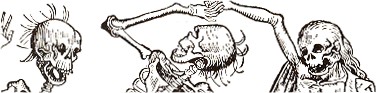
I think that in the contest of hair between mortality and immortality, never-ending time wins. This sentiment is based on seeing many images representing death and time over the years, not many of which I can not now produce on demand to make my argument a little more plausible, but, well, no matter. Two examples will suffice for now.
The first example stands for many of its type: it is titled “Imago Mortis” (the World of Death) and appears in Hartmann Schedel’s Liber chronicum (more commonly known as the Nuremberg Chronicles), one of the greatest illustrated (or certainly the most lavishily illustrated) books of the 15th century. Printed by Anton Koberger in Nuremberg on 12 July 1493, the Liber chronicum was basically just that, a walk through the known and imagined knowledge of the mid-Renaissance with the great humanist Schedel acting in the role of conductor. There’s certainly much of interest and disinterest in this book; Schedel was not afraid to make a guess (and even a wild one) when facts didn’t fit or were unavailable. (For example, he famously re-used the same view of a city to illustrate different cities.)
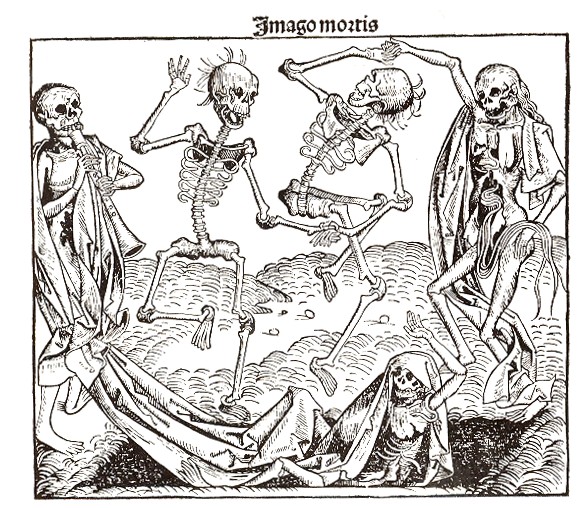
The Imago Mortis here is more like the Dance of Death, a subject visited many times by many great artists over a 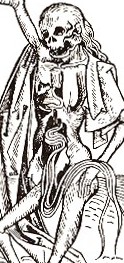 period of 500 years or so. But my interest right now is only in the hair; particularly the hair of the figure at far right, whose (her?) hair seems to be not only flowing down her spine but through it and her ricase as well, spilling out in front of her across her pelvis.
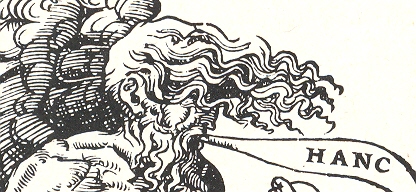
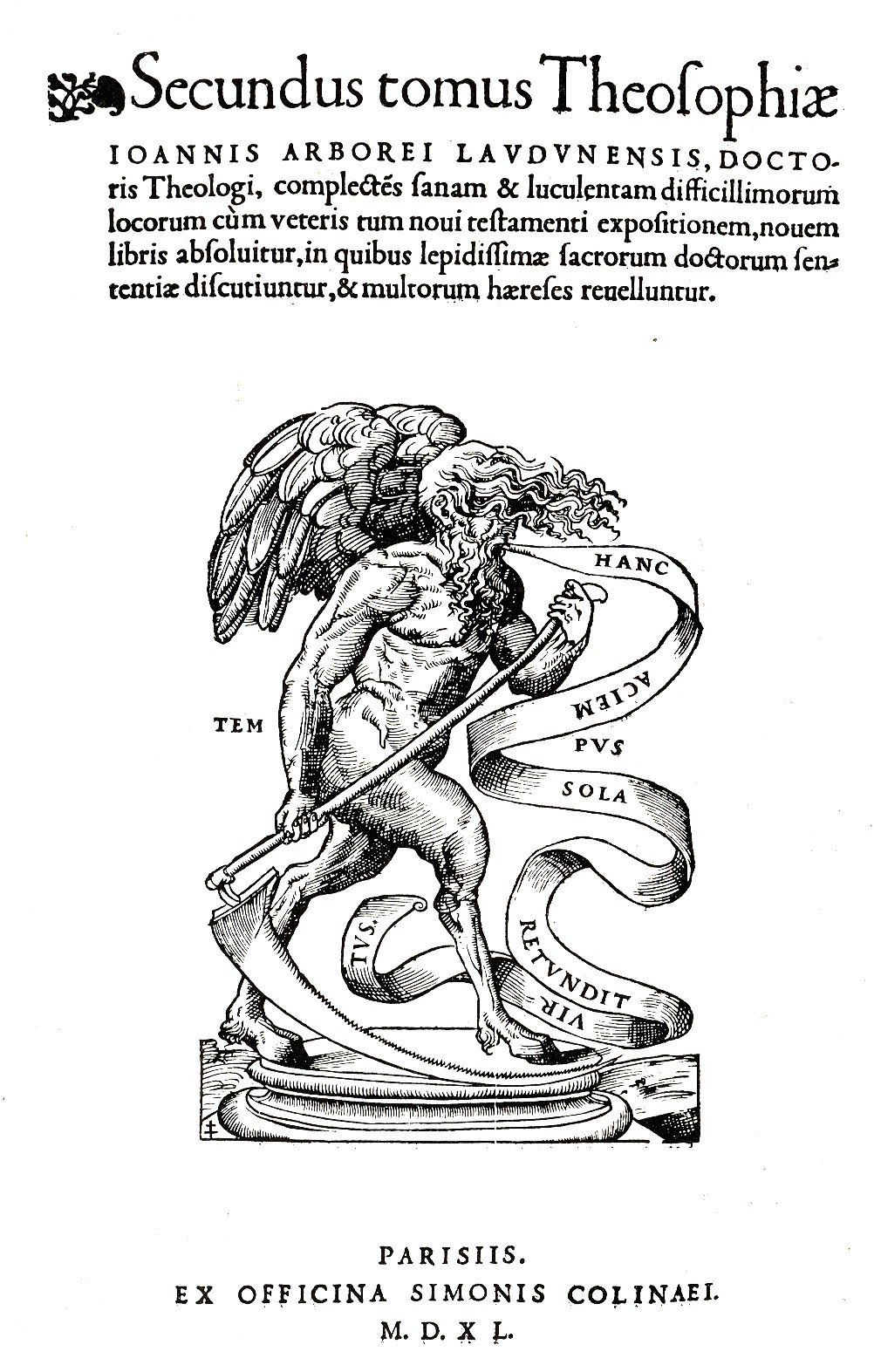 I’ve written earlier in this blog on the second woodcut image: it appears as the printer’s mark (of Simonem Colineum, or Simon de Colines) in the
second volume of Johann Arboreus’ Theosophia, complectens difficillorum…, which
was printed in
in 1540.
Satanic, what with cloven hooves and the legs of some animal, strong torso and
swift wings—the hair hiding the eye(s) completes a picture of damnable doom,
and of whatever end we’re coming to.
Except for the righteous, though not quite: the word balloon describing
Time’s spoken admonition is “Hanc Aciem Sola Retundit Virtus”, which means “only
good deeds dulls the blade”. That doesn’t
necessarily mean “stops” the blade, which is bothersome. I think that if someone were coming for me I’d like the blade as sharp as could be…
I think the winner is Time, whose hair–although not quite as long as that of the dead–is far more luxurious, which at the end of the day carries it. Also, Time’s hair is connected to a scalp; I don’t know what the deads’ hair is connected to.