JF Ptak Science Books LLC Post 980
Nothing
quite makes a profound statement like simplicity—the same sentiment applies
to the incredible, or impossible, or
inconceivable statement as well. For
example, Gertrude Gates Mudge’s “An Interesting Experiment with Malnourished
Children” (The Nation’s Health, August 15, 1922) seems quite an
exclamation without an ounce of emphasis in sight, a vast oversight of decency
compounded in its inelegant simplicity. Evidently acceptable (at some level) in
its own time, the announcement today seems criminal.
The
world is full of such pronouncements—perhaps they’re the very bones on which we
all walk. I was drawn to this subject
this morning, finding a bit of undoubtedly long-lost historical reporting on
medical experimentation which (in its second paragraph) makes the following
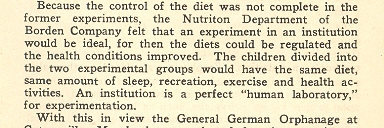
overwhelming understatement: “an institution is a perfect ‘human laboratory’
for experimentation”. It comes from a
small pamphlet published in 1924 by the Borden Company called The Catonsville Experiment It seems that Borden (a famous and large
dairy company) was trying to experiment with children to determine the
effectiveness of their new sweetened condensed milk over “regular” milk. They attempted experimentation in public
schools, but could only statistically control for milk intake at the school
itself, finding it “impossible to have
complete control over the rest of the childrens (sic) diets”. In the free school situation the Borden
company could also not control for exercise, sleep and “health concerns”.
That
is when the idea struck the Borden Nutrition Department to conduct their study
in an orphanage. Borden’s aim was to test the healthy effectiveness of their sweetened
condensed milk, and to also show that “no abnormalities in physical growth,
bone development, blood count, and kidney function would result from such an
experiment”. What this means is that
there events were a possibility, but it was worth it to Borden to test their
hypothesis out on actual human children.
There
were 60 children in the “experiment”, divided into two groups, one of which was
the control. All facts of the lives of
the children were controlled from March 15, 1924 though November 30, 1924—play,
regulated sunshine, sleep, schooling, rest, and of course food intake. Medical tests were conducted (frequencies not
specified), including general overall medical evaluations as well as blood and
urine tests—there were (at least) 18 sets of x-rays over 270 days.
Psychological and intellectual tests were also conducted, with the children
measured over dozens of different categories, including 14 classroom
activities.
The
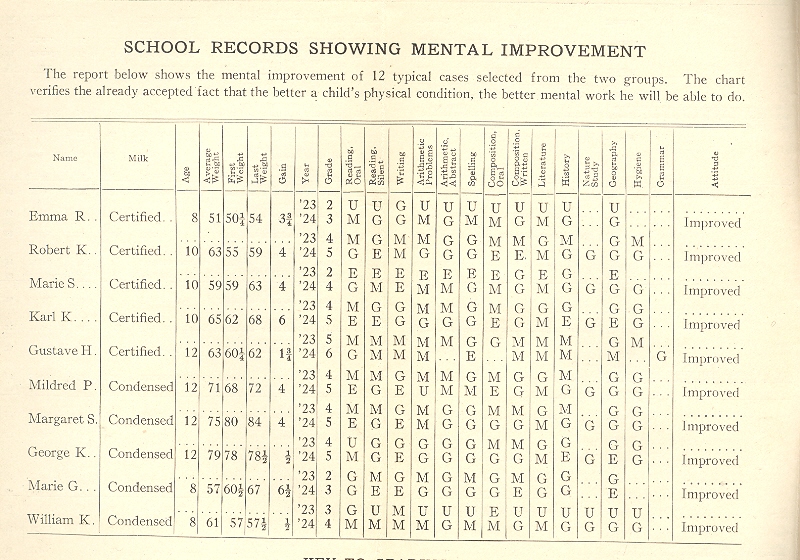
Borden Company published the results of all of these experiments in this small
pamphlet, with one large (and impressive) folding diagram outlining some of the
medical results (shown below).

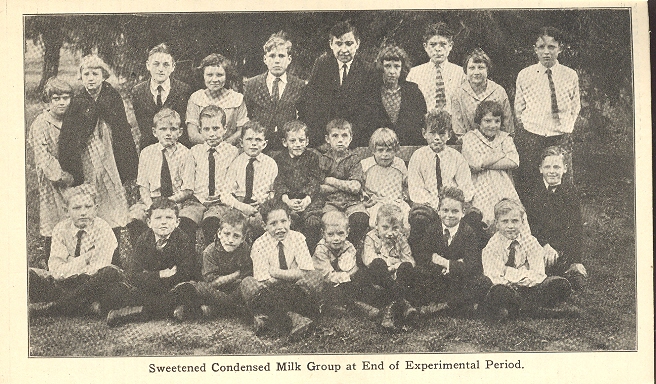
There
were also two photographs of the test subjects.
Undoubtedly they were not intended to look as though they were trophies,
but that is the general feeling I get when looking at the photographs.
The
bottom line was that Borden found their own product to be safe, and to not cause
kidney, liver or bone damage. Which was
good news to the children who were their test subjects.
Remarkably
Borden published these results two months after the test ended, evidently
without any assumption whatsoever that if there were to be negative effects
that they would occur immediately, and that a longitudinal study was wholly
unnecessary. Once the experiment ended, so too did the nee for testing their
short-term hypothesis of damage to the children.
I
wonder about what the effects of the 18 rounds of x-rays in 270 days were on these children, over time.

No doubt that in the dark history of human experimentation the Borden exploit would find itself in somewhat mild company–this of course hardly relieves them of their gross injustice of subjecting children to this sort of control and possible danger just so that the company could sell a milk product. It is an action that makes me think more of Lizzie (“I gave my mother forty whacks…”) when I think of Borden than Elsie the Cow. After a long run of financial successes, including being one of the leading dairy companies in America (and the owner/producer of Elmer’s and Krazy Glue, among many other diversified things), the Borden Company was completely and totally divested in 2005.