JF Ptak Science Books Post 1147
“Jeopardy is jejune now: naïve knight
finds ogres out-of-date and dragons unheard
of, while blasé princesses indict
tilts at terror as downright absurd.” –“Ennui”, by Sylvia Plath
“Ennui is the poetic state that occurs just before depression.” made-up Twain quote, seconded by a made-up Bierce definition, “Ennui. Depression without the imagination.”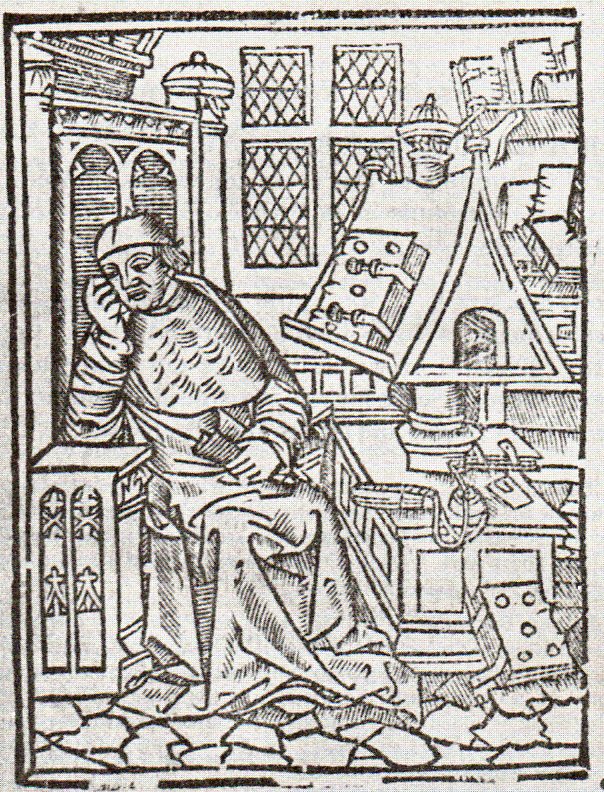
Ennui seems to have always been in the possession of those who could afford possessions–the laboring classes could only be affected with derangements and sloppiness and laziness, but the wealthy among the people of the earth could have ennui. They could afford to. And it seems to me that in my own walk-through in the history of illustration–especially relating to the sciences–that those most often depicted with ennui were saints and doctors, two generally mutually-excluding classes. I’m not so sure why this is the case for the doctor, or surgeon, or barber, or sawbones–it was not a pretty jog in the centuries leading up to our own. [Pictured here is a physician with things on/not on his mind, from Andrew Borde’s The Breuiary of Healthe, for all maner of syknesses and diseases…” from 1556, and which turns out to be one of teh first modern books on hygiene.]The working conditions were exceptionally difficult (in general), the treatments were blood-under-the-nails barbaric, and the survival rate for those under your care was poor. Perhaps it was the tools? They were’nt very glamorous things, either–nor were
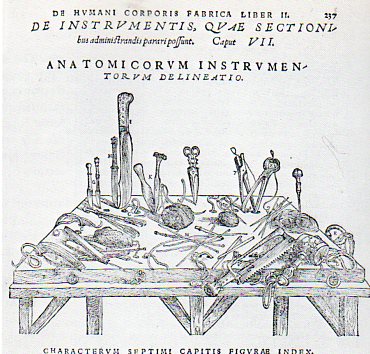
they necessarily clean. [Image of from Vesalius’ De humani corporus fabrica . 1543, (“On the Fabric of the Human Body”/”On the Construction of the Human Body”). I prefer “fabric” because of Vesalius’ superb re-discovery of muscle…] Urgent cleanliness in the surgical amphitheater wouldn’t come along until Sir Joseph Lister in the mid-19th century; so working as a surgeon in a bad hospital with rudimentary tools in bad working conditions and little light could not for a happy existence make.
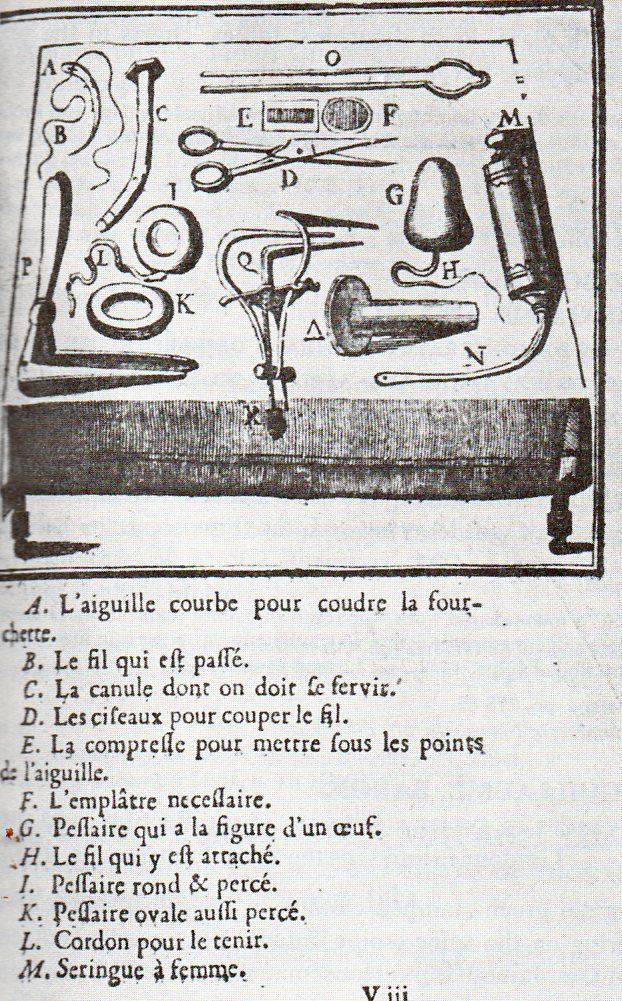
 [The differences between the two engravings above seem to our modern eye to be quite minute; but for the 160 or so years between the two publication dates, the advancements were considerable, given the time. This second image is a display of midwifery tools and instruments, which I guess wouldn’t make anyone today feel very comfortable–surviving childbirth for the woman was still a substantial issue, though less so than it had been in the first half of the 16th century. Image: Pierre Dionis, Traite Generale des Accouchements...Paris, 1718.]
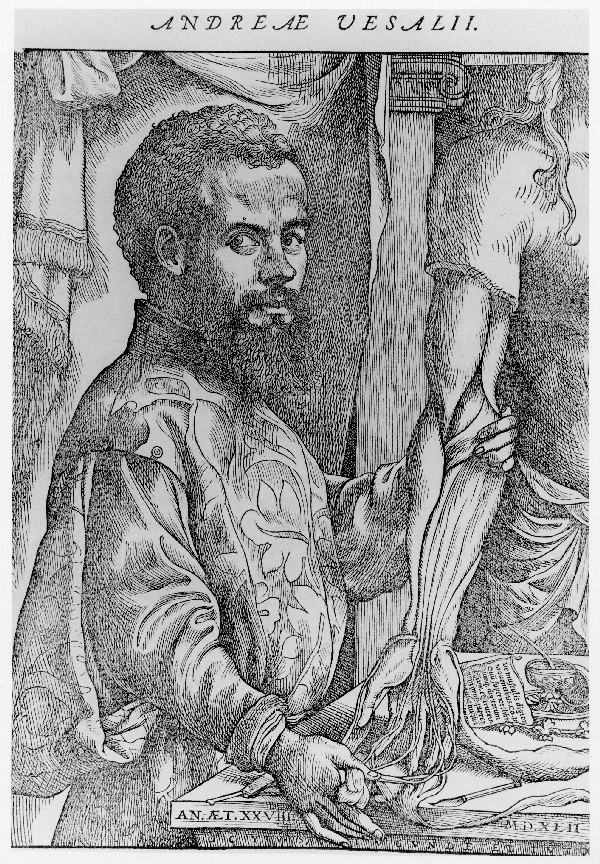
And yet imping his way through all of this is Vesalius1, who managed to accomplish accumulate mounds and piles of good data, organize and interpret it and then have the whole thing illustrated (with 200 of some of the greatest anatomical images ever made) and published all before he was 29 years old. Perhaps he wasn’t as susceptible to be provoked or drawn into ennui as most professionals of the time, being such a genius and coming from such a royal medical lineage2 as he. Or perhaps he was able to avoid the ennui that came with the brains and the genes. Ennui didn’t seem a part of this physician’s makeup, even though he was deeply in debt and a man slightly out of place. Maybe he didn’t have time to develop ennui, as he was an extraordinarily busy man who was dead at 50.
So, judging by the looks of things on the surgeon’s table, and imagining the stuff that needed fixing and the objects to fix it with, perhaps the physician was led down a path of slowly not being able to do anything…at….all. Ground to a nub, a stop, a chin-in-hand moment. Or not.
______________
Notes:
1. Vesalius’ revolutionary treatise on anatomy–which stressed anatomy in relation to physiology–was a clear break with the Galenic tradition, and was one of the first of the modern works on the subject. His book was published the same year as Copernicus’ masterpiece.
2. Vesalius’ great-grandfather, grandfather and father were professors of medicine, the last two being the Royal Physician and apothecary to Emperor Maximillian