JF Ptak Science Books Post 1152 {Part of the History of Women series.]
Looking at just one week’s worth of advertising directed at women in America’s most popular magazine.
One of the great custodians of American popular desire in the 1940’s and 1950’s was Life magazine, a picture-heavy chronicle of social history and needs and dreams. I enjoyed the issue of Life for 12 May 1947 because it had an article on the history of skirt lengths (something I wrote about earlier in this blog here), and looking at it a second time I realized that I had entirely missed the ad content that drove the magazine. The poetry of expectation flavored by the ads directed at women were rive ting to me here in 2010, partially because of their narrow aim, and partially for the simple and simplistic urges that were addressed.
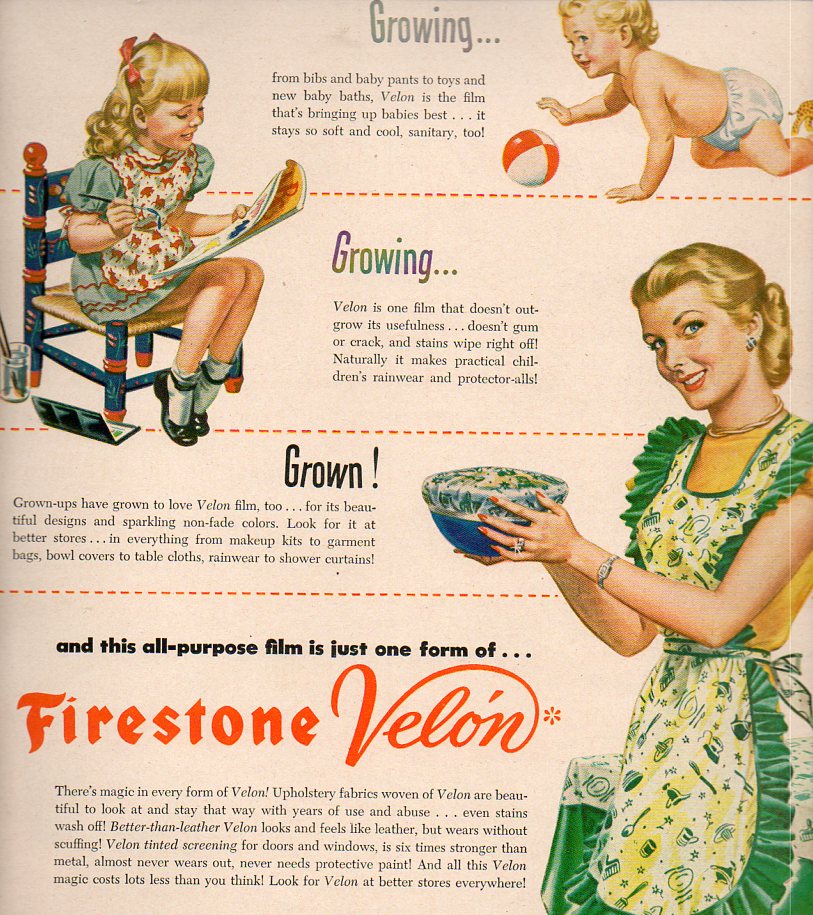
The basic messages were lace, timid street crossing, plastic conveniences, bendy girdles, smart shoes, refrigerator hope chests, instant coffee, machine made clothes by Singer, DuPont combs, artificial fabrics and diamond-centered bedroom window covers by Textron, “shoes to catch his eyes”, various flavor secrets, baby insomnia aids (“to help your husband sleep”), dreams of meat, and some other vaguely painful things.
The ad that first caught my attention was the life cycle of woman, seen above, picturing the grown woman in a petroleum-product apron gleaming as she worked her way through her Firestone-provided kitchen, emerging from babyhood to childhood to womanly-aprony-adulthood.
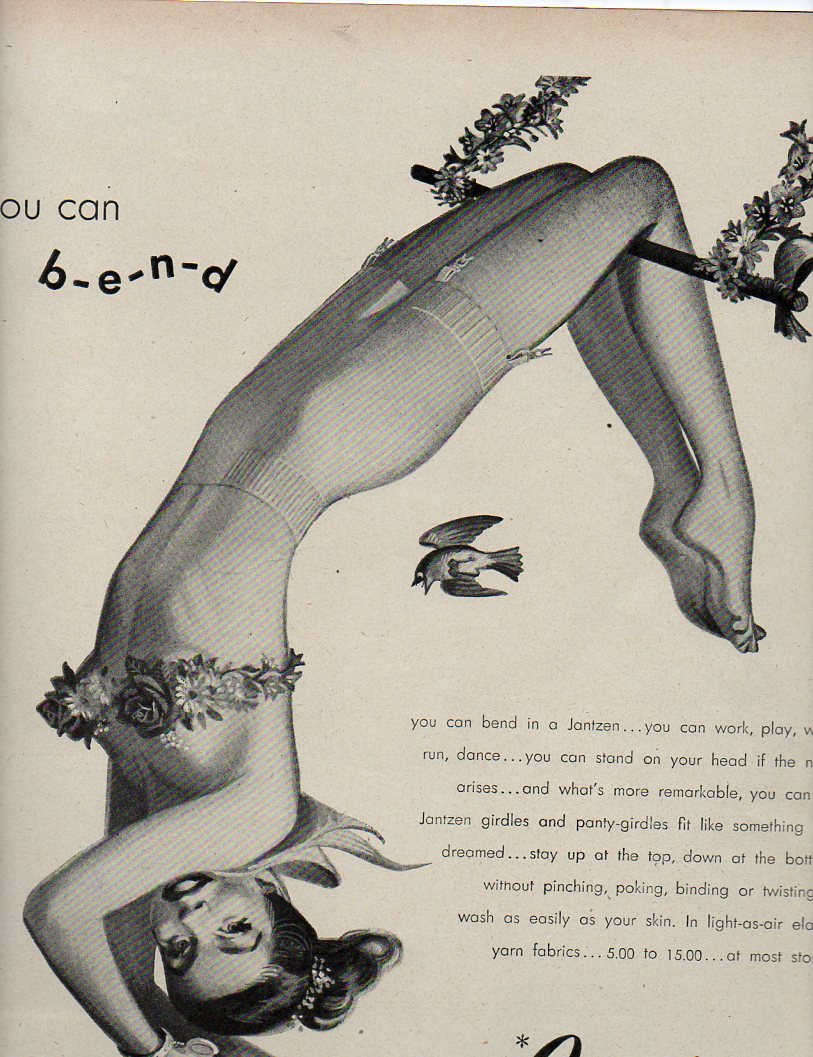
And an impossible position for girdle wears to participate in the wearer’s girdle’s allowances, complete with fluttery Disney-esque birds:
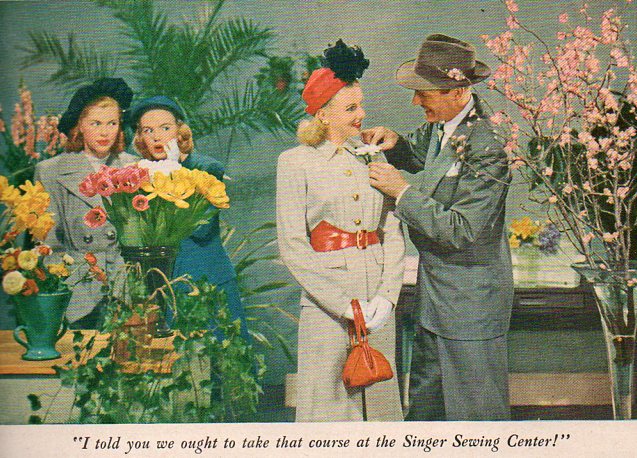
The clustered desire over the another woman’s success in snagging a man’s interest because she could sew:
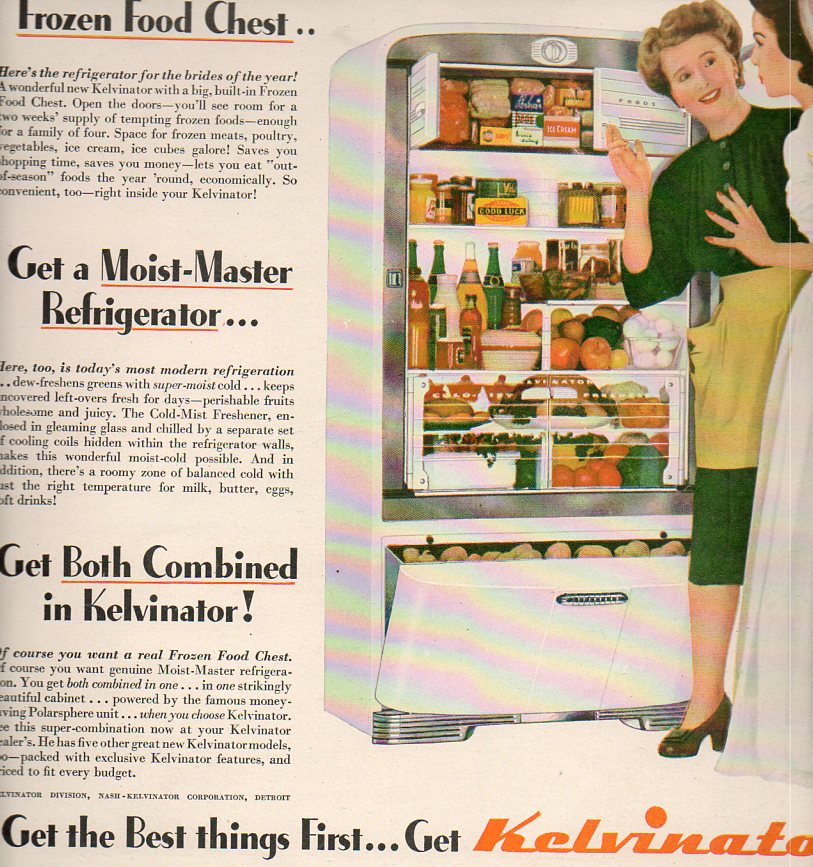
And just one of three ads exalting various refrigerators, though this one had a newly-minted bride inspecting a model that for all the world could’ve been her hope chest, though this version was filled with food and meat (and a whole hell of a lot of potatoes) and introduced by a version of herself in the next chunky-shoed decade:
There were ads for percale sheets, though the segment has a rather odd, vaguely proto-sensual feel to the thing (hardly I think what was intended in 1947). It plays out a little better when the ad is rearranged in filmstrip style, reading top-to-bottom, rather than side to side:
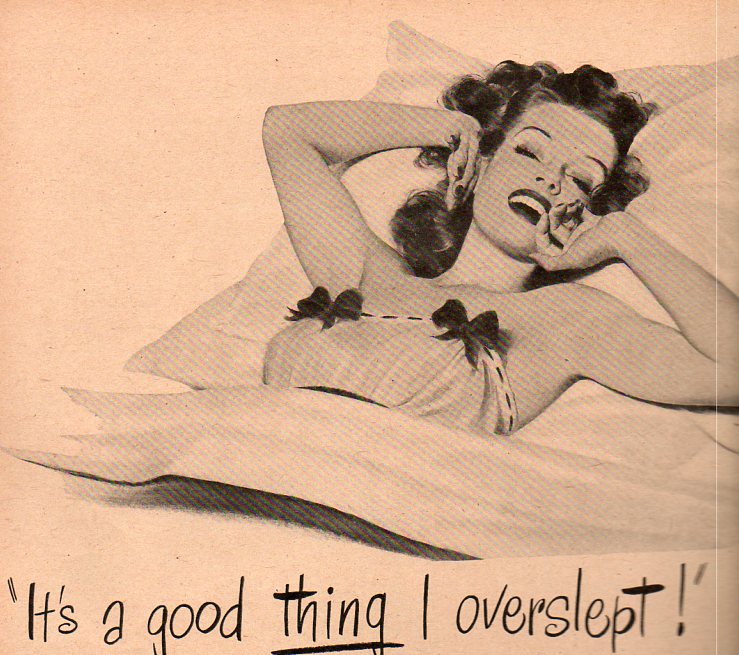
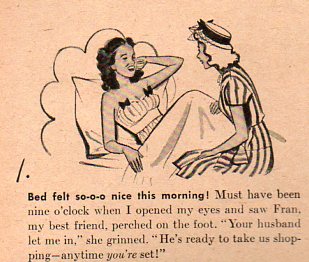
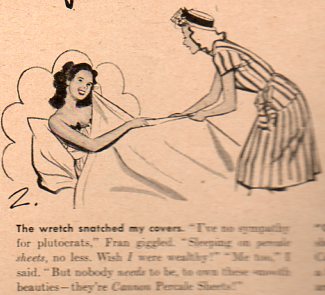
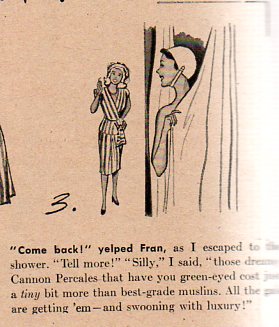
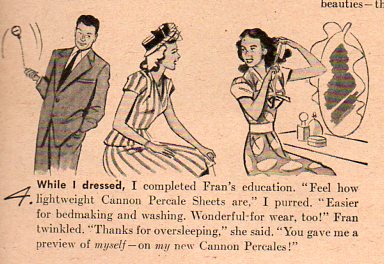
Hm.
Not all of the womanly attention of the magazine was focused on girdles and bras and wedding meat–there was an article on Dorothy Shaver, the President of Lord & Taylor, America’s “No. 1 Career Woman”. She made $110,000 a year and was widely successful, but still “carried a lace handkerchief and cross(ed) streets timidly”, and lived with her younger sister–in an earlier time Life tells us that Ms. Shaver would simply be called a “spinster”, “but now she is called a career woman”. There was no change in the description or definition of a “spinster” or a “career woman”–they just changed the name, the result being the same, even in describing the first American woman to ever lead a multi-million-dollar international business. (This in spite of the fact that there were plenty of working women at the time who were married and had families, no to mention the fact that we had just finished a war during which a near-majority of women were in the workplace. None of that seems to have come into play here in 1947, when those same war-working women were summarily replaced and sent packing, and the careerist was defined for one and all to be a spinster.)
I am sure that I will be called to task one day i n the not-too-distant future by my daughters, asking what it was, exactly, that people were thinking in the year 2000 in regards to women–so strange to them in their version of looking back on their equivalent of my 1947 Life magazine, a version in which I actually lived.
In any event, these ads weren’t necessarily what women wanted, of course–they were what advertisers wanted women to want.