JF Ptak Science Books Post 1176
“When beggars die there are no comets seen; The heavens themselves blaze forth the death of princes.” – Shakespeare.
“Threatening the world with Famine, Plague and War: To Princes, Death! To Kingdoms, many Crosses; To all Estates, inevitable Losses! To Herdsmen, Rot; to Plowmen, hapless Seasons; To Sailors, Storms, To Cities, Civil Treasons!” De cometis by John Gadbury, London, 1665
It is unusual to me that in the long history of early astrology, some of the greatest elements of the night sky–comets and meteors–are little used, perhaps even unuseful outside of adding flavoring to readings given the time and place of their appearance. They had been seen for milennia–appearing in Gilgamesh and the Book of Revelation for two samples– as prognostic of future events, John of Damascus and Aritotle and Ptolemy and Albumasar all writing about that quality.
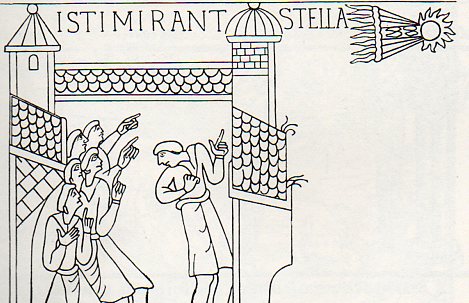
[The Bayeux Tapestry illustrating the appearance of the comet of 1066, later to be known as Halley’s comet.]
Comets and meteors didn’t really affect anything in the physical world, and in the astrological one their purpose was to perhaps predict a kingly death or the appearance opf warts on women. They were also seen by people like Aristotle to be atmopsheric events, living out their exsitence in close proximity to the Earth, incapable of having any undue affect on Earthly matters. Meteors would appear and then disappear, comets were surprises and visible for just short amounts of time; the rest of the night sky remained the same, intact and unaltered after their appearances. They were not understood, though they were seen by some as raging battles between forces of good and evil, personifications of the struggle between the angels of god and the elements of the devil. Meteors and comets were mysterious, unconquerable, unknowable, suspicious elements, and were evidently not useful to the early astrologers.
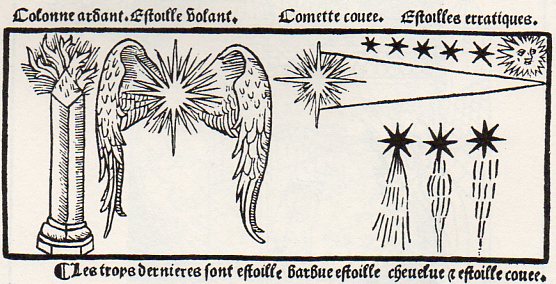
[Nicolas Le Rouge, Le Grand Kalendrier et Compost des Bergieres, published in 1496 in Troyes.
The night sky is a mnemonic device, a place to store memory and a holder of the alphabet of myths and beliefs of all, a culture written large across the sky. Meteors and comets were not predictable, and could add nothing insofar as a consistent bit of storytelling was concerned, though they certainly created their own stories in each observed appearance; they could also add punctuation and exclamation to whatever constellation they appeared in. For example if one appeared in a juncture with Jupiter, a major event for royalty would possibly be foretold. But as a permanent element to the visualization of the night sky, they had little power even though they seemed to be displays of fantastic energy and power in themselves.
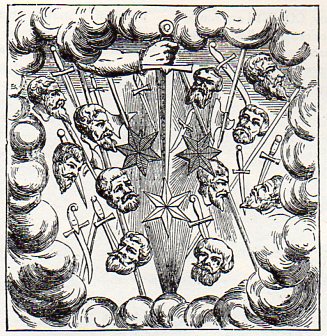
[Amrose Pare illustrated the comet of 1528 in his Livres de Chirurgie (in a chapter titled “Des Monstres Celestes”), published in Paris in 1597. Even though Pare was a towering figure and great intellect, he still personified the wandering stars with human faces, with hair and beards, accompanied by swords and shields. There were many other scholars who saw such things in comets and meteors, not the least of which was Maupertuis, who envisioned the tails as clusters of jewels; many others seeing many other things.
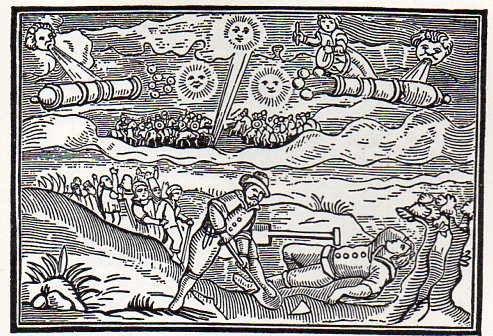
[For some reason the celestial court, divided by sunlight and flanked by two other sources of light, have ofund it expedient to issue comets from the mouths of Heaven Canon. I’m not sure what’s going on in the forground with the fellow working his spade next to the triangular blankness. the man to his right seems to have been overtaken in fear (as have the group of people visible to the left over the shoveler’s shoulder).]
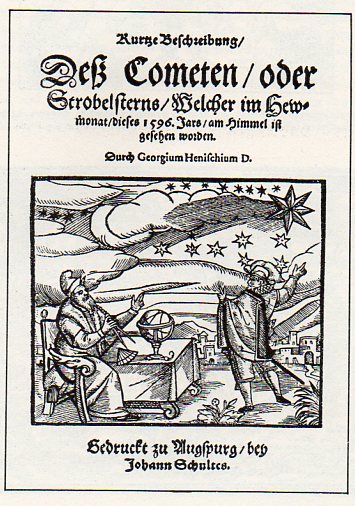
[Halley’s comet appears again on the title page of this work by the Hungarian George Henischius, a prfoessor of rhetoric, mathematics and medicine at Augsberg.]