JF Ptak Science Books Post 1334
 I remember that the floor of my grandmother’s beauty salon (in Great Barrington, Massachusetts) was a dark (gray on black?) rolled linoleum affair, not much different from the floors that you’d see (if you could see them) in black and white movies from the 1930’s. Grandma’s floors were probably that old–my memory is from the early 1960’s and the salon was far older than that–and so they looked like you’d expect an old, shiny, kept floor to look. Plus you’d never really see floors in those older films, anyway, so it was difficult to see even if there was a design, let alone imaging a color.
That’s why it is so surprising to see magnificently-colored floors in catalogs such as Armstrong Cork Company’s Better Floor for Better Business (1936) and Home Decorator’s Idea Book (1931). (Both of these booklets are available for purchase from our blog bookstore.) Color wasn’t invented after World War II–it just seems that way. Color photographs, color home films and color motion pictures really didn’t get a popular start until then, so it might be natural to assume that the world was a bit more bland in shades of gray before then.
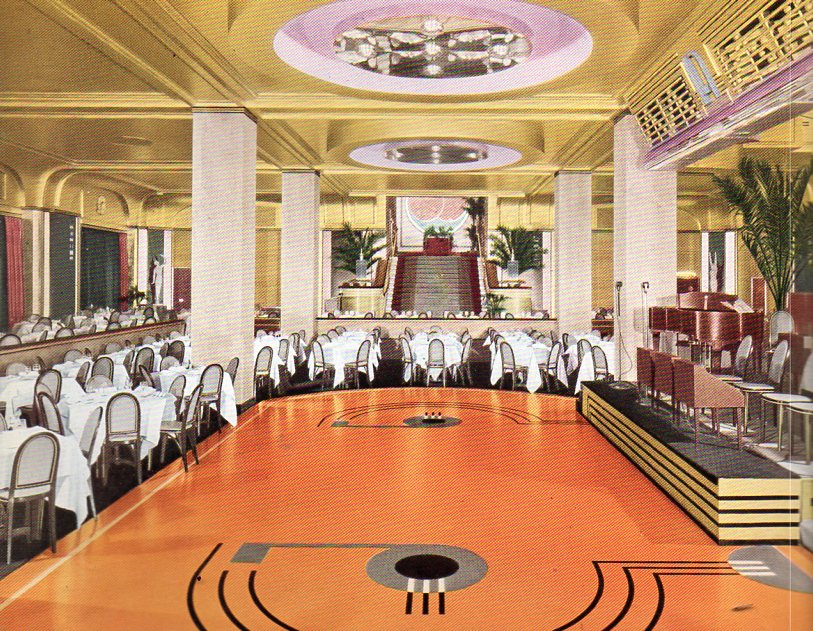
All the same, these floors are so terrifically colorful that they look to me to be like a tiny design writ large–like a design for nightclub’s matchbook cover done on a 500 square foot canvas.
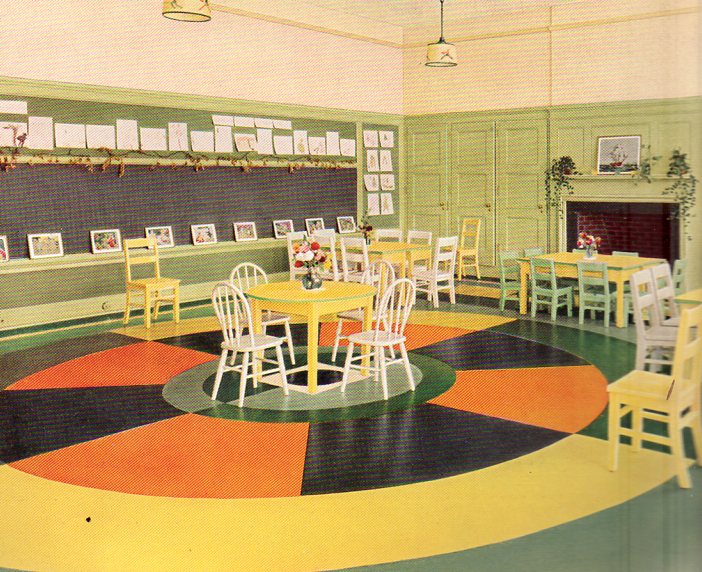
[This is a kindergarten room, by the way.]
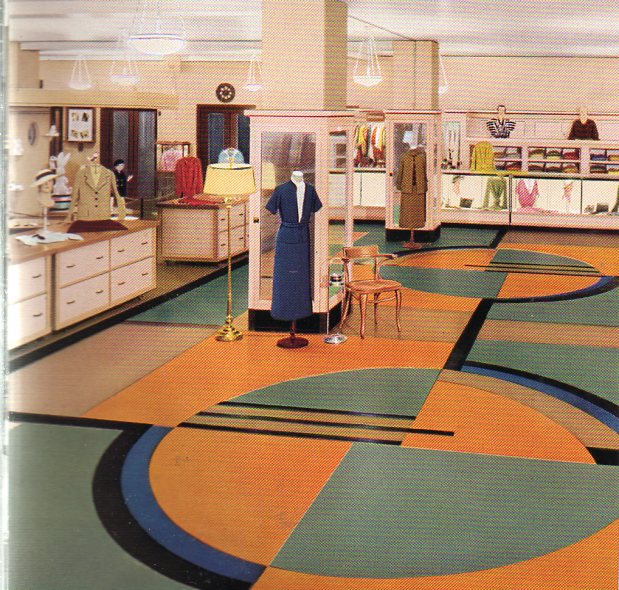
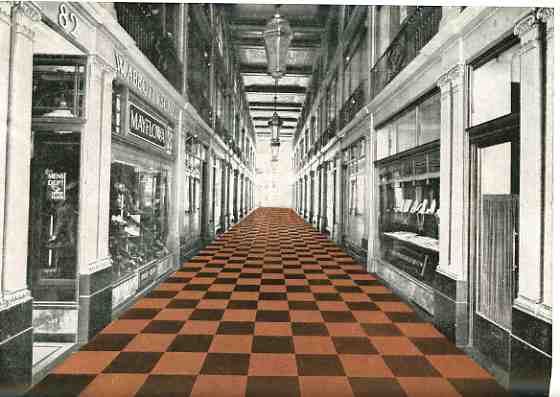 See what I mean? These floors are beautiful in a way that escapes beauty. I don’t particularly like them nor would I want to live on them, but they do have a certain inescapable loveliness to them that is just not beautiful. Perhaps it is the odd juxtaposition of unexpected color. This is seen in sharper detail (left) in a post that a made (“There Was a Rubber Lady in a Rubber Room…) earlier in this blog. Or maybe it is the unexpected combination of colors, or the unexpectedness of the colors themselves, that is the driver to this lusciousness.
And then there are the swastikas.
Now the swastika is a very, very old symbol, thousands of years old, transcontinental, transoceanic, a transcendental image that was completely and forever corrupted by the National Socialist Party, a shameful symbol, a symbol turned into a hatefuil and horrible thing in just 20 years or so, overtaking two millenia of use. And here we are, in the early- and mid-1930’s, during the time of the Nazis and Hitler and their free use of the swastika, here we are with this Armstrong firm from Lancaster, Pennsylvania, still using the swastika in design elements for their floors.
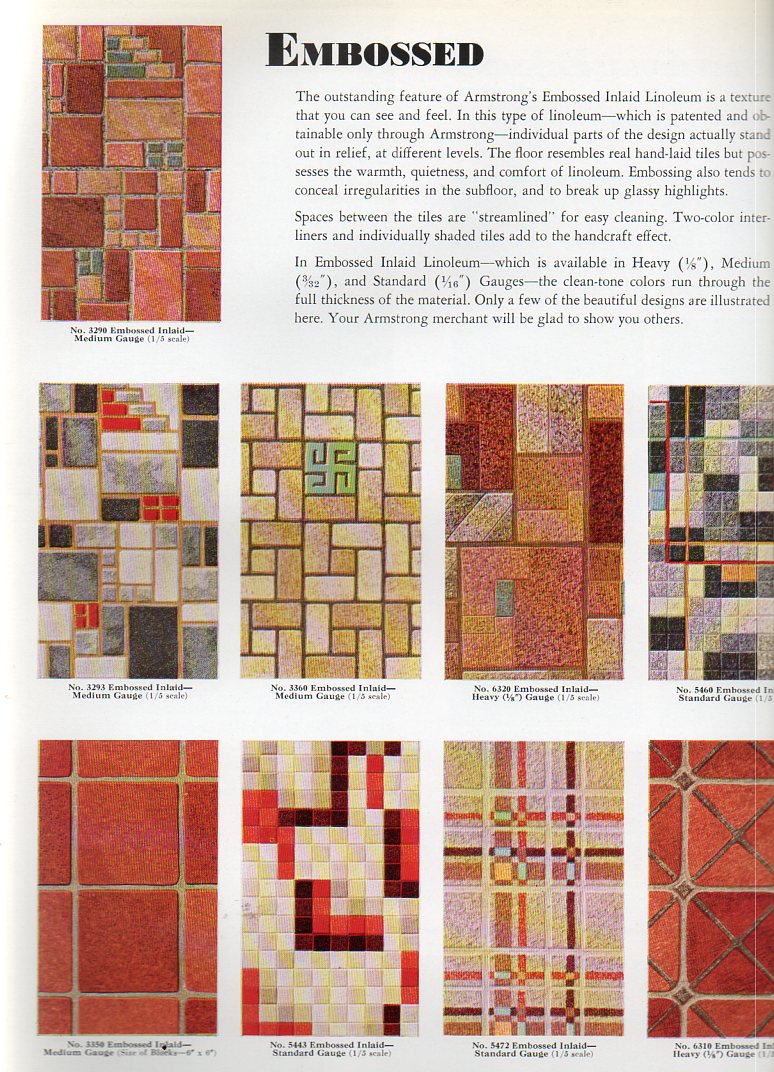
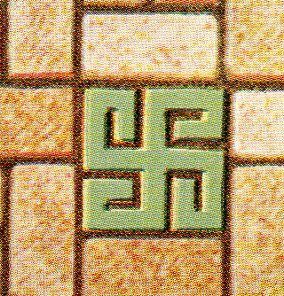
(Here’s one page of floor design elements from the Armstrong catalog at left; and the detail for design number three at right.)
Armstrong was also in the heart of some country within the United States (Lancaster) that was very rich in symbolist design, but I think that this has nothing to do with anything. I’m also not making th case for their being fascist leanings at Armstrong–I’m simply pointing out that even as late as 1938 (when another edition of this work appeared again with swastika design) that the image was still acceptable enough to have as part of a part of a floor. It strikes me as deeply odd.
Here’s another example from the 1936 catalog (and just to be perfectly clear I’m not highlighting the swastika part–it is offset in different colors in the originals):
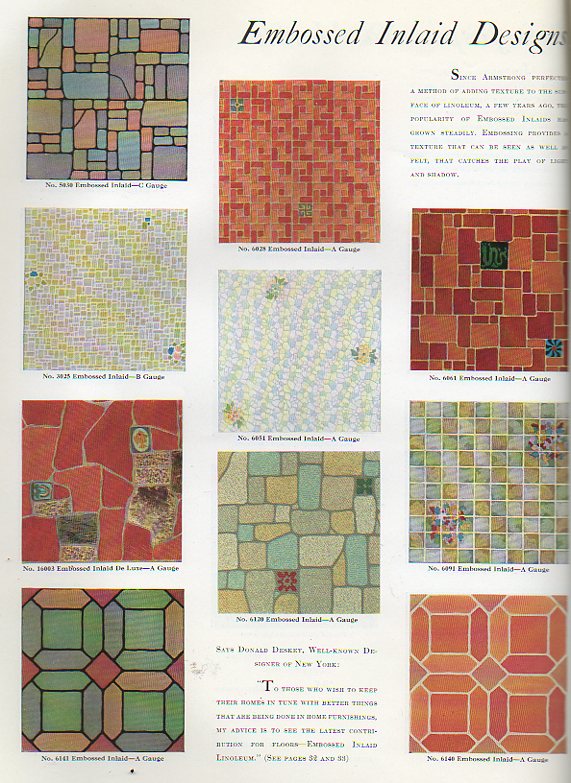
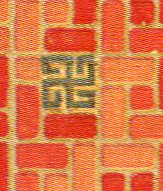
I’m not seeing Nazis in my porridge, though Madison Sqaure Garden was still getting filled up by American Nazis for their German Bund meeting in 1936–I’m just pointing out that it seems surpising that the symbol was still being used in popular design as late as it was.