JF Ptak Science Books Post 1364
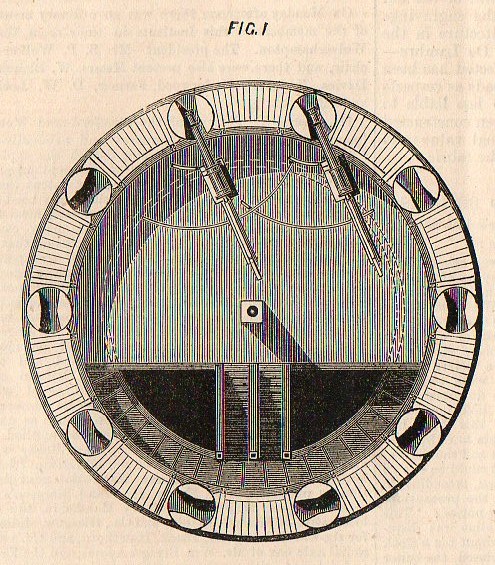
This image (from the The Engineer for 30 October 1874) shows a plan of the top floor of a revolving battery designed by M. Baltard in 1831 (and which is available at our blog bookstore). This idea is probably ancient, though it really only had major technological legs by the 19th century. Even though Baltard is given some fair credit for the modern rediscovery of the revolving turret–and in this short article he is given premier status–there were earlier engineers at work before him. For example, in the earliest part of the 19th century Col. John Stevens designed a saucer-shaped floating battery that was supposed to be able to fire in any direction; T.R. Timbly–slightly after Baltard–applied in the U.S. Patent Office in June 1843 for a device he called a “metallic revolving fort”. Then came the great John Ericsson–very long on accomplishments but very short now in modern memory, he is also one of those memorialized men in marble in DC for whom people have almost no modern recognition–who in 1854 produced an “impregnable battery revolving cupola”, which led to his great innovation on the Monitor. And as we recall, the Monitor’s defeat of the Merrimack in Hampton Roads in 1861spelled the coming end of the wooden ship of the line–metal ships with mounted revolving turrets fore and aft would prove entirely too far superior to the 19th century wooden ship.
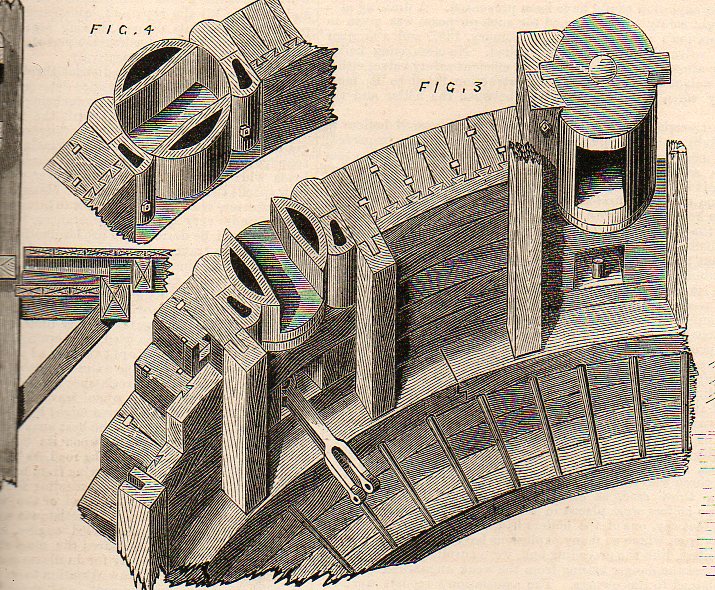
What we are seeing in the first engraving is the top floor of a two-story fortification–roof removed–showing the floor plan of the battery. The walls and roof were stationary; the floor was not. The two cannons were located on a revolving floor and were moved by turning the floor (basically) to one of the open firing windows (embrasures) a detail of which is above. When the barrel of the canon was pulled out of this opening, it was turned closed to prevent any fire coming into the fort.
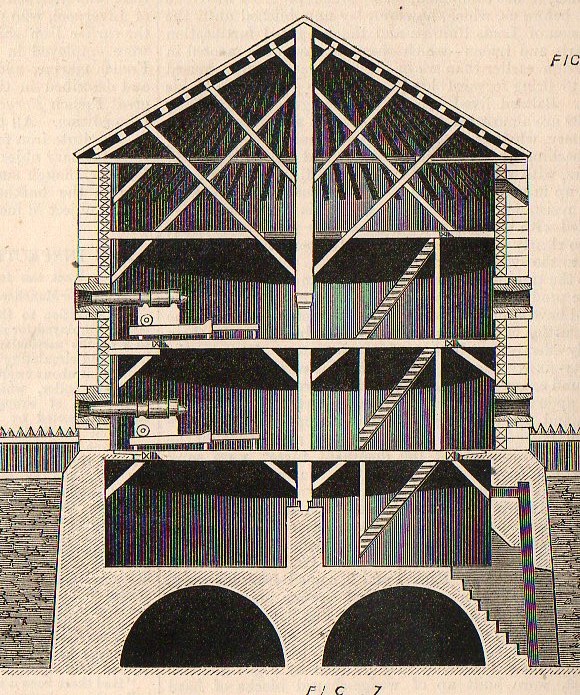
The engraving below shows a cross-section of the two-turret land structure.
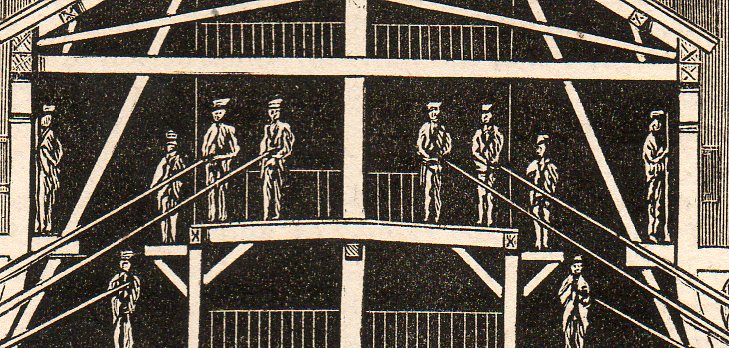
The engraving below shows the idea of the land fortification shipboard, one revolving turret fore and aft. It turns out that the engine for the vessel was human, the engineer calling for “either” convicts (forcats) or soldiers to row to move and position the boat
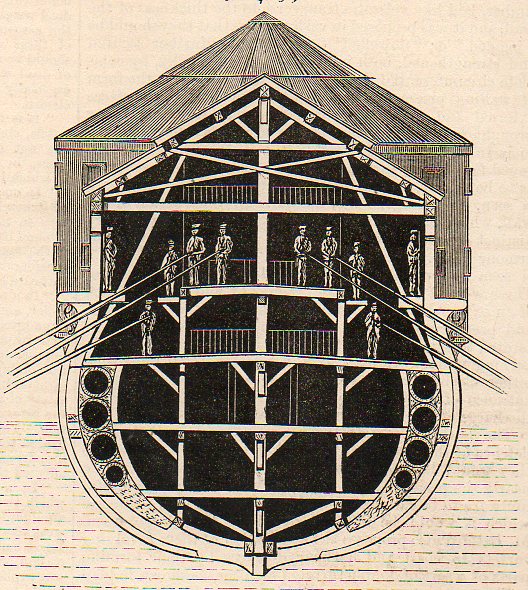
And a detail we can clearly see the long sweep oars:
And the turrets on the ship, the pre-Monitor-style ship:
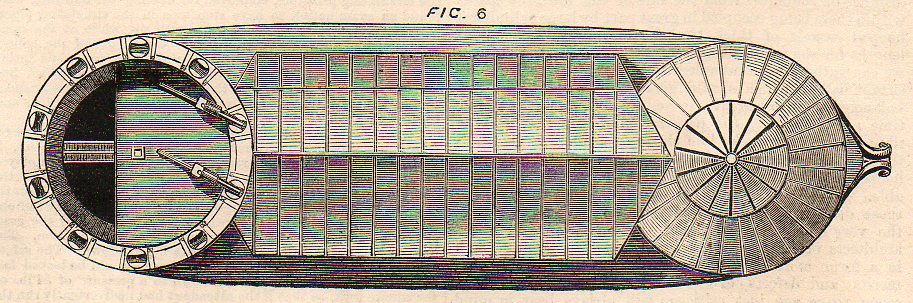
I assume that the boat was being used for coastal or harbor defense, or at least something very close to land, and was really more a floating, positioning battery than a boat. Seems to me though that after everything was said and done, after all the work was accomplished and the boat built, that making the whole thing dependent on sticks of wood was a fatal flaw.