JF Ptak Science Books Post 1535
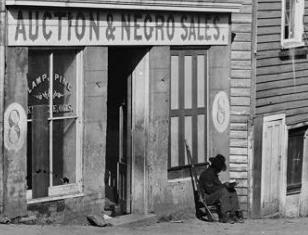
Atlanta, Georgia. Whitehall Street: ” China, Glass, Auction & Negro Sales.” 1864. Photo by George N. Gardner.

The first name people associate with photography and the American Civil War is Matthew Brady. Brady did of course come up with the idea for photographically documenting the conflict and made images of his own, but the truth of the matter is that he had a lot of help making his record–other great names from the early period of American photography were employed by him, sent out into the field to record what they saw. Alexander Gardner, Timothy Sullivan, James Gardner, William Pywell and eighteen others recorded the great events in addition to Brady, though for the most part it was Brady’s name on the finished work.
One of these men was George Gardner (1819-1902), who at one point owned his own studio in Oswego, New York in 1847, working for himself until he joined the Brady force in 1861. He left Brady in 1863, but he didn’t leave the war, becoming an official photographer for the United States Army, Chief Engineer’s Office and joining General William T. Sherman and the Military Department of the Mississippi in 1864, at which point he documented Sherman’s Atlanta Campaign. (One of the results of this effort was his 61-photograph work, Photographic Views of Sherman’s Campaign (1), published in a sumptuous leather bind in 1866, a big, heavy work with original albumen photographs.) The images below, however, were not published in this work–all 61 images can be view here, at the collections of the Hargrett Library at the University of Georgia.
Detail of the first image, above–the three other businesses that I can identify are tobacconists of one form or another. It looks like a Union private is sitting quietly (reading?) in front of the auction house, his rifle leaning against the wall. There were a lot of people going into this place, if grime on the doorway is a testament to a legacy of busy-ness.
I wonder if you were coming here as a slave, without the ability to read or distinguish any sort of written character, I wonder what you would think of those two enormous “8” characters painted on the side of the building. That symbol is an old one for infinity, continuing–I wonder how many cultures would have used that line as its own?
Atlanta, Georgia, 1864.

The only reason that the private in the photograph above is captured so clearly is that he was probably reading, which means he was sitting still for the minute or so that it would take to make the exposure. That’s what gives this image above its qualities of clarity and ghostliness–there are as many suggestions of people as there are imaged folks in this photo. What we see plainly are the men sitting on the business stoops–look more closely and you’ll see many more moving along the sidewalk, the briefest bits of them being captured by the long exposure. (There is just a hint of someone leaning against the gas light fixture in the foreground.)
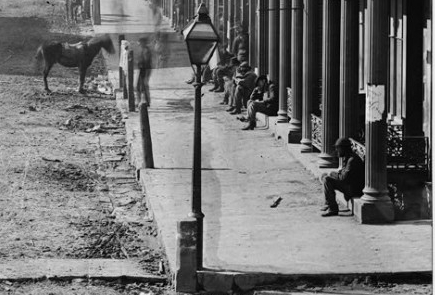
Nashville, Tennessee. 1864

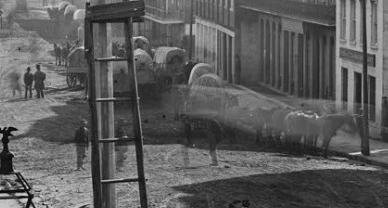
Atlanta, Georgia. View on Marietta Street, 1864.

Detail:
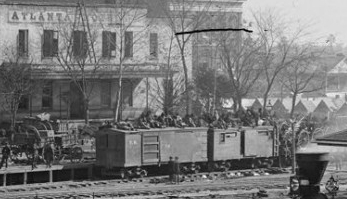
Atlanta, Georgia. 1864. “Soldiers on boxcars at the depot.” There was no date that I could find offhand on this image, so I don’t know if the soldiers were coming, or going, or already there and just trying to catch a breeze on top of the cars. It had to be after the end of the campaign, after Atlanta’s mayor James Calhoun surrendered the city following the entry of Henry Slocum’s XX Corps on 2 September 1864, and sufficiently after that for the men to climb on top of the boxcar and not get fried by a scorching Georgia late summer sun. They certainly weren’t busy pulling up the rails like they did in so many other locations in the city and vicinity, ensuring a de-mobilization of what had to this point been a primary center for Confederate munitions supply and manufacture.

Detail:
Notes:
1. The full title of the book is Photographic Views of Sherman’s Campaign, Embracing Scenes of the Occupation of Nashville, the Great Battles around Chattanooga and Lookout Mountain, the Campaign of Atlanta, March to the Sea, and the Great Raid through the Carolinas.