JF Ptak Science Books Post 1565
Nearly everything that we have or use or see today was at one point “new”; standard practices, commonly used implements or technologies or ideas were at some point a breakthrough, wholly uncommon, completely non-standard. This thought struck me while breezing through an issue of The Illustrated London News for September, 1913, and seeing the following headline:

The Wright Brothers made their powered flight in 1903, and it is a testament to the difficulty of performing upside-down flying that it took nearly 10 years to accomplish. And so it happened, Adolphe Pegoud (1889-1915) accomplishing the feat 21 September 1913–he was greeted everywhere as a pioneer and a hero. Flying upisde down, looping he loop (the distinction of “first to do this belongs to the Russian Nesterov who performed it in Kiev about a month earlier), doing the tail-slide, performing the vertical S, were all major feats, and all performed by Pegoud during this month of high activity. But the people who seemed to take the quickest and most particular interest in these “stunts” were the military folks, who instantly recognized the application of the maneuvers for aerial combat. And as quickly as they saw that the maneuvers needed to learned for offensive purposes, they recognized that they must be mastered for defensive reasons, as well.
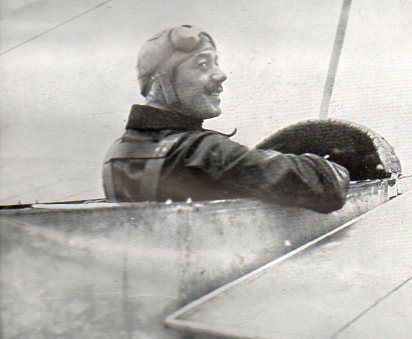
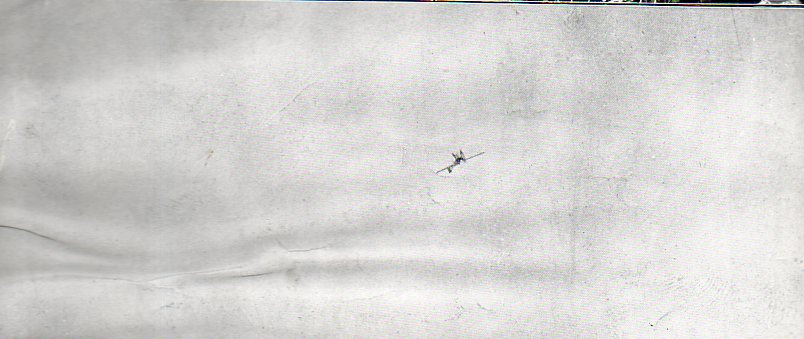
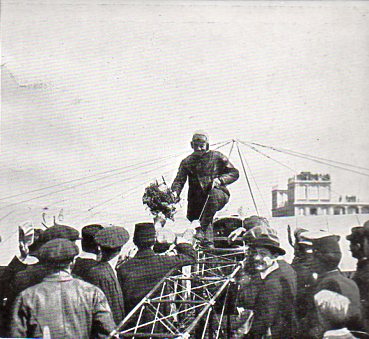
New York Times reported on Pegoud so: (via The Daily Planet at the Smithsonian Air and Space):
“Pégoud prepared a Blériot monoplane fitted with a Gnome engine and advised half a dozen friends of his plan. They did their utmost to dissuade him, but he invited them to witness the performance, and this morning at the Juvisy aerodrome he climbed into the machine and rose. At the moment of his departure he was by far the calmest person present.
He rose to a height of 3,000 feet and then turned the nose of the machine earthward. For 200 feet it fell like a stone. It then turned inward till it was flying on its back, after which it rose perpendicularly upward. Then it completed the circle by regaining its normal flying position, having accomplished an apparent impossibility.
The aviator came again to earth absolutely self-possessed. When he alighted from the machine his first remark was “I wished I had gone another thousand feet up. Then I could have done it twice.”
The issue of Sciewntific American for (October, 1913)
Image Source: Pionnaire GELong ago Sir Thomas Browne mused on what it was that the Sirens’ song might have been, trying to imagine and capture a source of vast imagination; it is equally complicated trying to understand how something we take so deeply for granted today was absorb when it was seen for the first time.

