JF Ptak Science Books Post 1578 [Part of this blog’s History of Lines series}
The post dedicated to Patti Digh, brilliant writer and birthday girl, who wrote a lovely, image-filled essay on Desire Lines back in December 2005 on her award-winning blog, 37days. I think the idea of Desire Lines is one of her favorites, and so I tried to imagine my own in her honor, a small Festschrift for the birthday girl. Happy Birthday, P.D.!
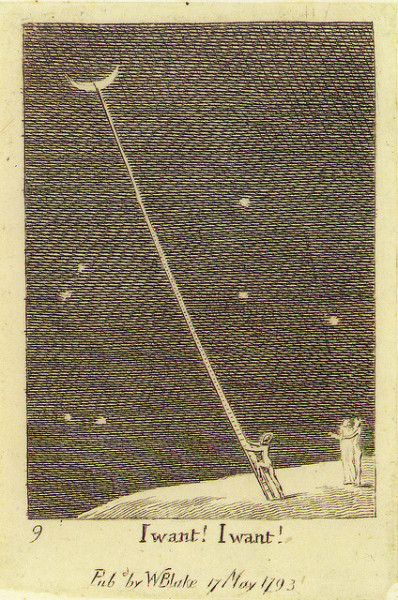
William Blake had a hard time of things, what with being thought of in unflattering terms of crazy vs. insane by many people rather than, say, being though of as “creative”. He led a good and relatively long life (1757-1827), and by his artistic and poetic creations inspired generations of other creatives, though he was very little recognized during his lifetime. He was a seeker, and was somehow able to do his art and printmaking and poetry without a substantial income, living mostly on adequate income and patrons, slowly advancing to semi-poverty as he aged , but dying without a debt to his name.
The “line” that I site above to his unusual work, The Gates of Paradise–not the Baptistery doors by Ghiberti–, was actually a ladder and a collection of lines, but with the application of perspective becomes one combined line quicker and longer than it could ever be a ladder. Blake’s character, as with Blake himself, wants whatever it is that he can have, conceivable or not; and som, if he wants the Moon, he just goes to get it. This version of The Gates of Paradise, which is largely a story of pictures and a few words as legend, was intended for children, perhaps–or at least that’s what the title says. In any event, its an interesting message to send to children whether it was actually intended for children of the chronological age, or not. The “I Want, I Want” legend really wasn’t necessary, as the image stands on its own.
Blake liked to tell a story with lines like this, as we see in this famous image of Newton:
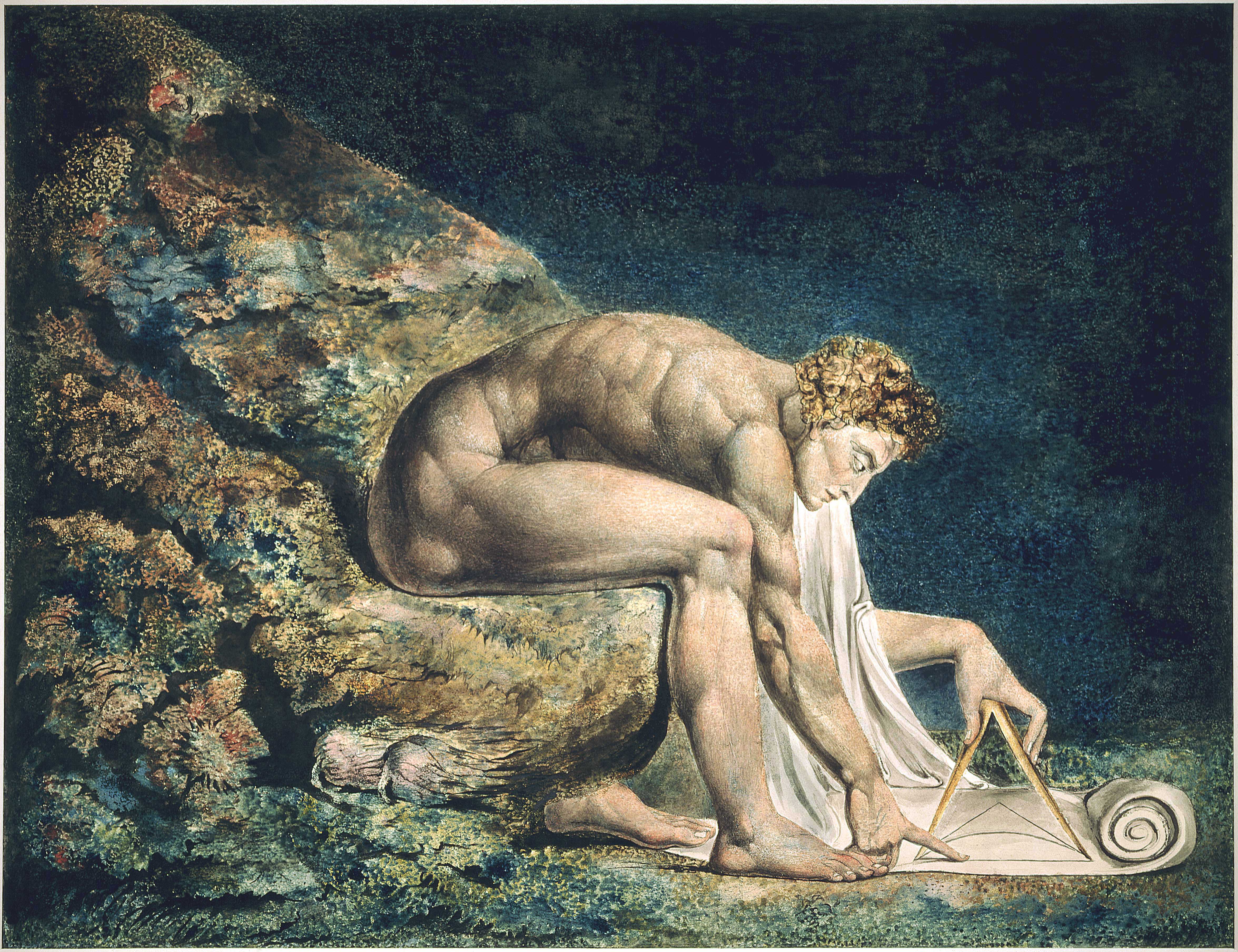
Blake was an impossible anti-Newtonian–at least in my limited reading of the man–making a career of being a spectacular and beautiful anti-rationalist, a weaver of smoke, playing with and distorting images like a theramin player of words, using language to produce dichotomies in even the most standard of sensate ideas. Blake was the poster child for thing anti-tech, an anti-scientist out to save the world from its scientific self, the rationalist world set to destroy imagination, the “Antichrist science” hell bent on destroying the soul of art and religion.
“Art is the tree of life; Science is the tree of death” wrote Blake, and so he chose the “Athesistic” Sir Isaac to stand for the beast, depicting him in art as a naked geometer intent on subjugating the world with a compass and a keen brain, reducing glory to quantification, the work of Satan.. For most of my life I thought that this image by Blake was celebrating Newton—I knew little of the poet/artist/poet, and thought the painting a reverence. When I understood Blake a little, I saw that the image was intended as a mockery of Newton and the idea of science—this was an unusual sensation, because absent the unspoken intention of the artist, you could still take the subject matter of the artwork two ways.
And of course the Creator:
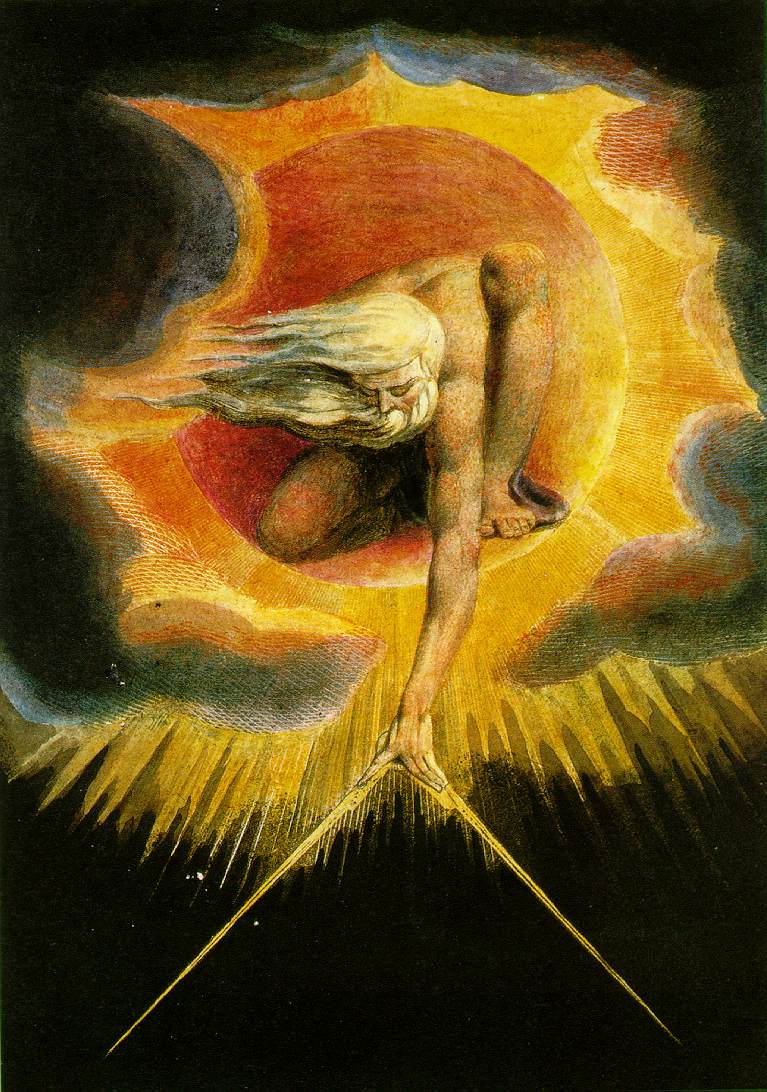
God is presented as the Great Geometer, the creative power of the universe issuing forth with compass/dividers, was perhaps a kind of Greek conception of the rule of the universe and its interaction with all things on Earth.
But it is interesting that in the end, Blake displays the sublime reasoning powers of Heaven and Earth, in the forms of God and Newton, both with desire lines. I think he enjoyed doing that.
The Series “For Children” of 1793:
