JF Ptak Science Books Post 1783

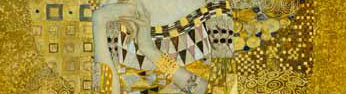
Is this detail a peek at the boundary of The Modern?
Are we seeing the boundaries of the new art? I’m not saying that this is the boundary, or the outermost, or the inner–but it is there, somehow, marking a line between the old and the revolutionary new, a line in the sand in the history of art.
The 1907 portrait of Adele Bloch-Bauer by Gustav Klimt almost seems to be among the earliest images of a synthetic human, a human no longer solely interacting with its environment, but also now becoming a part of it, the subject losing a part of itself to be a segment of design. The painting was also moving away from solely representational work, with Klimt allowing the expression of his painting to take over the recognizable subject. The subject and the idea of representational painting would disappear completely in just a few years’ time with the appearance of Kandinsky’s watercolor (Untitled) (1910). Klimit himself would continue his experimentation with The Kiss, which he worked on from 1905-1908.
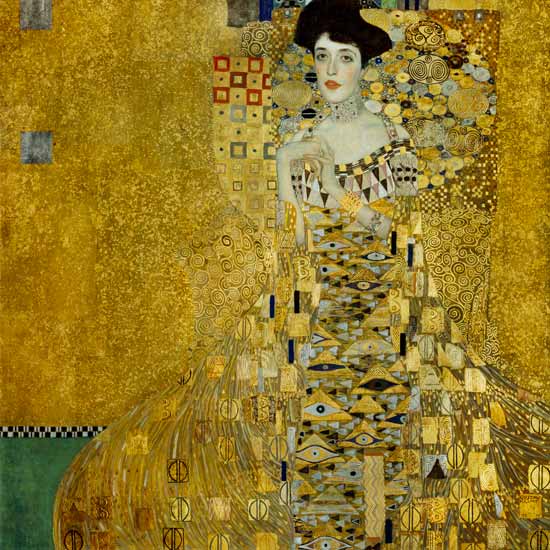
It is interesting to me to see how the subject and environment of a painting become one, as in the work, for examples of Ferdinand Leger, like his Nudes in the Forest (1909/10):

and Jacques Villon Soldiers on March (1913)

and Umberto Boccioni, States of Mind I (1911)

annd Michael Lerionov Blue Rayonism (1912)
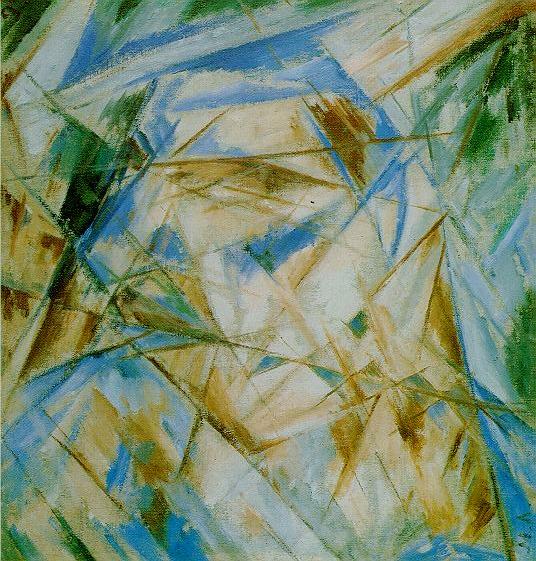
Lyonel Feininger Umpferstedt I, 1914

These more so than the earliest non-representational artists, like Franz Kupka’s Noctures (1911), or Gino Severini Hierogyphic of the Bal Tabarin (1912); and not in the very suggestive work of Vlaminck’s La Partie en Campagne (1905) or Matisse’s Joie de Vivre (1905) or even Picasso’s Les Demoiselles d’Avignon (1907). The Klimt just seems to me a blending of subject and the rest of the painting, and not in a Cubist or Constructivist or non-representational sort of way.