JF Ptak Science Books Post 2799
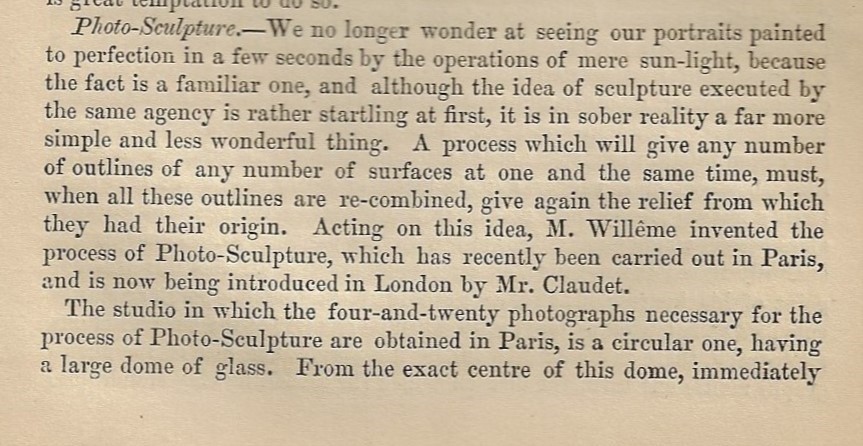
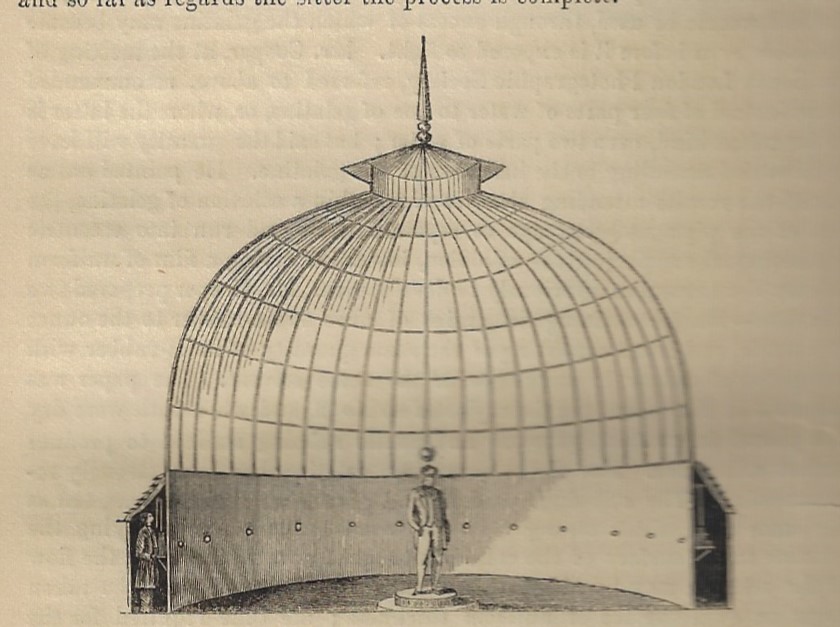
Well, the title to this post is not quite right as we would think of it in modern terms: this one is a human-based photo-aided clay fabricator of 2-D images into 3-D, which is something. What we have here is a dedicated apparatus for making a continuous photographic 360-degree view of a subject, set in order on a revolving disc on a magic lantern and projected onto a screen with a sculptor viewing the progression and making cuts and changes to his lump of clay in response to the change of perspective. The photographs of the subject were made in a circular hall, the walls of which hosted 24 regularly-spaced cameras working in unison to make a complete photographic record of the subject. The images were then taken and arranged in order on a large disc and portrayed slowly on a screen behind which the sculptor worked his magic.
The author tells us the process came from Paris via Francois Willeme (1830-1905), who seems to have created the process in 1859 and patented it in 1860 (1864 in the U.S.), and who started a veritable “craze” for the process.
The article I’m referencing and reproducing here is from the Popular Science Review of 1864, though an earlier paper was published on the process in the Journal of the Franklin Institute in 1861. Offhandedly I’ve spotted several articles in the Scientific American in 1867 (including a piece of micro-photo-sculpture), plus many other papers published before 1880, so the processes wasn’t obscure by any means.
In any event I found this interesting—having never seen this application before—and thought to pass it along. Plus the woodcut of the imaging room (or 3-D “scanner”) is very appealing in itself.