JF Ptak Science Books Post 1909
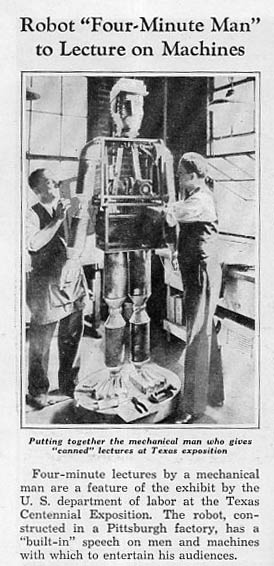
[Image source: Popular Mechanics, September 1936, page 400.]
Robots, or mechanical beings, or mechanized forms of humanity or from the animal kingdom have been around in popular literature for many decades by the time this giant robot appeared in Texas in 19361. (The idea is old though the name “robot” didn’t appear until Karel Capek invented it for his book on the future called R.U.R in 1920. Actually the human-like forms created by Capek in this early scifi work were biotech, and not fully mechanized.) The form of the robot stretches back hundreds of years, in a way–if not the exactly the idea of a robot, but at least with the appearance of one.
Such is the case with Albrecht Durer’s (1471-1528) revolutionary drawing of a geometrical man, compartmentalizing the bodyd into distinct chunks–these and other woodcuts appeared in his Symmetria partium…humanorum corporum and must have been an amazing, startling site for the new reader to such things in 1537.To me this looks like visionary thinking in trying to understand the motions of living beings with no actual way of capturing the image in motion.
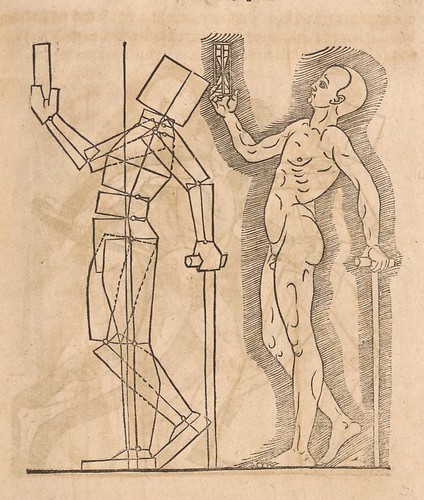
[This and many other images from the fabulous Bibliodyssey website, here.]
All of which are retro-reminiscent of early robots, like this from The Fantast in 1939:
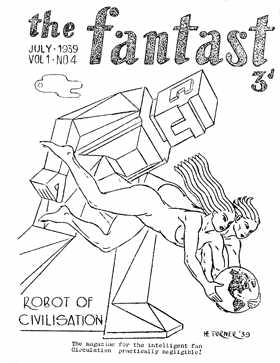 [Image source: the wonderful Cybernetic Zoo website, with loads of images and timelines, here.]
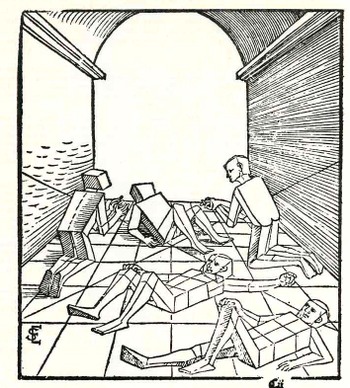
Seven years late in Nuremberg Erhard Schoen published Unnderweissung der proportzion unnd stellung der possen, liegent und stehent…, which followed Durer showing that the human form was reducible to connected but discrete Euclidean solids: