JF Ptak Science Books Quick Post Some examples from the uncollected series on Looking Straight Down can be found here and here.
- [With thanks to the captivating Pinterest account of the wonderful Public Domain Review which sparked this interest in the waterspout and which provided the first image, below.]
I’ve been involved in this blog at retrieving and tabulating antique images that look straight down on something. Today I imagine that we all take these sorts of views for granted, what with satellite images and Google Earth and airplanes and all. But in the pre-heavier-than-air era, seeing a published image that looked straight down from a height was quite rare. (And it needs to be strait down, not a bird’s-eye view. Things are very different between looking obliquely from an airplane window onto a cityscape than skydiving directly down on top of it.)
Benjamin Franklin had long been thinking about waterspouts, going back at least to the early 1750’s, though he did not have an article about them in print until the appearance of “Physical and Meteorological Observations: Conjectures and Suppositions” in the Royal Society’s Philosophical Transactions, LV (1765). The first image that I’ve been able to find of the waterspout occurs in 1774, though a prettier version of it is reworked a little, but with sharper delineations, in 1818:
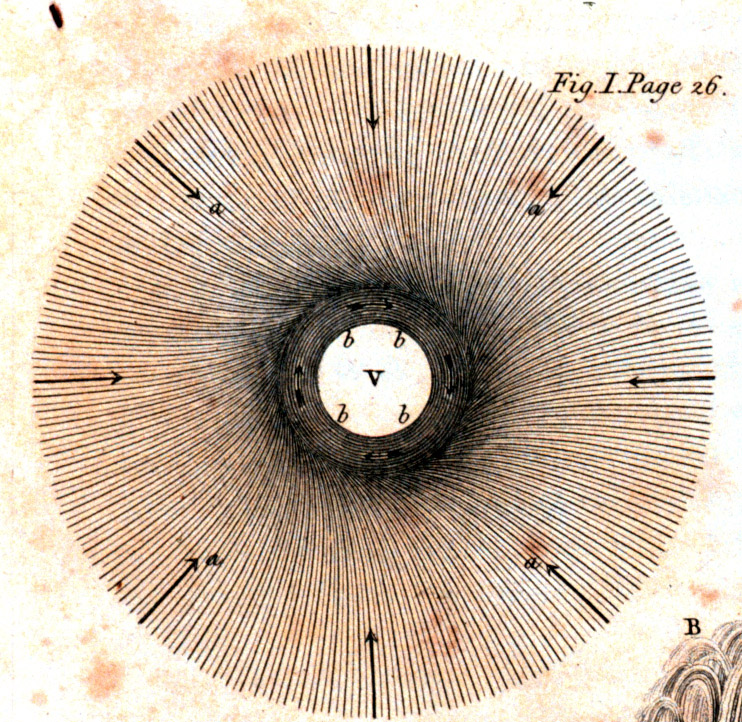
Here’s the full image (with a magic square that related to another article in the volume):