JF Ptak Science Books Quick Post

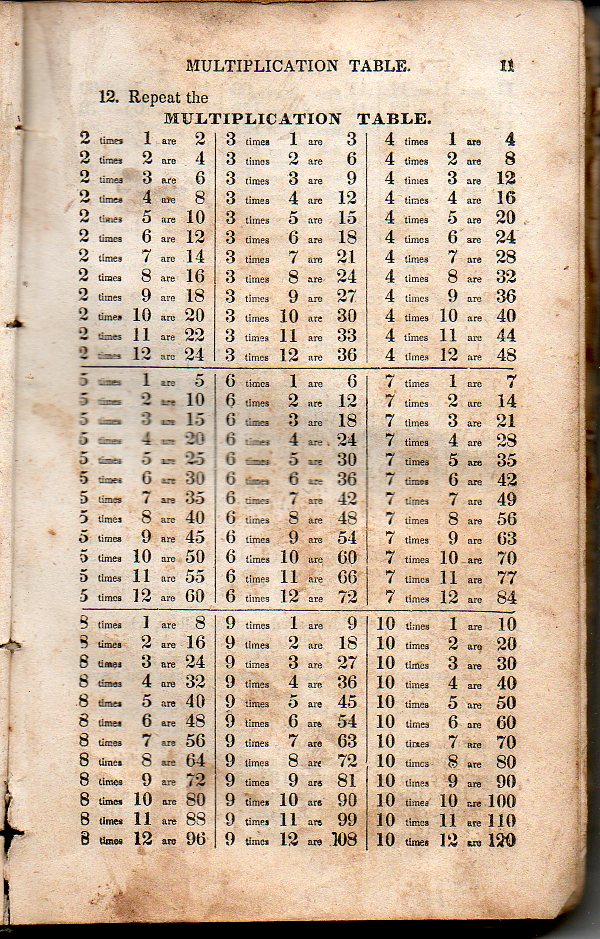
This beautiful table appeared in Roswell W Smith’s Practical and Mental Arithmetic, on a New Plan, in Which Mental Arithmetic is Combined with the Use of a Slate…, which was a soaringly successful book, this being the 53rd edition (!) and printed in Hartford in 1836. (Smith was a busy man, writing several other standard and widely distributed works in geography and grammar).
But what we find here, in one of the many tables in the book, is the surprising “3 times 3 are 9” rather than what we normally hear in the U.S. as “3 times 3 is 9”. Perhaps what we are saying is “three threes are nine” or “seven threes are twenty-one”, and so perhaps this really should be “are” rather than “is”, except in the case of a number multiplied by one, when we would use “is” (as in “1×3 is 3”, or “one three is three”). This would not be so for “3×1” where we are saying “three ones are three”).
We can also disregard both of those words and simply say “equal”. Or is that “equals”?
Its a small thing, I know, and I was attracted to the beauty and simplicity and assurance of the table–it is simply a finely designed thing.