JF Ptak Science Books Post 2033

Part of a series on the History of Blank, Empty and Missing Things
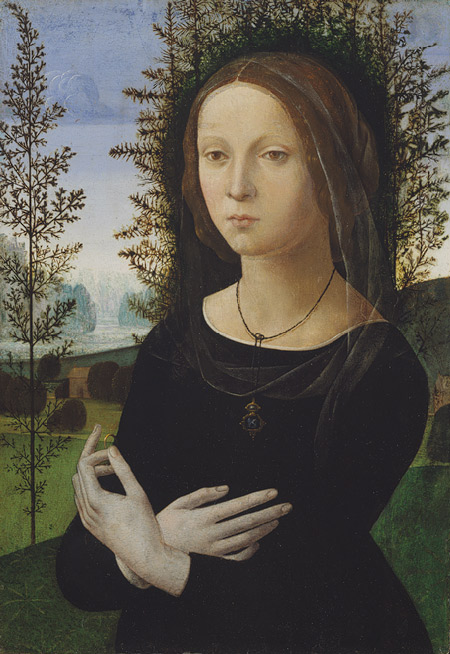 [Image source: Metropolitan Museum of Art.]
The idea of negative imaging–of forming an image “backwards”, or by using a surrounding space to define the image’s properties–came into play for me while looking at this beautiful portrait in the collection of the Metropolitan Museum of Art in NYC. Lorenzo di Credi (Florentine, ca. 1456-1536) painted Portrait of a Woman (an oil on panel) in the last decade of the 15th century, a beautiful work presenting the portrait of a woman who was possibly in mourning, modestly dressed in very dark clothing and holding a ring. What strikes me is the “dark halo” around her head, a black space outlining her head and neck and shoulders, giving all of those features a further powerful light by the very wide border between them and the juniper in the background. I imagine that this technique was used to establish a deep luminosity, but for me it also creates the presence of a halo by painting its absence–this is admittedly tenuous, but that is the way it seems, to me.
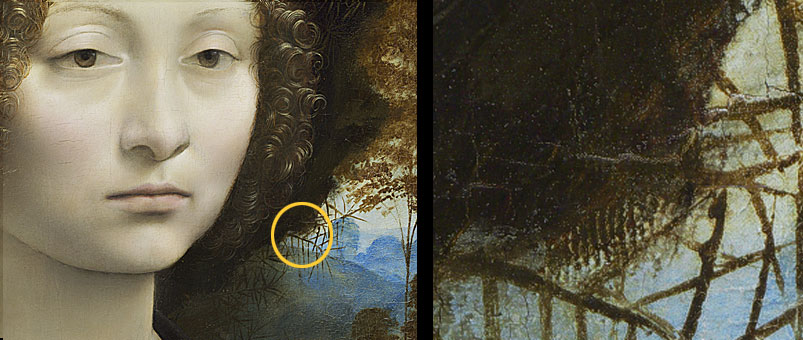
It also reminds me in a way of Leonardo da Vinci’s Ginevra de’ Benci, (c. 1474/1478, oil on panel), though there is much more detail in Leonardo’s non-halo.
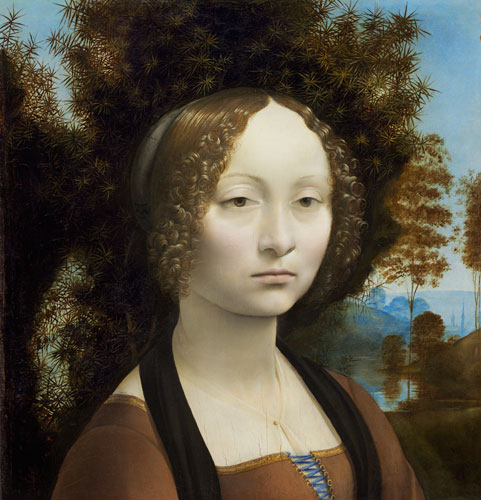
[Image source: National Gallery of Art, Washington D.C.]
Even
though there does not seem to be a “halo” in the Leonardo, there does
seem to be a fingerprint where the non-halo isn’t–evidently Leonardo
did not limit himself to just the brush in his painting technique, but
used his fingers as well.