JF Ptak Science Books Post 2097

Building on some reaching and questionable physical identification work of Sir Francis Galton, Raphael Pumpelly tried to make photographs of what scientists looked like.
At a scientific meeting of the National Academy of Sciences in Washington, D.C., Pumpelly (along with Dr. (Thomas Mayo) Brewer and the Secretary of the Smithsonian Institution, (Spencer F.) Baird) undertook the experiment to determine whether or not there was a certain composite “type” in groups of academicians. He employed the justly-named head of the photography department at the NAtional Museum, Mr. (Thomas Mayo) Smillie, to make a series of 2-second exposures of the scientists upon a single glass plate. Two seconds per portrait was not long enough to make a defined portrait for a single sitter, but if there 15 or 30 such exposures on the same plate it was seen that collectively a strong impression would be produced. The resulting portraits are interesting in their own way, but probably not so interesting without the backstory.
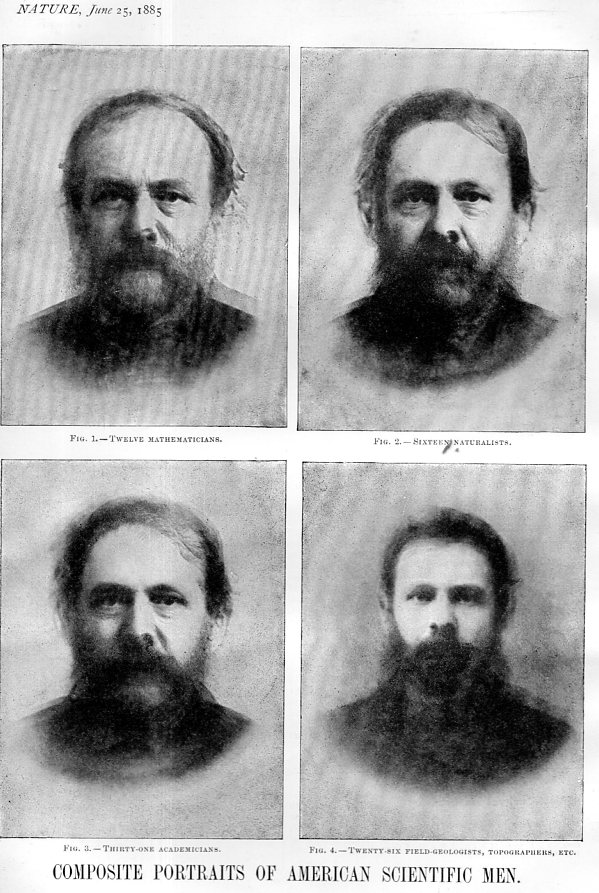
The problem of course is the interpretation and what could come of classifying external characteristics for internal capacities, which would make this exercise as useful as cranial bump reading or body mole mapping.
Also it is unclear that if you didn’t identify these images as composites of leading American scientists but were told that they were pictures of murderers or meat thieves or sneak burglars, it would be as easy to believe. Instead of identifying their characteristics of “intelligence” and “imaginativeness”, changing the grid-of-explanation to criminality would certainly change those readings to something else.
[The original paper is available via our blog bookstore, here.]