JF Ptak Science Books
The Charities Bureau of Kansas City published this handbook in 1921 for the annual fund raising season: The Hand Book for the Campaign
is a concise account of the principal helping-hand organizations, many
of which have (from our seat here in the future) quite extraordinary
names.
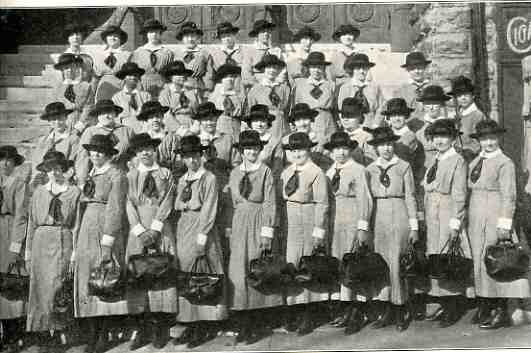
We find “The Rest Cottage” (“maintained as a refuge and
rehabilitation sot for homeless and unfortunate women and girls and
their destitute children”), the “Receiving Home for Children”, “The
Home for Infants”, “The Orphan Home for Girls”, “The Child Welfare
Club”, “The Children’s Hotel”, “The Whatsoever Circle”, “The Home for
Aged Women and the Destitute”, “The Presbyterian Home and School for Crippled Children”, “The Helping Hand Association for the Blind”, “The Girls Hotel”, “the Childrens Bureau”, “The Finding Society”, “The Home for Aged Women of the Mexican Christian Institute”, “The Hopkins receiving Home” and of course “The Society for the Friendless” (providing aid to the “man who comes from prison”, from Lansing, Leavenworth and St. Joesph. Actually the members of this society would receive the newly released convict as well as visit them in prison; the society reached over 13,000 men (and “girls in Industrial Schools”) between 1919 and 1921.
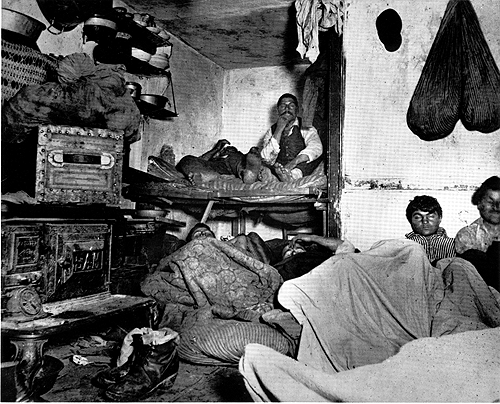
There were dozens of these agencies that were providing help and relief to the needy in the Kansas City area in the pre-Federal-help days. It is very interesting to see these charities divided along lines of need, rather than have them gathered together under a giant umbrella like, oh, the Department of Health and Human Services or some such agency. Or just the Department of “Human Service”(?) on the state level of many states. It seems more appropriate to actually specify the nature of relief rather than hide it away under a giant Orwellian blanketing cover of general services–it would be okay to be reminded that there are needs for abandoned children and destitute girls. Perhaps it would make us all a little more aware of who needs what in this rich and capable society. It just seems to me that codifying the extreme of social need into more amorphous units like we have done in the last 50 years or so smooths the edges that people like Thomas Nast and Jacob Riis* and Charles Dickens and Virginia Woodhull and Dorothea Lange and Dorthy Day** managed to sharpen. Sharp edges are good.
* Jacob Riis was perhaps the first documentary photographer of the American “underclass”, putting an indisputable photographic face on the living and working conditions of the laboring poor. A photograph of these conditions was irreproachable–it was something you could absolutely trust, mree so than an “artist’s representation”; like seeing a photograph from the surface of the Moon.
** Dorothy Day, (above), perhaps the least-known of these names, was a tremendous figure in the civil and workers rights movement and the founder of the Catholic Worker.