JF Ptak Science Books Quick Post A History of Blank, Empty and Missing Things 
In this blog’s series on the History of Blank, Empty, and Missing Things there have been I think no contributions to nothingness in the political sphere–which is odd, given how much of the time politics is about just that, staffed by people of that same quality. The experience of seeing nothing portrayed in a political caricature as seen below was such that it struck me how little I have seen any images quite like it. The “zero” appears in J. Grand-Carteret’s Les Moeurs et la Caricature en France, a thick book published in 1888 detailing the history of caricature and satiric expression in France. The image appears in chapter eight, on the political situation in France between 1816 and 1848 (Louis XVIII, Charles X, and Louis-Philippe). (Two years after abdication of Napoleon and right up to the revolutions of 1848. I wonder what it was like for Napoleon’s mother, outliving her son by 15 years?)
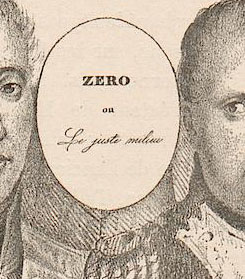 And the full image:
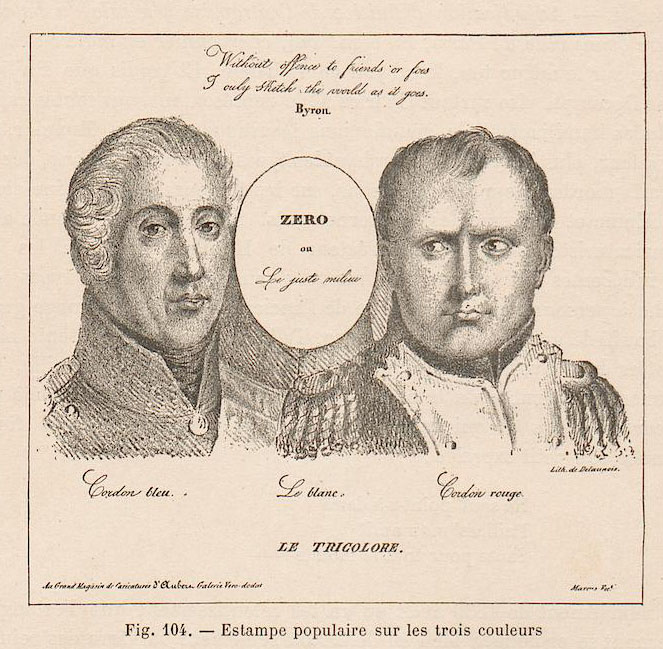 It is a overt play on the missing color of the tricolor–the flag and the colors of the flag that came into existence in France beginning with the revolution of 1789, and became the flag of the new republic. The color of course are red, white and blue (liberty, equality, and fraternity, or perhaps the colors of Paris (red and blue) and the white of the House of Bourbon, or something else. In any event, the “white” as the artist/commentator saw it, the leader filling that space, was not yet present.
The entire book is located at the University of Heidelberg site, here. The book is very highly illustrated, and it also has an appendix with a very useful list of caricature journals (pp 554-620) and biographies of artists (pp 620-675).