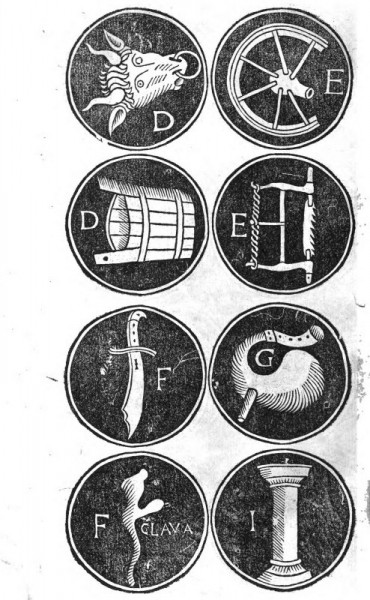
JF Ptak Science Books Post 2141 Part of the History of Memory series 
These are some fine and early printed examples of uploading information, though it had nothing ot do of course with electromagnetic anything back in 1523. The “Cloud” in question was the mind/brain, and the images helped to serve as placemarkers in how large amounts of memory were kept in the head, the methods available to just about anyone with a keen enough facility for organization and understanding, and the ability to develop learning mechanisms that would help to store and sort memory and info.
In another way, though, the process of memory was associated with the Cloud–this second attribution of the early Cloud, though–at least according to St Augustine–was God. Plato (Meno) thought along the lines of the soul learning nothing new, and that what learning was all about was recalling of the data that came to us before we were born. Augustine–mostly in Book X of the Confessions–had a different idea (and much more complex and elaborated than I could do justice here in a few sentences) about unconscious knowledge and memory, which was where, I think, he thought knowing God might be. This memory (the “divine quality” in Cicero’s thought) was the storehouse of expressions in the belief that the knowledge of true things was unconscious, and that in understanding memory this knowledge becomes evident, and that at the base of it all is the knowledge of God. It is as I said much more complicated (and elegant) than this, but I think that the root of it is correct, at least so far as memory is concerned.
In any event, here are some of the visual clues for creating alpabetic memory palaces as found in the short (30 leaves) 1523 work by Gulielmus Leporeus, Ars Memorativa (and available from the Bayerische Staatsbibliotek, here)