JF Ptak Science Books Post 2349
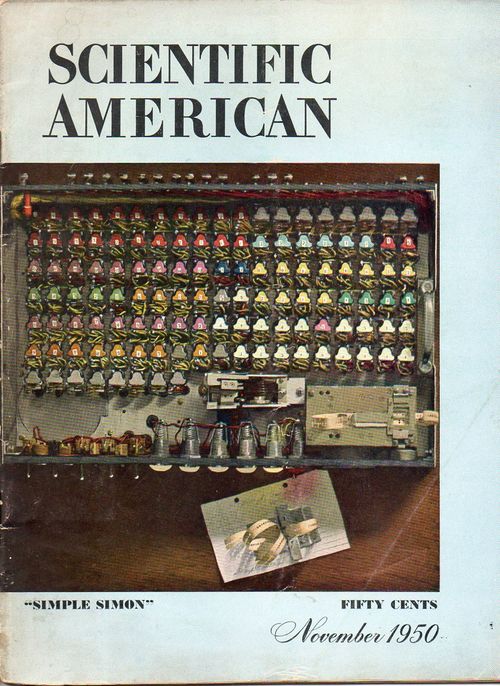

The first exposure of the American public in general to a “personal computer” may have been in this issue1 of the Scientific American for November 1950–an article called “Simple Simon” by Edmund Berkeley. ( Berkeley also wrote a book called Giant Brains, which seems to me to be the first mass-consumption book–written in terns for the general public–on how the computer works, and the design of “how a machine will think”. Berkeley looks at the MIT Differential Analyzer #2, the Moore School ENIAC, Bell Labs’ General-Purpose Relay Calculator, and the IBM Automatic Sequence-Controlled Calculator.)
The Simon was a five-hole paper tape (which was its data entry and memory) 2-bit storage relay-based computer that could use numbers from 0 to 3. It was extremely limited, but it worked, and it was real. And affordable. And a baseline for things to come.
Berkeley introduced the idea for Simon in Giant Brains:
“We shall now consider how we can design a very simple machine that will think.. Let us call it Simon, because of its predecessor, Simple Simon… Simon is so simple and so small in fact that it could be built to fill up less space than a grocery-store box; about four cubic feet….It may seem that a simple model of a mechanical brain like Simon is of no great practical use. On the contrary, Simon has the same use in instruction as a set of simple chemical experiments has: to stimulate thinking and understanding, and to produce training and skill. A training course on mechanical brains could very well include the construction of a simple model mechanical brain, as an exercise…”–Edmund Berkeley, in Giant Brains, 1949, p. 22
In the Scientific American paper Berkeley introduced the machine and how it functioned; he also described three three outcomes for Simon:
- First: “Simon itself can grow. It possess all the essentials of a mechanical brain…”
- Second: “It is likely to stimulate the building of other small mechanical brains. Perhaps the simplicity and relatively low cost of such machines may make them attractive to amateurs as the radio set and the small telescope.” [The “low cost” in 1951 was $600–equal to about $3000 today.]
- Third: “It may stimulate thought and discussion on the philosophical and social implications of machines that handle information…”
Berkeley finishes the three-page article with the following paragraph, looking into the not-too-distant future:
“Some day we may even have small computers in our homes, drawing their energy from electric-power lines like refrigerators or radios … They may recall facts for us that we would have trouble remembering. They may calculate accounts and income taxes. Schoolboys with homework may seek their help. They may even run through and list combinations of possibilities that we need to consider in making important decisions. We may find the future full of mechanical brains working about us.”
Scientific American in that same year published another early computer effort of high marks: the great Claude Shannon’s “A Chess-Playing Machine.” This is the first (and popular) appearance of Shannon’s technical paper (which would appear a month later in the Philosophical Magazine), and it is the earliest appearance of an attempt to understand the necessities of a computer for playing a game of chess.