JF Ptak Science Books Quick Post
I bumped in this issue of Nature (volume 106, pp782–784) this evening, and as it turns out it is the “Special Number: Relativity” and published February 17, 1921–and it is packed. Somehow when I first looked at this weekly I mega-missed the Einstein entry–as is customary I work back-to-front, bottom-to-top (don’t ask) and was so taken by the collection of Big Names that Einstein’s escaped me. Einstein’s article is longish for this journal and concise, with numerous references in the influencing forces in his development of the theory of relativity (which he capitalizes). 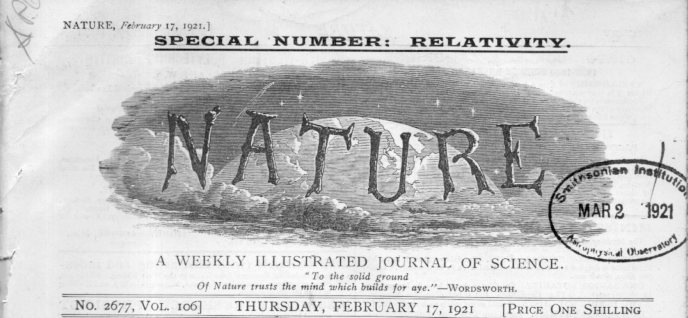
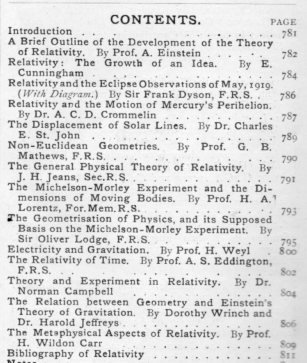
The table of contents for this single week–though it is (roughly) a double issue of thirty pages or so–incoudes work by Cunningham, Frank Dyson, James Jeans, H.A. Lorentz, Oliver Lodge, Herman Weyl, A.S. Eddington, Norman Campbell, and Harold Jeffreys, plus a few pages of tight bibliography.
Here’s the beginning of the Einstein article, courtesy of Nature, with the rest of it available from their website, here. My copy (formerly in the Smithsonian Institution) is too tender to open fully for the scanner, but the cover’s masthead is certainly available, and pretty. Abraham Pais notes in his Subtle is the Lord : The Science and the Life of Albert Einstein, that Einstein delayed the publication of the issue somewhat in his attempts to make a complicated issue fit in the space allot (as in the old Mark Twain adage, “If I had more time I would have written a shorter letter”). So, the Einstein:
A Brief Outline of the Development of the Theory of Relativity, by Prof. A. Einstein
[Translated by Dr. Robert W. Lawson]
There is something attractive in presenting the evolution of a sequence of ideas in as brief a form as possible, and yet with a completeness sufficient to preserve throughout the continuity of development. We shall endeavour to do this for the Theory of Relativity, and to show that the whole ascent is composed of small, almost self-evident steps of thought.
The entire development starts off from, and is dominated by, the idea of Faraday and Maxwell, according to which all physical processes involve a continuity of action (as opposed to action at a distance), or, in the language of mathematics, they are expressed by partial differential equations. Maxwell succeeded in doing this for electro-magnetic processes in bodies at rest by means of the conception of the magnetic effect of the vacuum-displacement-current, together with the postulate of the identity of the nature of electro-dynamic fields produced by induction, and the electro-static field.