JF Ptak Science Books Post 2362
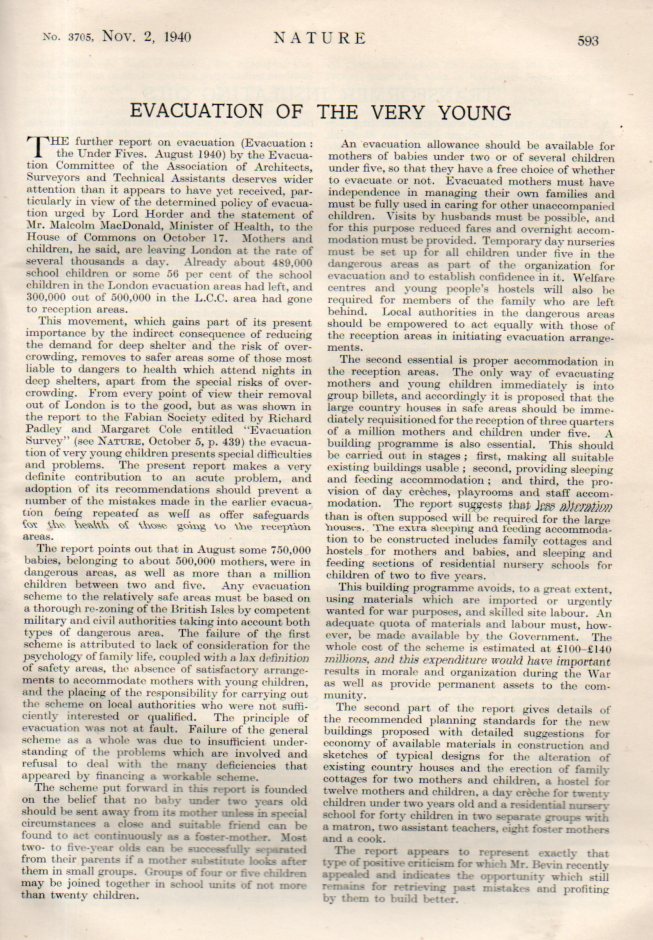
It is good to remember the early part of the war and the efforts made by the people of Great Britain, and their sacrifices, This notice appeared in the November 2, 1940 issue of Nature which recounts the evacuation measures of children during the Battle of Britain. By this point more than half of the school children in the London evacuation areas had been been evacuated, with nearly a million leaving altogether in a total evacuated population of some 3.5 million people. (At the very beginning of the war there was also an evacuation program for Jewish children from Germany to England–this was the Kindertransport which brought some 10,000 children to safety.) It was a sort of reverse/anti “Children’s Crusade” (as in the subtitle for Kurt Vonnegut’s Slaughterhouse Five), where rather than an army of children sent to expel or convert Muslims from Jerusalem/Holy Land in the 13th century, the children were sent to safety away from a crusade against their homeland. The major difference besides the existence of their opposition is that this evacuation was real, and the so-called “Children’s Crusade” was not.
The Battle of Britain was fought primarily from 10 July to 31 October 1940, so by the time this report was published the Brits had been able to turn the tide of Hitler’s plan. (The air strikes wouldn’t really end until the Nazis turned their attention to the Soviet Union in Operation Barbarossa in May 1941.) And that plan, named Luftschlacht um England, was to overtake and destroy the British capacity in the air, for as long as the English had command of the airspace there would be no way that the Nazis could force an invasion by land/sea (at least in the minds of the Oberkommando der Wehrmacht and Hitler). And so the Nazis failed–it was their first major defeat, and, especially, with the turning of attention east, it was a pivotal point of the war
The numbers of loses: England: 1,023 fighters: 376 bombers, 148 coastal command aircraft for a total of 1,547 aircraft and 544 pilots and aircrew killed. There were also 27,450
civilians killed and 32,138 wounded. The Germans lost 873 fighters and 1,014
bombers for a total of 1,887 aircraft and 2,500 pilots