JF Ptak Science Books Quick Post
This is a comparison between two different types of photographic vision–one on seeing instantaneous and direct responses, a photograph recording a true and unguarded reaction; the other, though it was the achieving the same but used a series of photographs laid one on top of the other for a complex amalgam. Charles Darwin used the first, particularly in the Expression of Emotions, and Francis Galton the second, in his Inquiries into the Human Faculty (1883). This is Galton’s version, the famous frontispiece to his 1883 work:
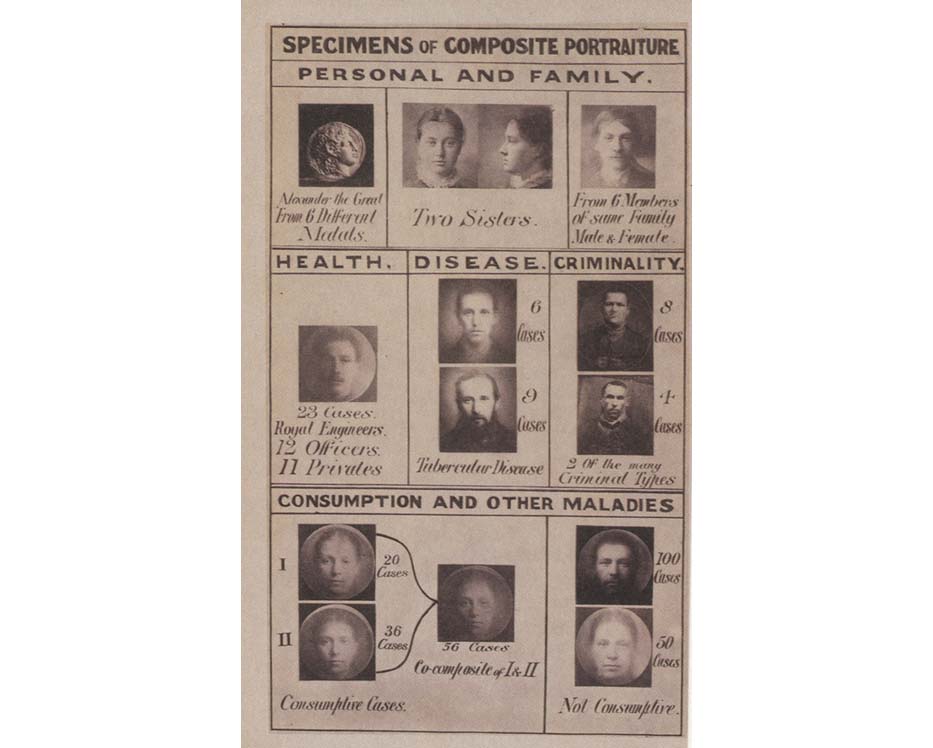
Living within a self-defined truth function, and its own language, setting its own parameters, finding what it wanted to find. Galton’s work is more like ambient music with a touch of Steve Reich, multiple layers of the same piece of music textured at intervals one piece on top of the other, seeing what came out the other end. Darwin’s approach was a simple score.