JF Ptak Science Books Post 2372
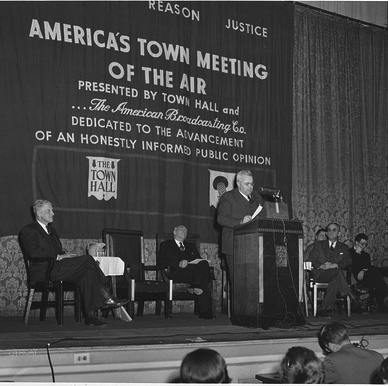
It turns out that I own a good stack of guideline publications for what was America’s first news talk show,1 “America’s Town Meeting of the Air”, produced by the Town Hall Advisory board between 1935 and 1956.2 It was a weekly show, and in general–at least for the 90 examples I have for the 1938-1941 period–each broadcast came with a three-sheet guideline for the listeners on the subject of the weekly topic.
The first sheet was a general statement of the show’s interest–for example, “What Shall We Do With the Joads?”, for March 7, 1940 (the Joads being the family in the Steinbeck mega-epic The Grapes of Wrath). These intro pages are usually very concise, very well written, logical, and provocative.
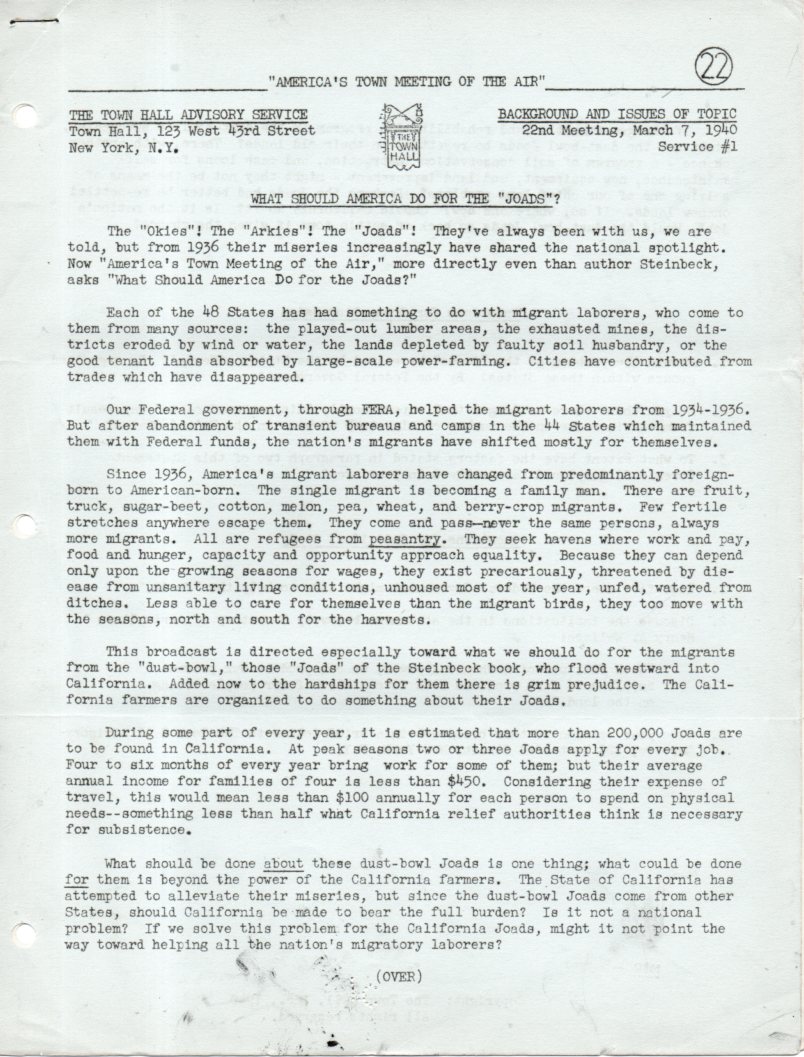
The second sheet is really what surprised me so–a bibliography and suggested reading for the discussion. That means that before the radio program was broadcast the producers provided listeners a handy sheet with material to read so that they could better follow the discussion–this seems truly exceptional by today’s sub-standards of a great chunk of radio political discussion, where volume/noise dictates correctness over recognized references. I wondered before looking at the list if The Grapes of Wrath would be there, because, well, it wasn’t necessarily a popular read everywhere in spite of the book’s critical reception. It was there, along with (shockingly) Dorothea Lange and Paul Taylor’s (her husband) An American Exodus; Carey McWilliams’ Factories in the Field the Story of Migratory Farm Labor in California; and You Have Seen Their Faces, by Erskine Caldwell and Margaret Bourke-White (described as “the Southern sharecropper in photographs and prose”). Actually all of the books and articles are given a similarly very-short description like this, in spite of their Great Classic status of today–the photographs by Bourke-White and Lange and McWilliams and their accompanying texts are really nothing short of masterpieces, difficult and challenging exposes of a national tragedy –and here they are, suggested reading for listeners of a radio talk show.
 [Image source: Old Time Radio, here.]
The third sheet was a “Who’s Who” of the speakers for the show. In this case, they included Rexford Tugwell (an economist and former Director of the Resettlement Administration); Hugh Bennett (Chief, U.S. Soil Conservation Service); Carey McWilliams (the author of Factories in the Fields and at the time Chief, Division of Immigration and Housing for the state of California); and Philip Bancroft (a member of the executive committee of the Associated Farmers of California, the farmers of that state being a particular target of Steinbeck’s in The Grapes of Wrath). There were serious people. And this was a serious radio show. Each week six pages of tight typescript on 11×8.5″ sheets would be sent out, and each we the shows were of similar quality…just very impressive stuff.
[A sample broadcast-on Social Security–can be heard here at the Social Security Administration.]
The topics for conversation make for interesting discussion in themselves, and pretty much serve as a social barometer for the period. Here’s a sample: