JF Ptak Science Books Post 2391
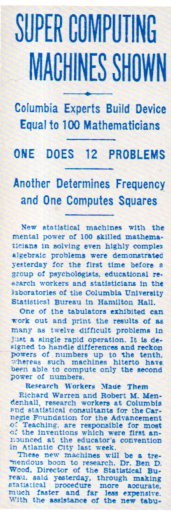 I thought for a moment that the Oxford English Dictionary had been scooped in identifying the earliest usage of the term “super computer” when I saw this newspaper article in the wonderful book by Charles and Ray Eames called A Computer Perspective (Harvard University Press, 1973). The article refers to an unidentified machine at Columbia University in a March 1, 1920 article, which would beat the first use found by the OED in 1927 (see below) by seven years. So, I checked this out a little, and latched onto a reference to Dr. Ben D. Wood as the director of the Statistical Bureau at Columbia, and found that this event didn’t happen until June 19291.
And so the Eameses got this one wrong, or the editor did, or the proof reader, or the typesetter. So instead of being 1920, this is at the very least second-half 1929, some two years or so past the first use identified by the OED. It is also possible that this might be 1931/2. Still, this was very early for using the term, and the article is interesting.
More can be found on the machine (which was probably the “Columbia Machine”, which as also known as the “Statistical Calculator” and the “Difference Tabulator”, and with some affection “the Packard”. A very good appraisal of this machine can be found at the Columbia University site for computing history at Columbia, http://www.columbia.edu/cu/computinghistory/packard.html
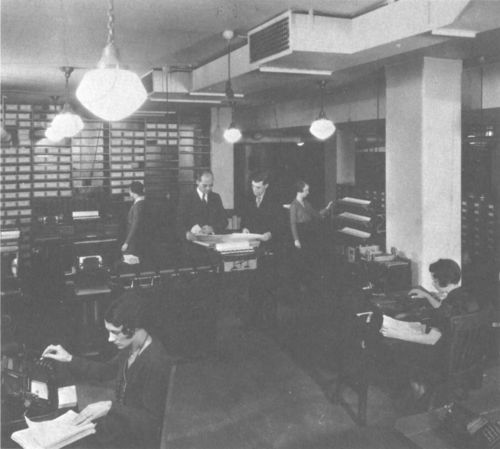 The Columbia Statistical Bureau, 1932: Source: http://www.columbia.edu/cu/computinghistory/statbureau.jpg
OED: the earliest usages of “super computing”:
1927
Army Ordnance Mar. 342/2 The central station instrument, which is a super-computing machine, solves the geometrical and ballistic problems.
1944
Pop. Sci. Monthly Oct. 88/2 Aiken will remain at Harvard after the war as director of a supercomputing laboratory.
OED: the earliest usages of “supercomputer”:
1949 Acta Crystallogr. 2 344/2 Modern super-computers will soon provide the ideal method, at least for the more complicated structures.
1968 N. Walford tr. O. Johannesson Great Computer iv. 108 Linking together about a hundred computers..and combining them..to form a unit known as the supercomputer.
OED: earliest usages of “computer” as a person:
1613 ‘R. B.’
Yong Mans Gleanings 1, I haue read the truest computer of Times, and the best Arithmetician that euer breathed, and he reduceth thy dayes into a short number.
1704 Swift
Tale of Tub vii. 140 A very skillful Computer, who hath given a full Demonstration of it from Rules of Arithmetick.
1855 D. Brewster
Mem. Life I. Newton (new ed.) II. xviii. 162 To pay the expenses of a computer for reducing his observations.
1893
Publ. Amer. Econ. Assoc. 8 23 Some curious computer makes out the cost of electing a President for these United States to be four hundred millions of dollars.
OED: earliest usages of the “computer” as a device:
1869 ‘M. Harland’
Phemie’s Temptation i. 12 [Phemie] plunged anew into the column of figures… Her pen was slowly traversing the length of the page, at an elevation of a quarter of an inch above the paper, her eyes following the course of the nib, as if it were the index of a patent computer.
1897
Engineering 22 Jan. 104/2 This was..a computer made by Mr. W. Cox. He described it as of the nature of a circular slide rule.
1915
Chambers’s Jrnl. July 478/1 By means of this computer the task is performed mechanically and almost instantaneously.
1941
Nature 14 June 753/2 The telescope drive is of an elaborate nature; the effects of changing refraction, of differential flexure and of errors in the gears are automatically allowed for by a system of ‘computers’.
Notes:
1. Columbia University computing timeline.
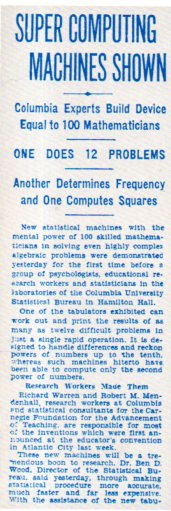 I thought for a moment that the Oxford English Dictionary had been scooped in identifying the earliest usage of the term “super computer” when I saw this newspaper article in the wonderful book by Charles and Ray Eames called A Computer Perspective (Harvard University Press, 1973). The article refers to an unidentified machine at Columbia University in a March 1, 1920 article, which would beat the first use found by the OED in 1927 (see below) by seven years. So, I checked this out a little, and latched onto a reference to Dr. Ben D. Wood as the director of the Statistical Bureau at Columbia, and found that this event didn’t happen until June 19291.
 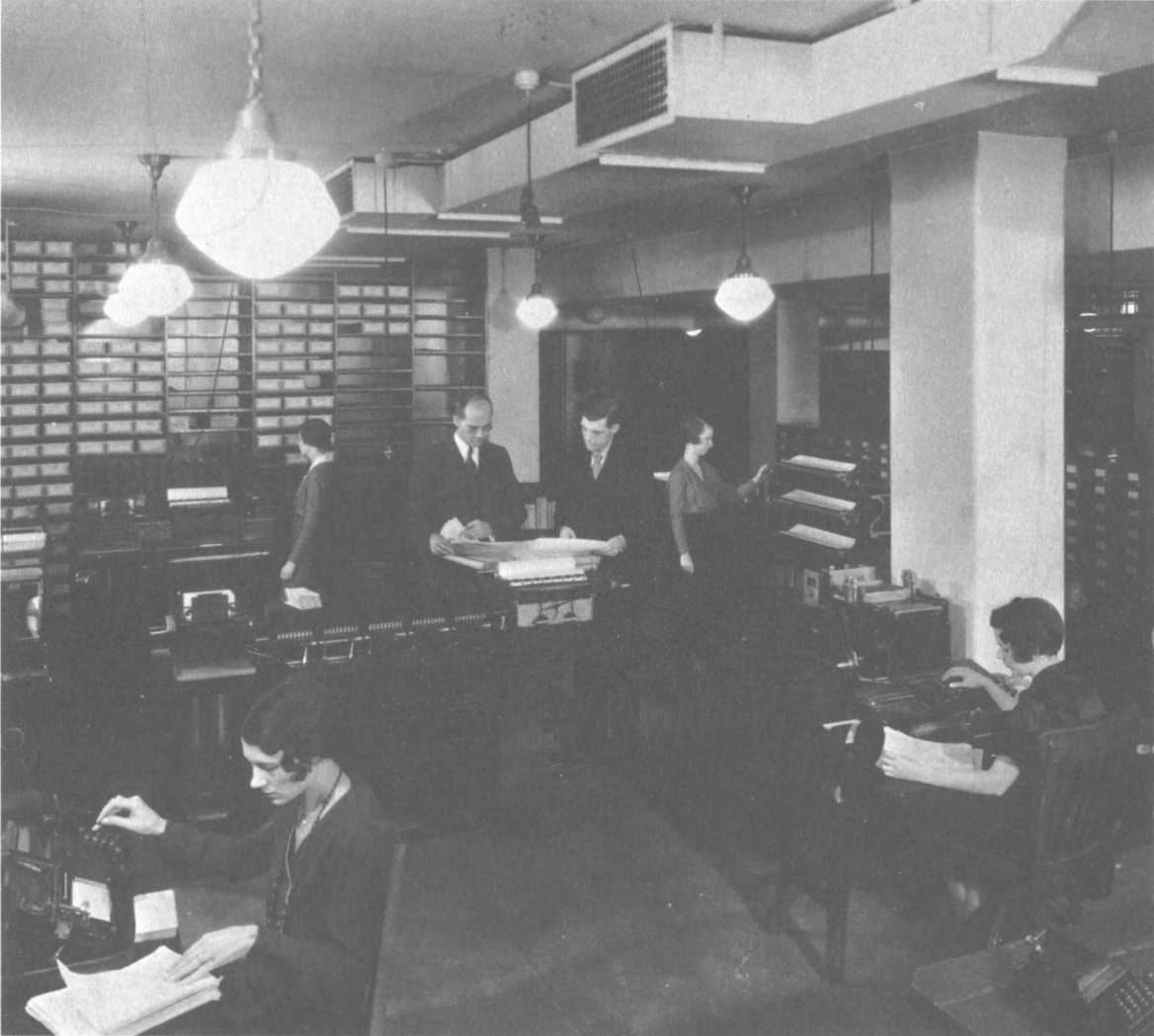 The Columbia Statistical Bureau, 1932: Source: http://www.columbia.edu/cu/computinghistory/statbureau.jpg