JF Ptak Science Books Post 3836
I just came upon a very early image of a cowboy, finding it in an unusual publication, American Agriculturalist. It is vacquero in a branding scene, and even though the word “cow boy”/”cowboy” has a longish history and easily researched, finding the earliest image of the cowboy is a more complicated matter. Images of cowboys begin to appear commonly by the late 1880’s, but once you get before 1880, the cowboy in art/representation gets more and more difficult to locate. It seems as though the among the earliest images is “El lazo”, showing a gaucho chasing a cow, which was illustrated by “J.D.” and printed in 1841. An image of cowboys branding cattle in Texas appears 26 June 1867 in Frank Leslie’s Illustrated Newspaper, and then I’m not coming up with much else in the pre-1870 era. Which takes us to the work illustrated below by the Frenchman Edward Jump (1832-1883) and his vacquero. (I’m sharing this hoping that someone will have some references for a timeline of the depiction of the cowboy…if that is you, please let me know).
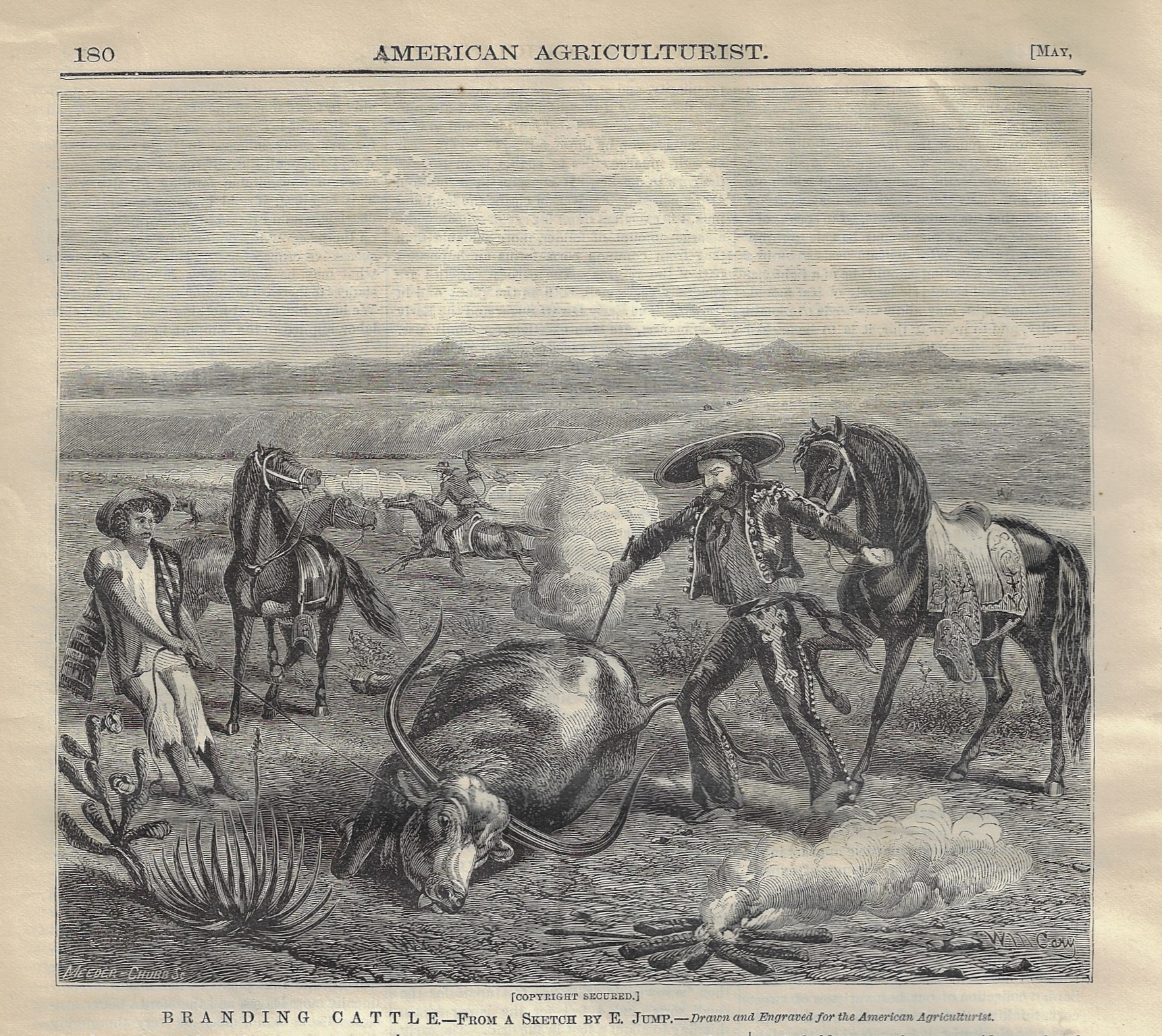
In the meantime, I’ve done the easier task in looking at the history of the word “cowboy”, as follows.
The word “cowboy” (“cow-boy”, “cow boy”) was little seen in the U.S. in the decades before the great surge in cattle drives—prior to the 1870s. The word most commonly associated with America’s greatest folk heroes actually got its beginning in Ireland, and was commonly used in Britain from 1820-1850 where its meaning was quite literal, applying to the young boys tending the cows owned by a family or community. An earlier use by Jonathan Swift in 1725 also refers to nothing more than a boy tending cows.
The word “cowboy” is first seen in the U.S. in the New Orleans Picayune, not referring to a man, but to a race horse instead. The word—referring to humans—breaks into printed use in the U.S. at about the same time the great drives were ending. Perhaps the first mention in print of the human cowboy comes hyphenated in Wilkes’ Spirit of the Times magazine in 1866. By 1877, only 11 years later, the great national character, Texas Jack (a scout brought along by Buffalo Bill Cody to his Wild West shows whose real name was John Burwell Omohundro, Jr.), laments the passing of the long drive and the cowboy in the same journal:
“The cow-boy…how often spoken of, how falsely imagined, how greatly despised, how little understood!”