JF Ptak Science Books Post 2457
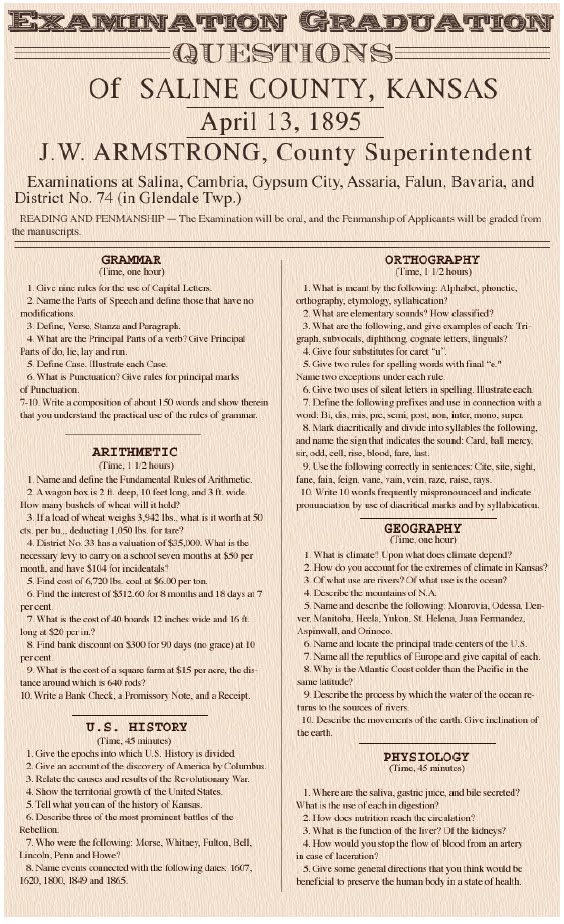
I’ve bumped into this exam a number of times around the web–it is for an eight grade final exam for Salina, Kansas, in 1895. (That’s the year that physics changed nearly completely with the discovery of the x-ray by W. Roentgen.) Perhaps it is an “average” test of competency for kids of this rank and year–that would be sort of appropriate, in a way, since the geography of Salina puts it almost at the middle of the state and almost at the center of the country. Salina wasn’t organized as a town until nearly the Civil War; it grew from 900 people in 1870 to 3,000 in 1880 to 6,000 in 1890, mostly because of the cattle trade and then farming. So when this test was made, the kids taking it were probably the children of farmers or millers, working class families.
 [Source: http://fanaticcook.blogspot.com/2011/11/1895-eighth-grade-final-exam-from.html]
It reminds me a lot of the general physics and natural philosophy and mechanics textbooks for kids that I’ve seen from the 1850-1900 period–lots of very practical stuff that went into running a life, plus the theoretical bits, and applied inferential parts. I know that I can go to Ganot’s Physics for 1885 and see how I can pull the stuff together that I can make an explosive with to remove a stump. Also there’s the mechanics of rolling a wagon sideways along a steep embankment and what makes it possibe/dangerous to do so. And much more. A lot of that would fly out of you head in short order, but a lot wouldn’t; and at least you’d have the cerebral muscle memory to know how to try to figure a problem out even if you didn’t have all of the parts to do so.
And so, with the Salina test, there’s a lot of material that an 8th grader (or adult) would just not know because there was no need to teach it. On the other hand, sitting down to “explain” arithmetic is a good question, and probably a necessary one, but still looks foreign to the reader in 2015. Also the question “what is punctuation?”–that’s a good one.
So here’s the questions. I think that they reveal more of what you’d like to know rather than what you do know..
Also I note that they used the term “U.S.” history rather than “American” history, since the questions are more about the United States of America and not about the continent/s, which includes a lot more than just the U.S.
Eighth Grade Final Examination, Salina, Kansas 1895