JF Ptak Science Books Quick Post
- There’s another interesting story on the use of “Archie” as a nickname in another military situation, here, in an earlier post, “George and Archie: Two Misty Names in Making Everything Into Nothing. Hiroshima, 1945.”
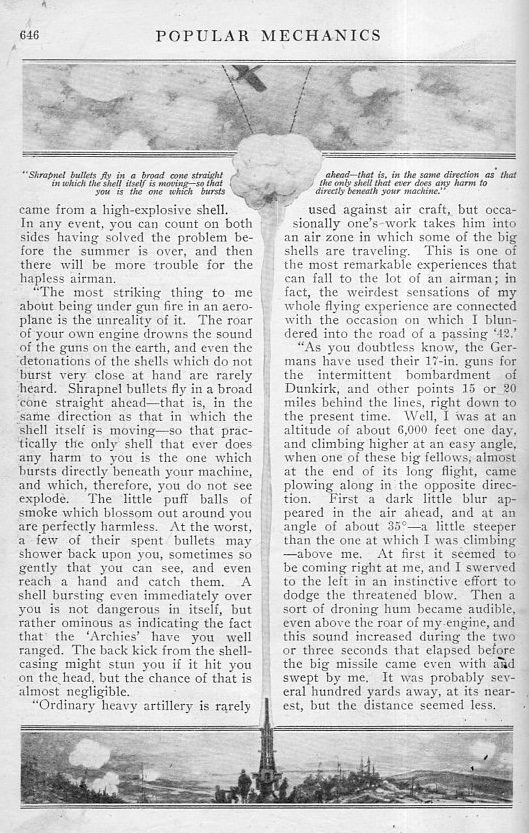
This interesting graphic appears in the article “Airmen’s Sensations in Battle” in Popular Mechanics, November 1916. It hows a cross-section, of sorts, of an air battle with antiaircraft involvement, and to my experience is of a very unusual design. The author writes of being chased by Fokkers and then met by “Archie” (British slang for antiaircraft guns) fire from below. Overall it is an effective design that heightens the sense of the story.
Notes:
“Archie”: “Nickname given to anti-aircraft fire during First World War. Said to derive from a British pilot who reacted to enemy anti-aircraft fire by shouting the line from a music hall song ‘Archibald certainly not’. This caught on and was inevitably shortened to Archie.”– Phil Jobson Royal Artillery Glossary of Terms and Abbreviations Briefly put, the AA situation during WWI was, well, primitive–necessarily primitive, I mean. There was some improvisation against balloons earlier on but the first AA-downing of a military aircraft was evidently in 1912 in the Italo-Turkish War. In 1916, two years into the war, the development of firepower against aircraft (and the detection of them, which extended to acoustical devices for the greatest part) was still in its very earliest stages.