A Daily History of Holes, Dots, Lines, Science, History, Math, Physics, Art, the Unintentional Absurd, Architecture, Maps, Data Visualization, Blank and Missing Things, and so on. |1.6 million words, 7500 images, 4.9 million hits| Press & appearances in The Times, Le Figaro, Mensa, The Economist, The Guardian, Discovery News, Slate, Le Monde, Sci American Blogs, Le Pont, and many other places… 5000+ total posts since 2008.

Category: Iconography

  • Catechizing the Sky–Writing on the Stars

    JF Ptak Science Books  Post  1166

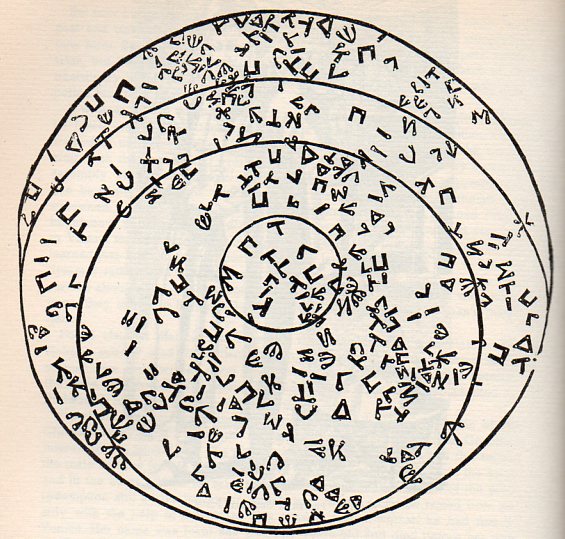
    Working on the next installment of cosmological images [and also a continuation of the series on writing systems] I put together a series on naming the stars, ideas providing the mechanics for naming the celestial kingdom, applying an alphabet for relative discussions of the heavens.  The most provocative of them all, I think, belonged to Guillaume Postel (1510-1581), a scholar who took flight in his imagination and who  established a world system which for him created  a harmony between all things that existed and the maker of the universe, and which basically was an attempt to move far past any identification system to a catechize the stars. Postel’s was a communication system between man and the beyond, not a coordinate system.  He incised the stars in his vault of heaven with Hebrew letters which would be the keys to understanding all things–and at the basis of all of this was his conception of a world unified religion which incorporated Christian ideas and values and to which all other religions would transpire. 
    Alphabet--stars  hebrew519

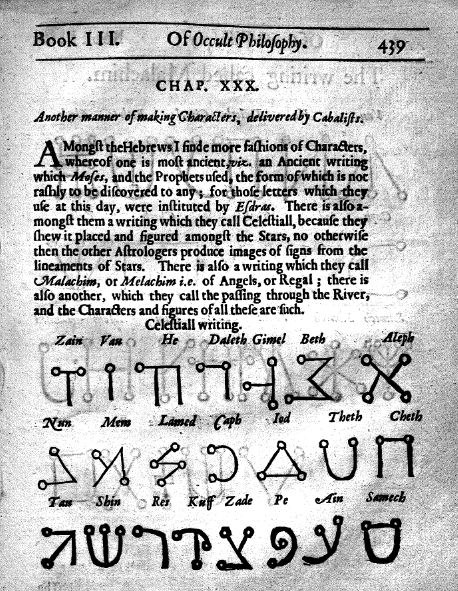
    There were numerous other attempts to establish divine alphabets, though none so far as I know were inscribed directly on the stars intended to serve as a means of transferring information and insight.  The extraordinarily accomplished (Renaissance man of the Renaissance, physician, astrologer, botanist, occultist, and general fill-in for whatever discipline needed help) Paracelsus’ Alphabet of the Magi also used Hebrew letters supplemented with magical alphabets for divination purposes, though not on the stars.  Heinrich Cornelius Agrippa (an astrologer/magician/theologian/occultist, 1486-1535) in the early 16th century came close to the Postel idea with his Angelic Alphabet, though this was used to communicate with angels and again was not incised on the stars themselves.  John Dee’s (a man of many and high accomplishments, a mathematician, occultist, astronomer, astrologer, alchemist and divine, 1527-1608) angelic alphabet was somewhat similar to Agrippa’s; his “Enochian” language used to communicate with angels.
    Alphabet--celestial

    Letters and numbers were of course used on stars but in general were used to identify the magnitude and position of stars in the constellations.  Johann Bayer (1572-1625) applied Greek letters to stars according to their relative luminosity in his revolutionar Uranometia (published in 1603).  John Flamsteed (1646-1719, and who was “The King’s Astronomical Observator” and  the first British Astronomer Royal)would come a little later and use an arabic numeral and Greek letter system, which would give the relative luminosity as well as the star’s position from the western-most edge of its constellation. 
                                       
    But it was this image by Postel which is the most astonishing, really, attempting as it did to read the heavens and the works of God without ever having to actually see the Creator (a thing most impossible, as stated in Exodus 33:20).
    ·Posted by :

    ·in:

    — — —

  • Footnotes in the Future–Swift, Lull, Borges and the End of Writing

    JF Ptak Science Books   Post 1155

    “The most ignorant person at a reasonable charge, and with little bodily labor, may write books in philosophy, poetry, law, mathematics, and theology, without the least assistance from genius or study.”   Jonathan Swift, in Gulliver’s Travels

    “Hell is the kingdom of the animal that swallows up the memory of all things… Between life and death there is no destiny except memory. Memory weaves the destiny of the world..”  Carlos Fuentes, Terra Nostra

    “A people without history/ is not redeemed from time, for history is a pattern of timeless moments” — T.S. Eliot, Four Quartets.

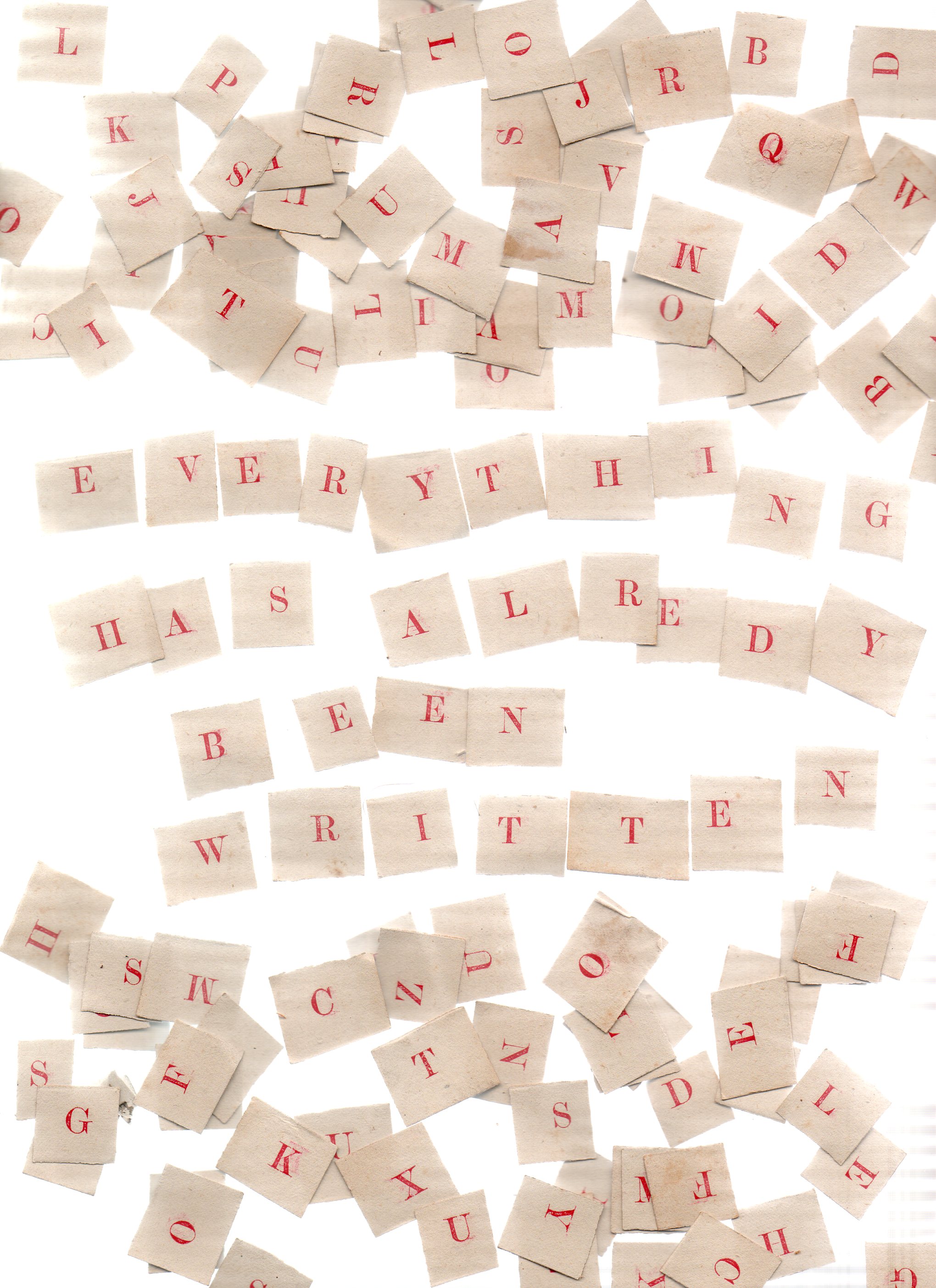
    The future history of writing–it will tell us–was already written before it was written.   In the future, when everything that can be written has been written and everything spoken has already been spoken, perhaps the first footnote in the history of already-done things will be to Jonathan Swift.  The experience belongs to us through Lemuel Gulliver1, who after surviving two trips (one to Lilliput in which Gulliver is twelve times the size of

    Written468

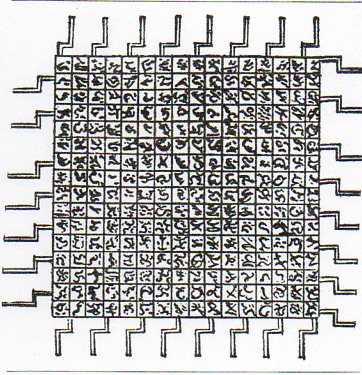
    everything else, and the second to Brobdingnag where he is one-twelfth the size of everything) comes to a third (of four2) in the land of Laputa.  It is here where he encounters a conversation machine that, when cranked, produces anything and everything, the known and unknown, the original and the copied, and have the thought and spoken
    word belong to the manipulator of the machine.  Everything that can be said is in that box, waiting to come.  The 20′ square was occupied by cubes with words on their sides, with 40 cranks and 40 handles and 40 operators to manipulate the mechanical vocabulary and associated scribes to record anything that made sense, and would be the springboard of “knowledge”operating without a manual or an intelligent primum mobile. (The image of the machine–which bears some resemblance to an integrated chip–appears in the third edition of Swift’s book, and as you can see is not a well-drawn thing, missing a row and a column and a crank here and there. A fuller description is found below.)

    Writtenc machine470

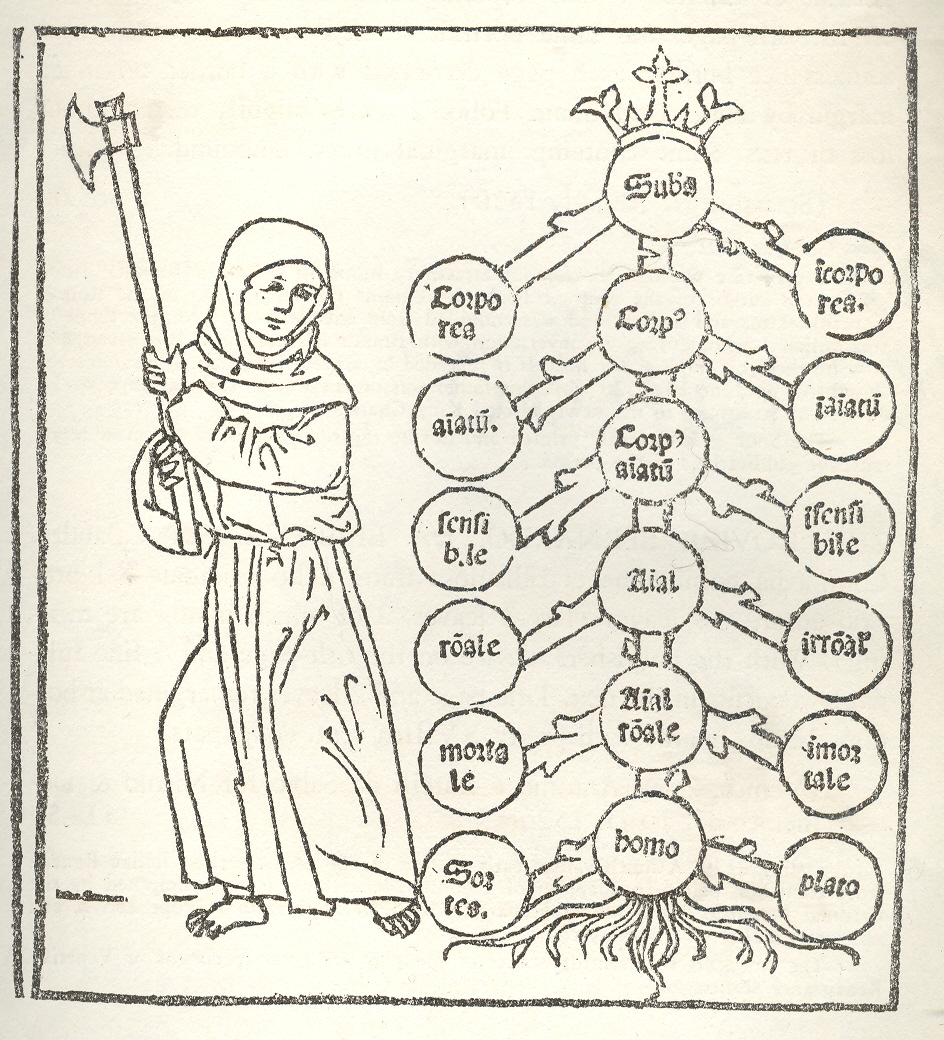
    The idea of a universal knowledge or an expanding, forever-library is very old, particularly if you expand the concept a bit to include Aristotle and the Tree of Porphyry3.  While not exactly a generator in the sense of Jorge Borges’ Library of Babel or the Swiftian machine, the ancients did 1--logic treeproduce very interesting, elegant, beautiful ways of story information and ordering information.  The Tree of Porphyry is far more concise–an abbreviation-compared to the infinitely expanding hexagonal rooms filed with books and attendant librarians in the Borges’ universe.  Or the Ars Magna/Thinking Machine of the 13th century Ramon Lull (also known as Ramon, Raimundo and Raymond, Raimundus and Raymundus Lull, Lully and Lullus and Lulio), the ultimate organizer of how sentences can be made and knowledge produced/uncovered (particularly if you want to please the logic of the church and the Creator), and which was almost certainly known to Swift (and which was also written about, described and worried-over by Borges4).  There are many other early figures in this category to be sure (Lewis Carroll, William Jevons, and even in a way Mr. Venn, not to mention Leibniz and his calculator,  and the changes in scientific method and (English/Dutch) mathematical concentration on applied mathematics of the 17th century that made thinking about the industrial revolution possible)), but that would be left to (at least) a longer post.  (The Lull wheel, below.)
                               

    How long will it take to digitize everything that has ever been written, or recorded, or composed? Several generations? Ten?  It may well come to pass in shorter time than we think; and when you compare this control of recorded human history to the centuries that will follow in developing “computers”, how can we possibly know what will become of all of it?  In the coming centuries and their attack on intelligence, when in the future the brain is a harvest of the computer, perhaps intelligence finally submits, and everything that can be done has been done, the progress of humanity snubbed to a stub. Or expanded exponentially.  It is such a tough call to make…

    Notes:

    1.  Jonathan Swift, Travels into Several Remote Nations of the World, in Four Parts. By Lemuel Gulliver, First a Surgeon, and then a Captain of several Ships.  1726.

    2. The third voyage was Part III. A Voyage to Laputa, Balnibarbi, Luggnagg, Glubbdubdrib, and Japan. The fourth finds humans as pets/inferiors in the island of the Houyhnhnms, a land of intelligent horses.

    3. The “tree” was a diagrammatic creation of a 3rd century Syrian mathematician/logician/philosopher named Porphyry who– much taken with Aristotle (and with the Categories in particular)– developed a systematic approach to the organization of thought in diagrammatic form.

    4. Borges J. L. (1999) ‘Ramon Lull’s thinking Machine’ in The total library: non-fiction 1922-1986 (Edited by) Weinberger, E., trans. Allen, E. Levine, S. J., and Weinberger, E. London, Penguin, on pp 155-160.

    It is interesting to note that Lull, who gave up everything to follow his calling into the church (and who was antagonized by the belief that his very act of missing his left-behind life to be a sin against god’s choice of him to follow his “career path”) was demonized by the church soon after his death, his works prohibited reading for hundreds of years.  He was resurrected in 1958 though on a path towards sainthood, a doctor of the church.  

    A description of the Swift machine:


  • The Mess in the Message: Propaganda in Textbooks and the Control of Intelligence (with Examples from the Confederacy)

    JF Ptak Science Books   [A note on an idea for a future post.]

    Like my father before me, I grew up playing Cowboys and Indians.  In many respects, that game was probably not all that far removed from the history that we learned in our school textbooks.  Growing up in a myth and reading about other myths, its hard to disassociate yourself from the power of those words.

    I was thinking about this earlier, finishing a post on 19th century American occupational alphabets, and thinking of the ways in which certain classes and types of people are represented–stereotypes, radical misstatement of the truth, and outright lies were sometimes included, and as they were being used to help a young child learn the alpha-beta, they also formed the core, a foundation, of a belief system simply through association and repetition–a twisted mess that very well might have taken decades to unravel.

    In that light, I’d really like to see a history of propagandistic history as taught in American schools–that’s where early battles are fought, that’s where the power of words gain strength, and that’s where the basis of all future histories that threaten those introductory lessons come to a point of contention, if not conflict.  The power of language finds its way into the young vocabulary, and has a hard time being removed.           

    Someone wrote a book about everything that they ever needed to learn was learned by kindergarten.  That sort of education cuts both ways.

    Whether it is an assault on the integrity of the biological sciences and general logic for textbooks to include “alternative” in the teaching of the formation of species and the world, or representing geological time that began in impossibly late stages in the development of the Earth and the Solar System, or glorifying the presidency of Ronald Reagan, it is the control of language that leads to the control of thought, and it is on textbooks that many of these battles are currently being fought.  And have been fought. 

    If I had access, I would love to look at the following books, their titles suggesting a frontal assault on remedial and basic ideas of communication re-fitted to the place and time and people–language and definitions reconsidered to serve the purposes of  a new user group.  I’ve chosen these titles simply because of their titles, and also because I’m in the South. (And partially too because my wife’s great-great grandfather and three associated relatives fought in the Cause, against the Union, and that is part of their history.)

    And so the books that I’d like to see:

    Richard McAllister Smith unleashed quite a torrent over a few years:  The
    Confederate First Reader: Containing Selections in Prose and Poetry, as
    Reading Exercises for the Younger Children in the Schools and Families
    of the Confederate States
    (Richmond 1864) followed by The Confederate Primer (1863) and The Confederate Rhyming Primer [Or, First Lessons Made Easy. Designed as an Introduction to the Confederate Spelling Book] (Richmond:
    1863) and The Confederate Spelling Book, with Reading Lessons for the Young, Adapted to the Use of Schools or for Private Instruction. (Richmond 1863).

    Leverett, Charles Edward. The Southern Confederacy Arithmetic. By S. Lander, A. M.. Augusta: J. T. Paterson and Co., 1864.

    There was also the very concerted effort by Mrs. Marinda Branson Moore, including The Dixie Speller. To Follow the First Dixie Reader, ( Raleigh: Branson and Farrar, 1864), The First Dixie Reader; Designed to Follow the Dixie Prime (Raleigh: Branson, Farrar and Co., 1863), followed by her The Geographical Reader, for the Dixie Children.(Raleigh: Branson, Farrar and Co., 1863), and her  Primary Geography, Arranged as a Reading Book for Common Schools, with Questions and Answers Attached (Raleigh: Branson and Farrar, 1864). 
                                       
    Robert Fleming managed to really mix it up, and also to get all of it into the title of his book  The Elementary Spelling Book, Revised and Adapted to the Youth of the Southern Confederacy, Interspersed with Bible Readings on Domestic Slavery. (Atlanta: Franklin Steam Printing House, 1863.)

    Lemuel Johnson’s. An Elementary Arithmetic, Designed for Beginners: Embracing the First Principles of the Science. By L. Johnson. A. M., Professor of Mathematics at Trinity College (Raleigh: Branson and Farrar) published 1864

    ·Posted by :

    ·in:

    — — —

  • The Movies and the Discovery of the Modern Smile

    JF Ptak Science Books  Post 1131

    [A continuation of sorts on an earlier post “Did Teeth Exist in the Renaissance?  Art and the Toothy Smile, 1300-1600”]

    Did more people in the U.S. laugh in 1924 than at any time in American history?

    The mass-consumed smile, the social laugh, the pantomime, the big grin, the sly eye, the devilish smirk, the latent laugh, the absorbed chuckle, the impish grin, were all elements of the human comedy that were difficult to see in the theatrical realm.  When performers were in front (or within, etc) a large audience, many subtleties of humor and comedy inherent in communal story telling that could be conveyed by facial expressions were simply lost.  
    Keaton
    The culture of the magnified  moment, especially in comedy, I think,  was not discovered until the motion picture was invented.  It was then, and then particularly with the invention of the closeup, that comedians were finally able to display the vast quiet parts of their craft, especially in fine pantomime.  This sort of thing was just not visible in the performers on a vaudeville or burlesque stage.  It was with the motion picture and the close-up that made the facial expressions as keen as and broadly appealing as slapstick, or the good-bad paradigm, or even The Chase.

    Fatty Arbuckle, Chester Conklin, Fred Sterling, Charlie Chaplain, Ben Turpin and especially Buster Keaton (whose facial expressions were exceptionally wide without really ever changing his expression) all came to greater prominence because of the close-up. There were more people from more different social and economic backgrounds  seeing more comedy by more comedians–and seeing more of the comedians–than at any time in human history.  And I guess we can infer that they were laughing more, because the output of comedies (Ben Turpin producing 150+ movies in one year alone, for example) continued to grow.  

    [I think that if you had to identify one single development that would allow the non-comedy to move to the top of the marquee was the invention of the serial–showing a series of episodes, which building one on the other, leading to a longer, intertwined story, developing characters and of course the audience, the returning audience.]

    In the chicken-and-egg scenario, perhaps what moved the laughter forward more so than the close-up was standardization of motion picture practices, especially in the display department.  That allowed movies to be more easily distributed, making for lower prices, more audience, more profit, more movies, more laughter (etc.).

    Standardization is an interesting story, and as much as it seems to take the creative edges off of some things, it adds to it in other ways.  “Standard Operating Procedure”, the codification of law/de jure, defining words in a consistent manner, having the same rails for all trains, establishing consistent screws threads, creating surgical procedures, developing prescription standards, having interchangeable parts for things like guns and cars and gin reapers, having standard weights and measures, and on and on, are all important things that allow us to not have to repeatedly recreate the daily bits and pieces of our lives.  (Even the “little” improvements in this area can have enormous consequences, like, for example, the British Navy standardizing sailing blocks, which went a long way in ensuring ship operation and safety.  Stuff like that seems like just a bit-and-piece, until you look at their long-term effects.

    Anyway, I could very easily be all wrong about this laughter thing, but from where I sit this morning, its an interesting thing to think about.

    ·Posted by :

    ·in:

    — — —

  • Propaganda and the Dinner Table: Strike-Breaking and Graphical Display of Data, 1911

    JF Ptak Science Books LLC  Post 987

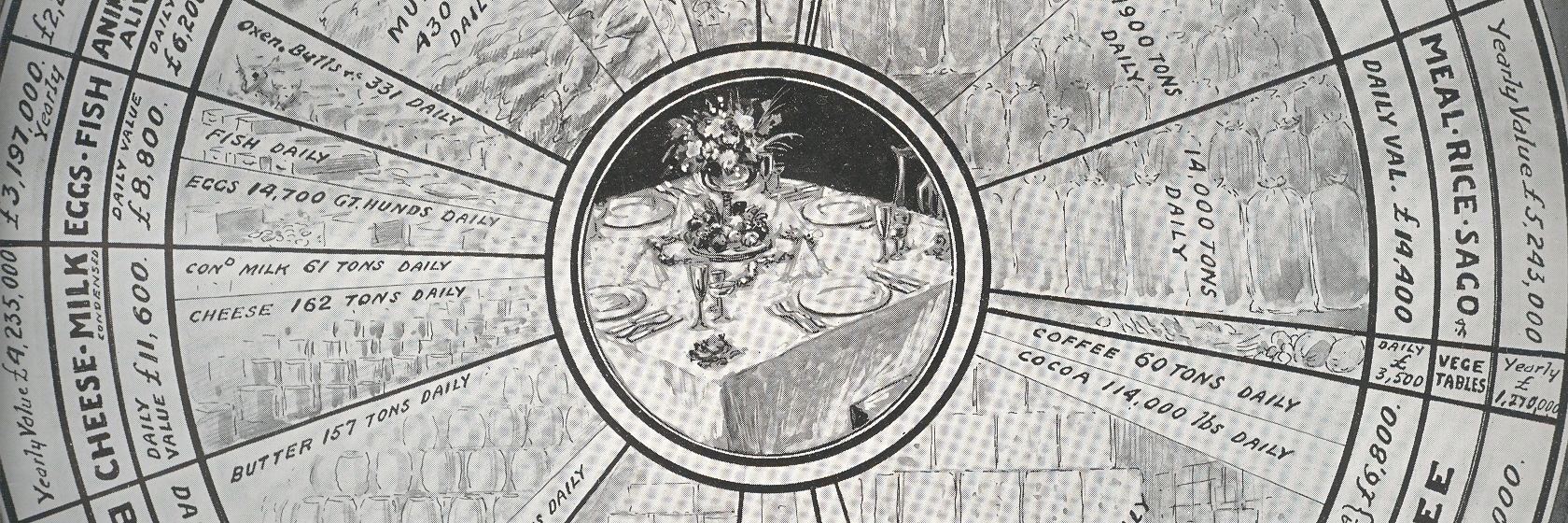
    Mar 25 dinner plate det

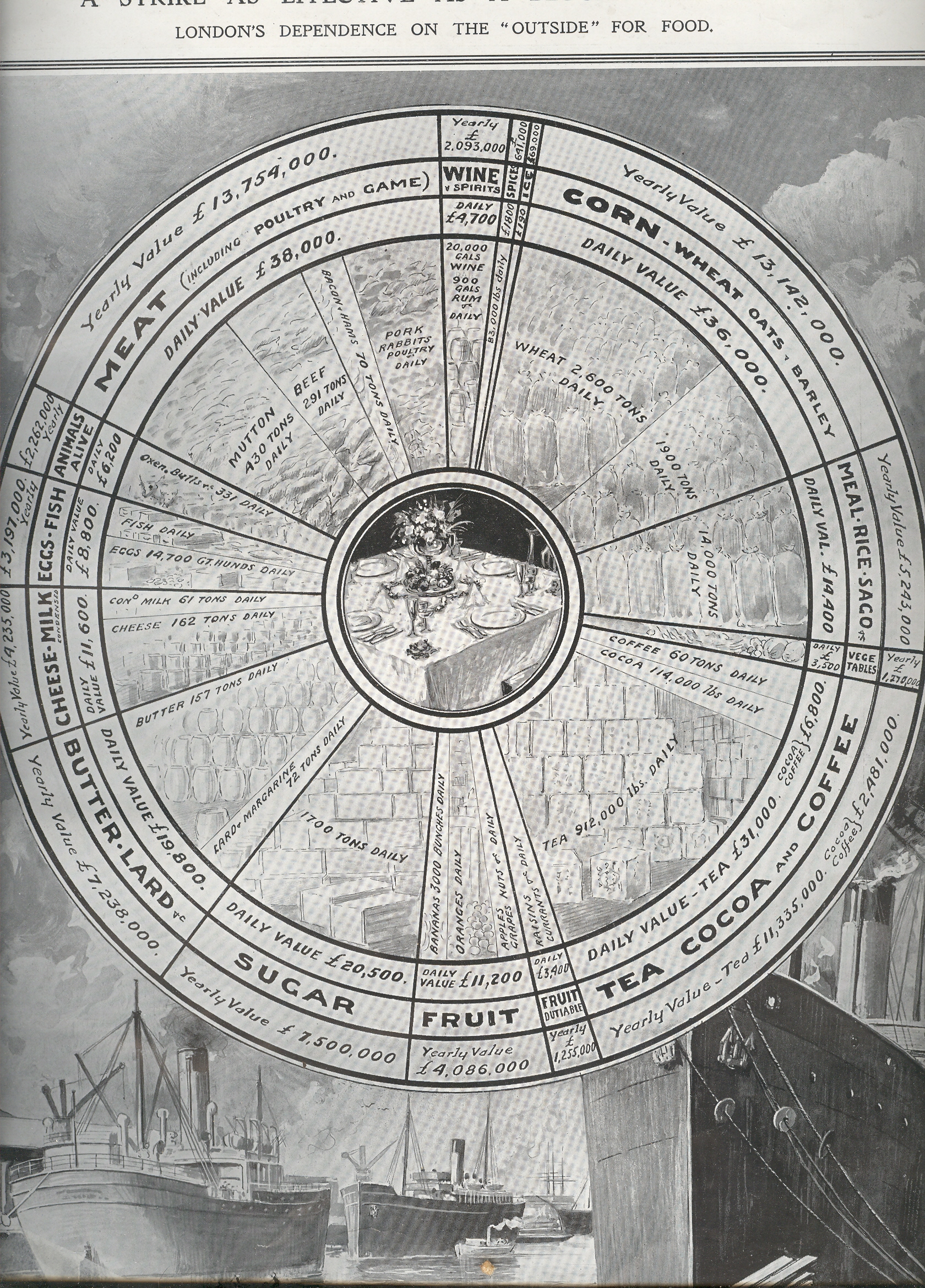
    This graphic display of the effects of a  transport workers’ strike is a pretty,
    well-designed piece of propaganda designed to draw in the general, middle-class
    (such as it was) and working population into league against the strikers.  At least that’s what it looks like to me: the
    strangulating effects of food not coming into the port of Liverpool
    and its attack on the family dining table. Literally, and figuratively: a
    table, by the way, that appears at the direct center of attention, the bull’s-eye
    of what is a target, made to look like the transport workers were taking direct
    aim at the symbol of the family. 

    All of what was going on of course was that some hard working people were
    trying to get a little more money to put food on their own  tables—the facilitators of food distribution
    for the nation’s people wanting nothing more than a little more food for
    themselves and their families.  And these
    were the people, by the way, who did not set a five-utensil place settings with
    linen table covers and a large fresh bouquet as is oddly the case in the illustration.

    By the time this illustration appeared in the Illustrated London News in August 1911 the movement had already
    been active for a year—there had also been a call to action the month before
    involving over 100,000 workers.  The National
    Sailors and Firemen’s Union, and the National Union of Ships’ Stewards, Cooks,
    Butchers and Bakers, dockhands, lorry rivers,  general laborers, and on and on, were involved
    in the strike, which was a bitter and confrontational battle between them,
    scabs, police, the army, and of course the owners of the means of production
    and shipping means.

    Mar 25 dinner plate


    After the battle of greed and need, need won.


  • War of Nicknames: 19th Century Criminals vs. Modern Mobsters vs. mid-Century Baseball vs. Mathematicians & Physicists

    JF Ptak Science Books LLC  Post 979

    [See my earlier post on the change in 19th century Western literary figure nicknames]

    Inspector
    Thomas Byrnes published a remarkable mug book and history of criminality in his
    1886 Professional Criminals of America.  It is remarkable how often the hundreds of
    people detailed in this book went on to long, vast, storied and a well-traveled
    careers, stopping here and there for a few years in Sing Sing or Dannemora,
    before moving on to riper pickings in other cities.  But what I’ve focused on in this book,
    unfortunately or not, are the categories of crimes and the nicknames of the
    criminals, many of which strike me as prosaic.

    [The interesting image below shows the only criminal in their sick/death bed,a accompanied by two rather ordinary guys who–uncommonly–are not looking down.]

    The nicknames include such lovelies as Big Rice, Mollie Matches, Doctor Dick, Hoggie, Fairy, Blink, Nibbs, Funeral, Deafy, Milkman, Poodle, Daigo, Shang, Bugs, Shone, Bad Boy and Tit.  The women ha dfar fewer nicknames, the three of the best of that limited selection being Mother Hubbard, Black Lena, Big Bertha and Kid Glove Rosey.

    Their classifications of crime included boarding house thief, swindler, pennyweight, confidential operator, bogus custom house collector, sawdust gamer, scarper, river thief, tip lifter, window smash, skingamer, and butcher cart thief. (At some point I’ll need to write a little something about the originator of the “Butcher Cart Thief”, Big Frank McCoy.  Big Frank didn’t steal butcher carts–he would make his daring escape after robbing bank in a passing butcher cart.  He’d rob the bank and spring onto the back of a cart to make his getaway.  I think that this tells us that in NYC, for example, in 1882, there were so many of these carts in the streets that a person could actually get lost in a sea of the things…perhaps like hiding in a cab nowadays. Quite a little peep into a time long passed.)

    But
    in the annals of nicknames these are not my choices for the most colorful, or
    descriptive.  Leaving out all other categories
    (political, religious, musical, military will just have to wait for a more
    rainy day) of nicknames except for mobsters (as in “The Mob”), professional
    American baseball and physicist/mathematicians

    [And from the female end of the book:]

    Baseball
    has provided ceaseless though a little limited entertainment, tending sometimes
    toward the poetic overstatement (the Chairman of the Board, The Mighty Slider,
    The Great Significance) though it does get down to business in the ‘40’s and
    ‘50’s (the golden age of BB nicknames). 
    Here are a few examples, minus the racist stuff:  Pork Chop, Tater, Gummy, Whale, Pickles,
    Rawmeat, Spud, Bunny, Beast, Kitten, Possum, Slug, The Rat, Pudge, Tomato Face,
    Buttercup. (The most effective nicknames could’ve been made by combining two of the single names:  “Spud Rawmeat”, “Pudge Slug” or “Gummy Buttercup”, for example.)  There’s an awful lot of them
    dealing with food, and a whole heck of  a
    lot dealing with facial features; they all seem to outweigh ball playing
    ability, by far.

    So
    far as I can tell there are no good nicknames for physicists and
    mathematicians, except for the ones that I’ll make up right now.  Richard (“You Talkin’ to ME?) Feynman, Albert
    (“Lady Boy” and “Big Soft”) Einstein, Paul (“Deep Face”) Dirac, Enrst (“’Stache Boy”) Mach, John
    (“The Big Finger”) Nash,  Ernest  (“The Bone”) Rutherford, Erwin (“Slitty” or
    “Tabs”) Schroedinger,  Isaac (“Sparkles”)
    Newton, Kurt (“Bad Water”) Goedel, Norbert (“Double Fisty”) Wiener,  John (“Johnny the Push” or “Other God” or
    “Sweet Suits”) von Neumann are all possibly pretty if not irreverent.  They also don’t come close to the overall
    winners in this restricted category of nickname appreciation, modern mobsters.

    No
    one, I think quite comes to grip with nicknames as does The Mob; there’s a
    certain joie de morte there that escapes other groups, possibly because of its
    terminating, enforcing qualities and expectations. 

    Pete the Killer, Frankie Shots, Jimmy the Monk, Louie
    Two Gun, Tommy Scar, Louie Ha Ha, Joey the Animal, Teets, Richie the Boot, Joey
    the Push, Nags, Fifi, Joe Bananas, Baldy Dom, Frankie the Bug, Big Nose Sam,
    Butterass, Chicken Sticks, No Nose, Louie the Mooch, Joey Spoons, One-Ear
    Frankie, Punchy, Richie Phone, Beany the Squint, the Blind Pig, Joey Beans, and
    of course Jimmy the Sniff.  And a host of
    Big ____, Little_____, Crazy _____, Fat ______ whatever. 

    I think that The Mob takes this contest, fair and square.

    (For the record, the entire text by Byrnes is located here; also, I have the original 1886 edition and a 1969 reprint available for purchase should the spirit move anybody.)


  • Seeing Vision: Examples of Light and Sight, Personified

    JF Ptak Science Books LLC  Post 976


    (On seeing the morning’s rising sun): “Looks like light to
    me.” SpongeBob SquarePants


    “All the fifty years of conscious brooding have brought me
    no closer to answer the question, ‘What are light quanta?’ Of course today
    every rascal thinks he knows the answer, but he is deluding himself.”  A. Einstein

    “Are not gross bodies and light convertible into one
    another, and may not bodies receive much of their activity from the particles
    of light which enter into their composition?” I. Newton, Opticks,
    1704, Query 30.

    Mar 12 #51

    Depicting the capacity of sight and nature of light has been
    both an easy and a knotty problem in the history of science. Over the
    successive theories on the basis of light the artistic presentation of the
    phenomenon has been generalized (generally) in a very simple way:  by straight lines.  There’s certainly nothing wrong with that,
    the lines are just parenthetic place-holders suggesting direction, not actual
    descriptors of what light “looks” like.

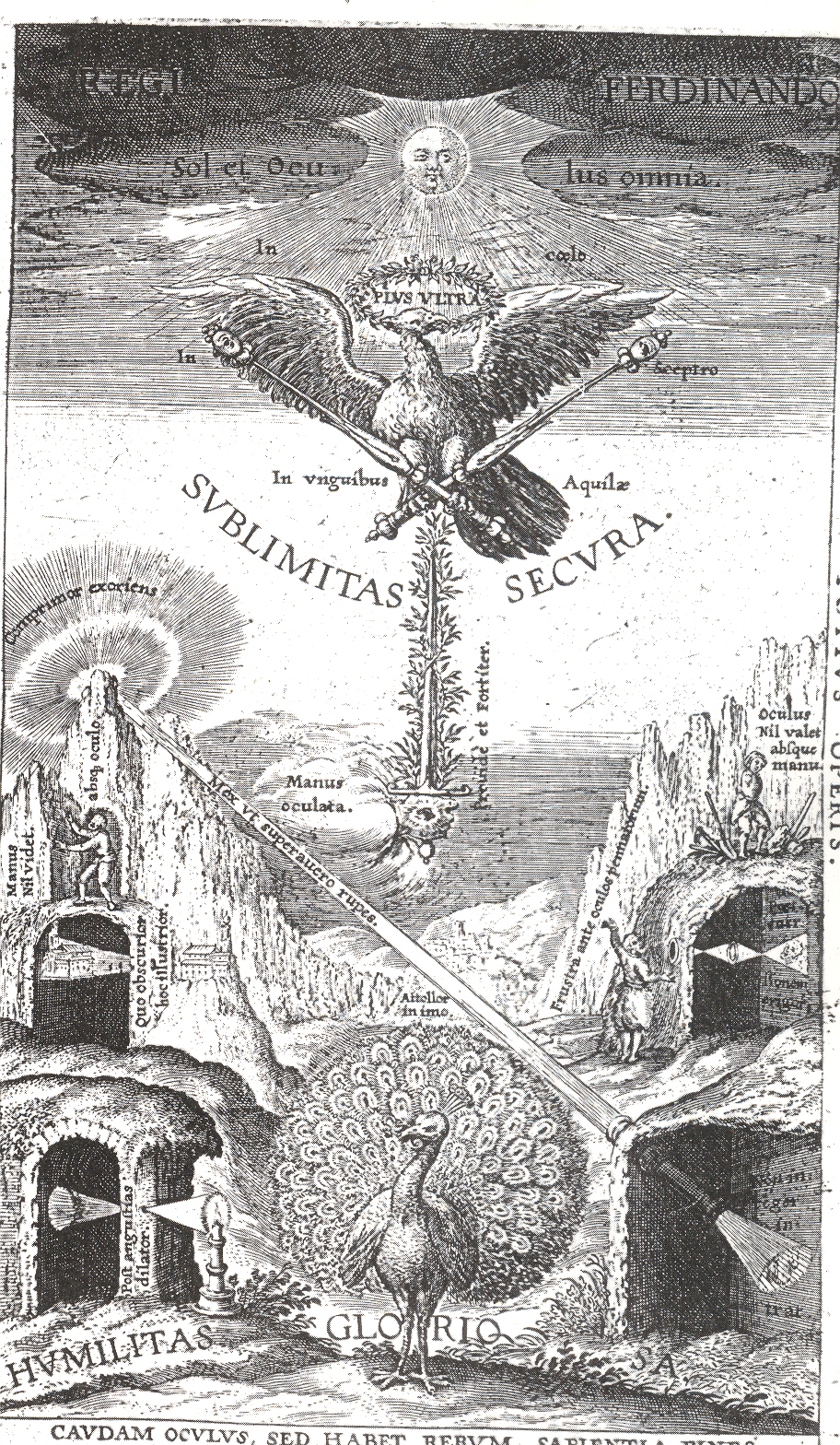
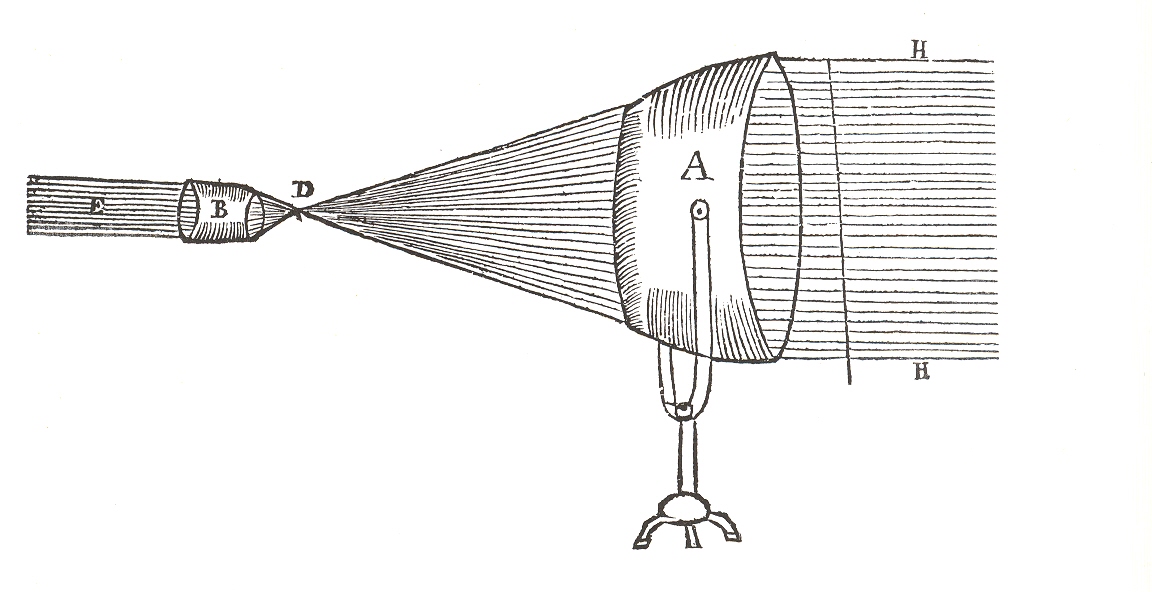
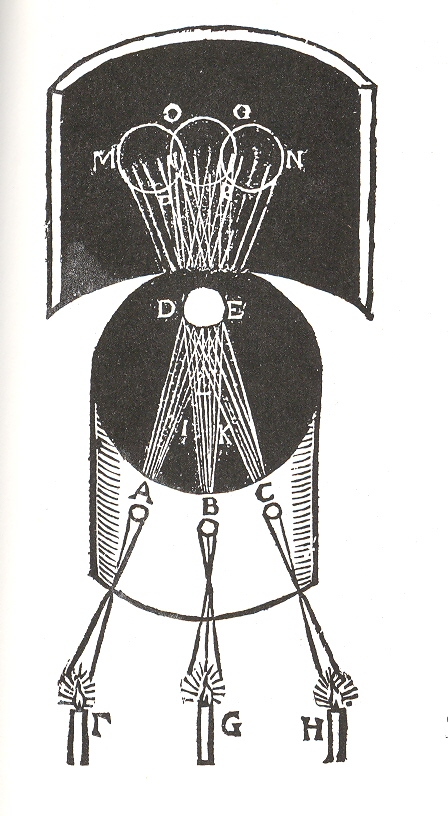
    There are literally hundreds if not thousands of images printed 1550-1850 to call upon to make this point, and I’ve selected but a few.  The first belongs to Jesuit astronomer Christoph Scheiner and which appeared in his  Oculusm hoc est: fundamentum opticum...,printed in Innsbruck in 1619. His work is an out-and-out landmark in the history of optics,  physiological optics and ophthahlmometry, and provided a springboard for two generations following him, not the least of whom was Rene Descartes. The illustration above is the book’s frontispiece, and features four camera obscuras demonstrating four principles of the eye, the middle ground of which is a beam of light 

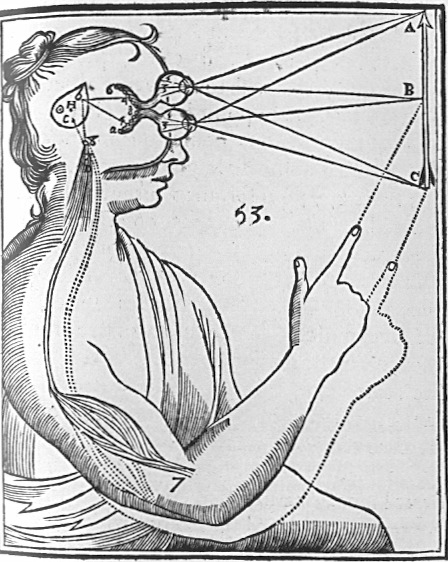
    Rene Descartes depicted the interpretation (in his  Principles of Philosophy of 1644) of light and its physiological reaction in the brain as follows:

    Cartesian_Vision

    the lines of sight depicting binocular vision, observed (and compressed) by the eye’s “particles” and processed by the pineal gland which in turn manipulate the “fluids” in the control of nerves and muscles. 

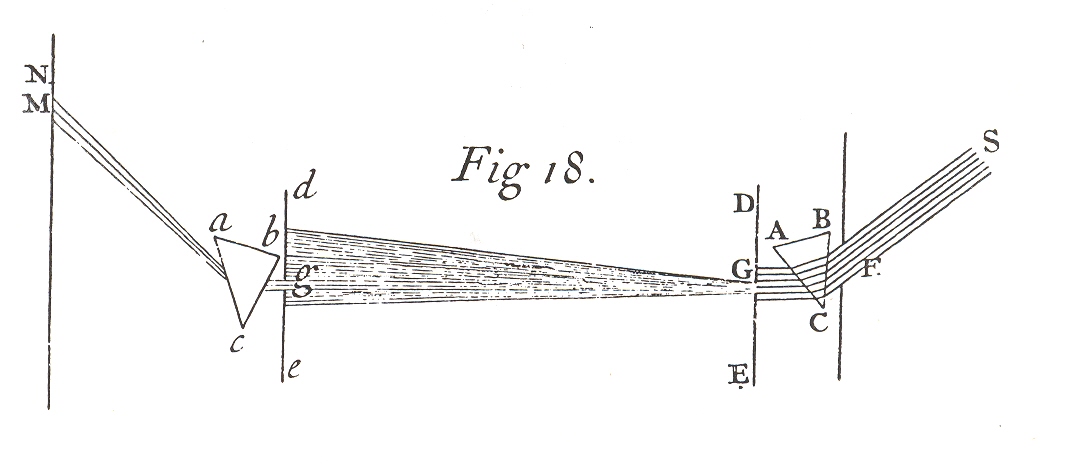
    Another example of even greater fame than the iconic image by Descartes is that of the diagram showing the connection between color and its reflective index by Isaac Newton, appearing in his Opticae of 1706.

    Mar 12 newton 

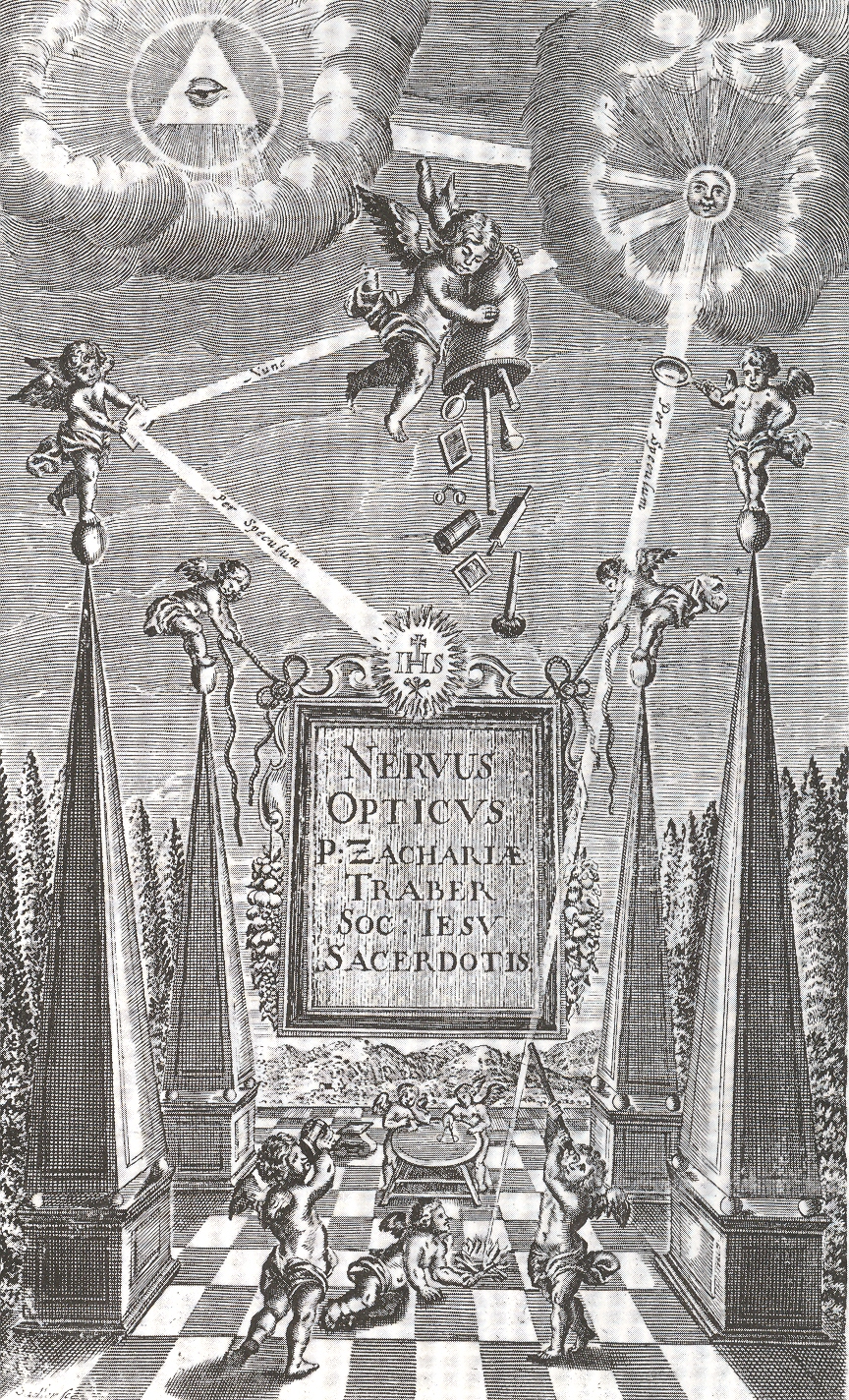
    Another fine example comes from Zacharias Traber’s (1611-1679) beautifully illustrated classic of optics (and physiological optics) , Nervus Opticus sive Tractatus Theoricus..., published in Vienna in 1690.  Traber is a great collector and synthesizer of the work done during and before his time, using the work of Descartes, Kepler, Schott, Kircher, Scheiner and Aguilon (for example), and then further implementing their ideas especially in the areas of color theory  and light refraction.  The image certainly reflects Jesuit Traber’s religious training, depicting the holy source of light (originating with the almighty force) which directs it to the sun; the light then is left to the inquisitive and playful hands of cherubs who reflect and magnify it, as well as use it to start a fire (from the condensing lens) and observe it through a telescope. The main cherub empties a sack containing a number of different optical tools, no doubt for the playful brethern beneath. 

    Mar 12 trauber 

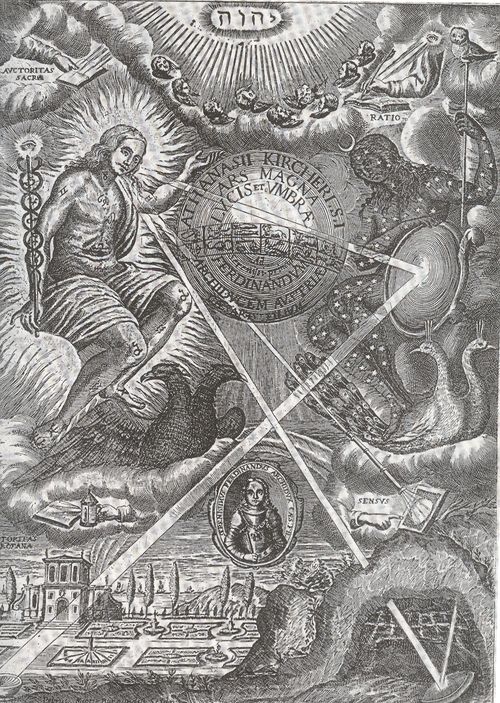
    And then of course there is the great, unstoppable, polymathic and sometimes incorrect Jesuit Athanasius Kircher.  This image appears in his masterwork Ars Magna lucis et umbrae, printed in Amsterdam in 1671, which deals with light and shadow, optical illusions, color, refraction, projection and distortion, sundials, mirrors, as well as astronomical subjects. Most of these subjects are clearly seen in the engraved frontispiece to the work (below), the source of all of the “rays” of light coming from the godhead, relayed through a telescope, reflected from a mirror, and gathered in a camera obscura. 

    Mar 12 kirch 

    Other interesting images from the Kircher include this spotlight.

    Mar 12 krirch detail long

    Mar 12 krirch black detail


  • Popular Culture Images–The Long Road, Allegories of Life’s Stages

    JF Ptak Science Books LLC  Post 969

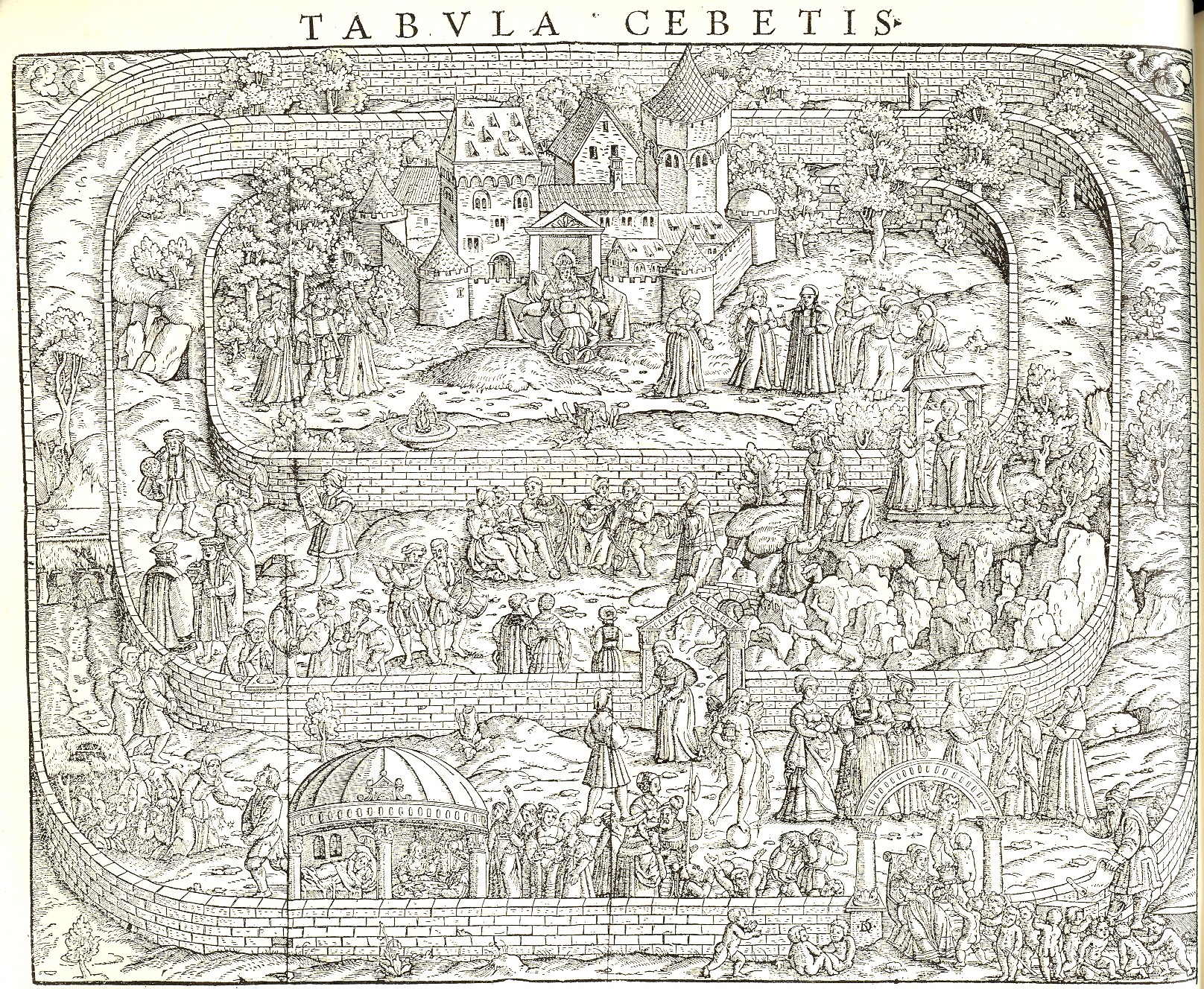
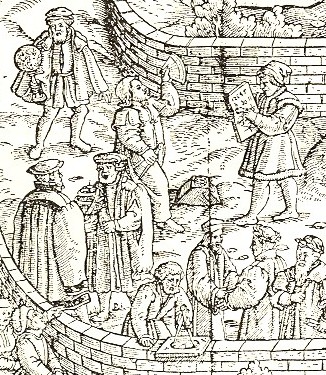
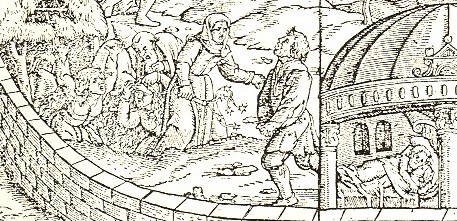
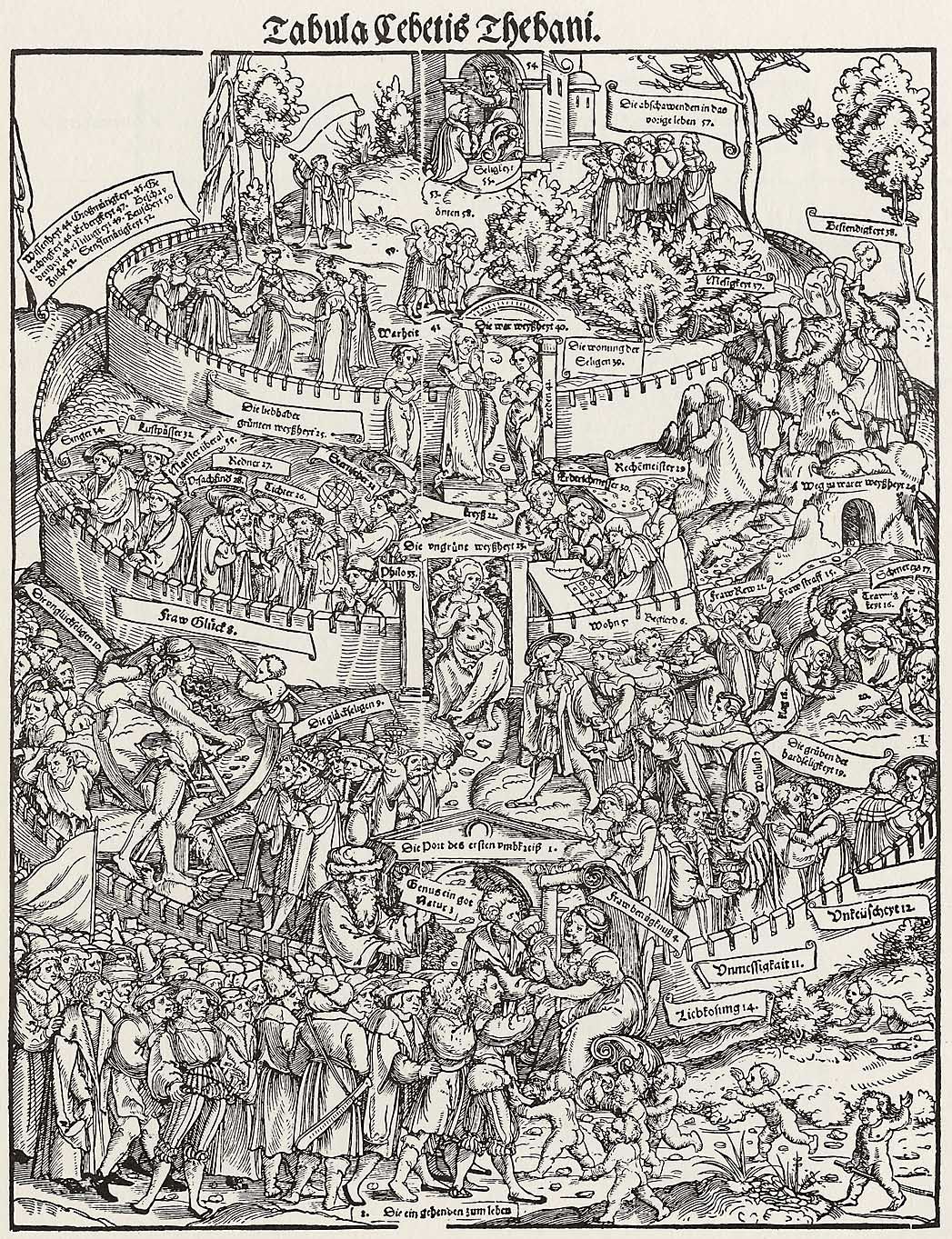
    This remarkable woodcut appears in Epictetus’ Enchiridion (1563), and is one in a long history of images portraying the moral life of humanity.  The longitudinal study of birth, corruption, vice, penance, achievement, want, lewdness, cowardice, sloth, and a penetrating multiple visits of the seven deadlies was intended to show the rough rode that lay ahead of us all on the way to the crowning glory.

    The full image appears below, with details following:

    Mar 9 life

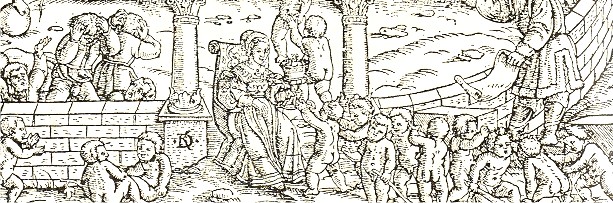
    This is a detail from the lower right, showing the beginning of life, an abundance of babies, with the foot of Fortuna seen at upper left, she observing (or not) the toddlers’ advances along the walls of life. 

    Mar 9 life beginning 

    The achievements of middle life are clearly seen:

    Mar 9 life middle age

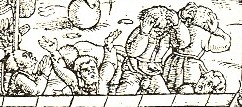
    As are the temptations of immoral life and the sins that await:

    Mar 9 life punishment

    Unfortunate sinners turned away at the foot of Fortuna:

    Mar 9 life punishmen2t

    And at the end of the journey, following the three concentric walls leading to finality:

    Mar 9 life end2t 

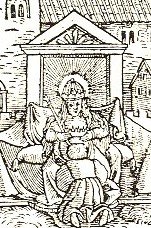
    This image looks a little suspect, but when you look at other woodcuts of the Tubula you can see this action a little more clearly (and from the side)–and what they reveal is Mother Church rewarding the supplicant with a crown.  This is more clearly seen below, in the 1551 versin of teh morality play by Johann Kramer (and published in Munchen);

    Mar 9 tabula

    The interpretations of these images areas varied as each of their characters, the details of which can be explained one way one day, and another the next; the morals and the end-tale stay the same. 

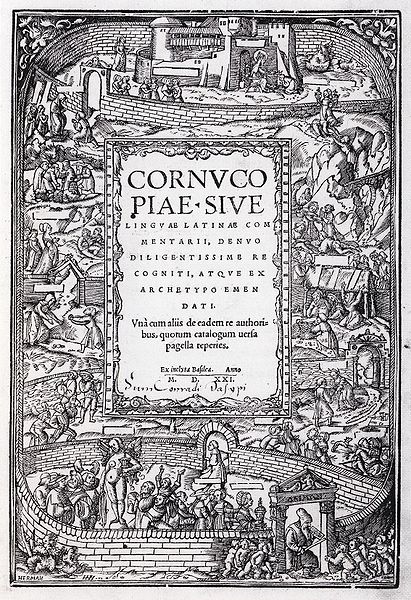
    Another example, this one from 1521 and after a work by Hans Holbein:

    Mar 9411px-Tabula_Cebetis_B,_woodcut_after_Hans_Holbein_the_Younger

    ·Posted by :

    ·in:

    — — —

  • Medical and Liturgical Cardiac Pathology, 18th Century: Scarpa & Senac vs. the Throne of Satan

    JF Ptak Science Books LLC  Post 952

    0--heart of man 1 It is a bit odd to compare these three relatively contemporary
    works on the human heart and to see their points of correlation and (vast)
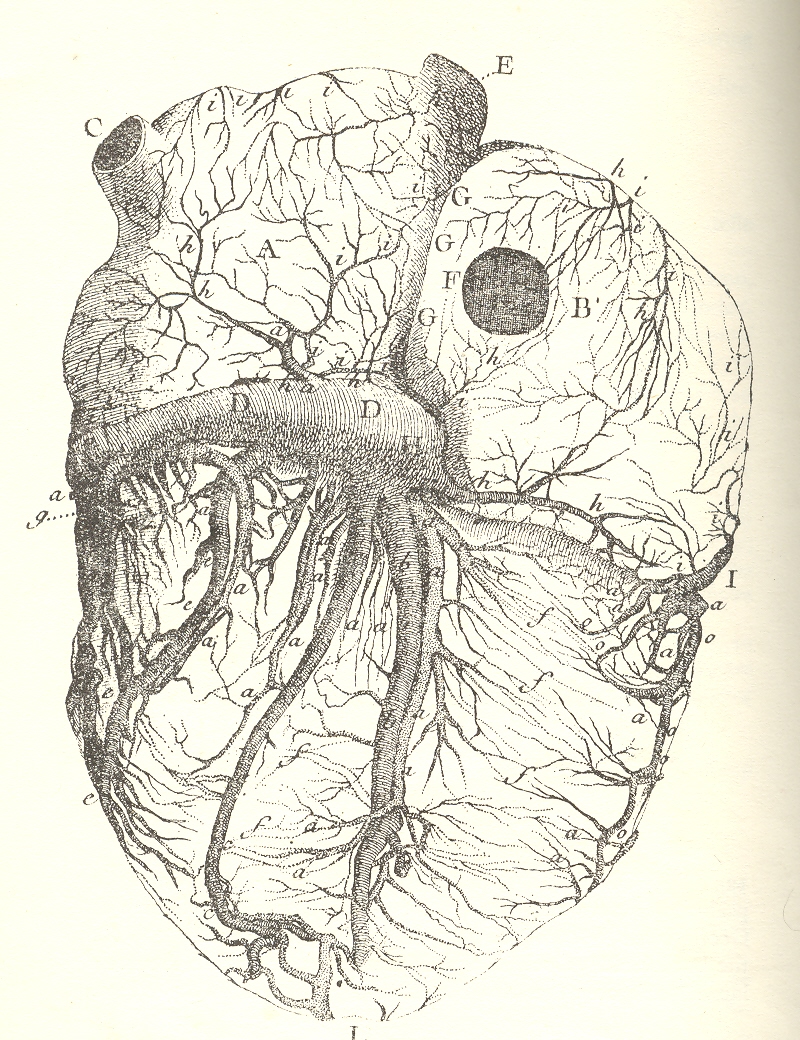
    departure. The first belongs to Jean Senac, whose Traite de la Structure de Coeur…(published in 1749) was one of the
    most valuable works on the 18th century on the heart, laying a firm
    foundation for the study of its pathology. 
    Senac

    Senac  

    (1693-1773, born in Gascony
    and later physician to Louis XV) was the first visitor to many aspects of the
    heart’s physiology, describing delation (as the most common evidence of cardiac
    pathology), correlated hydrothorax with cardiac failure, pericarditis, and much
    more—he also published exquisite illustrations by Jacques Poitier to accompany
    his text.

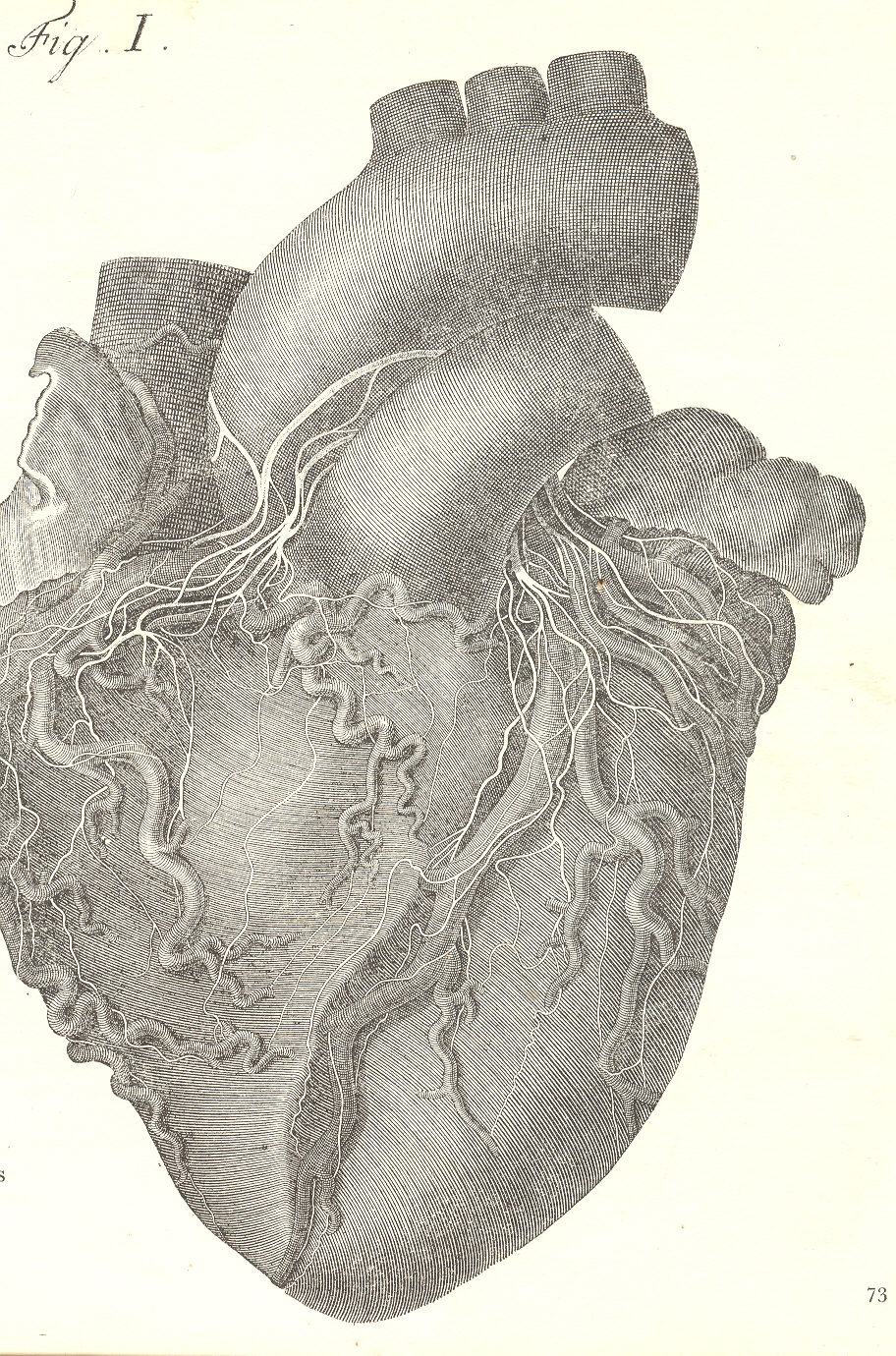
    The next image is the first to properly describe the nerves
    of the heart, and was published in the magnificent Antonio Scarpa’s Tabulae neurologicae ad illustrandam
    historiam anatomicam cardiacorum…
    in 1794. 
    Scarpa was a monumentally

    Scarpa

    accomplished anatomist who was also a gifted
    artist, and it is his own work that illustrates this masterpiece.  The original edition of this work is huge,
    atlas-sized, and the images of the heart are life-size and float in plenty of
    free, very wide and perfect margins.


    On the other end of the spectrum we have this liturgical
    philosophical anatomy of the stages of the heart in grace and disgrace.  Mostly I’m interested in the foul part, which
    shows the advanced mortification of the organ in seating the throne of Satan. The
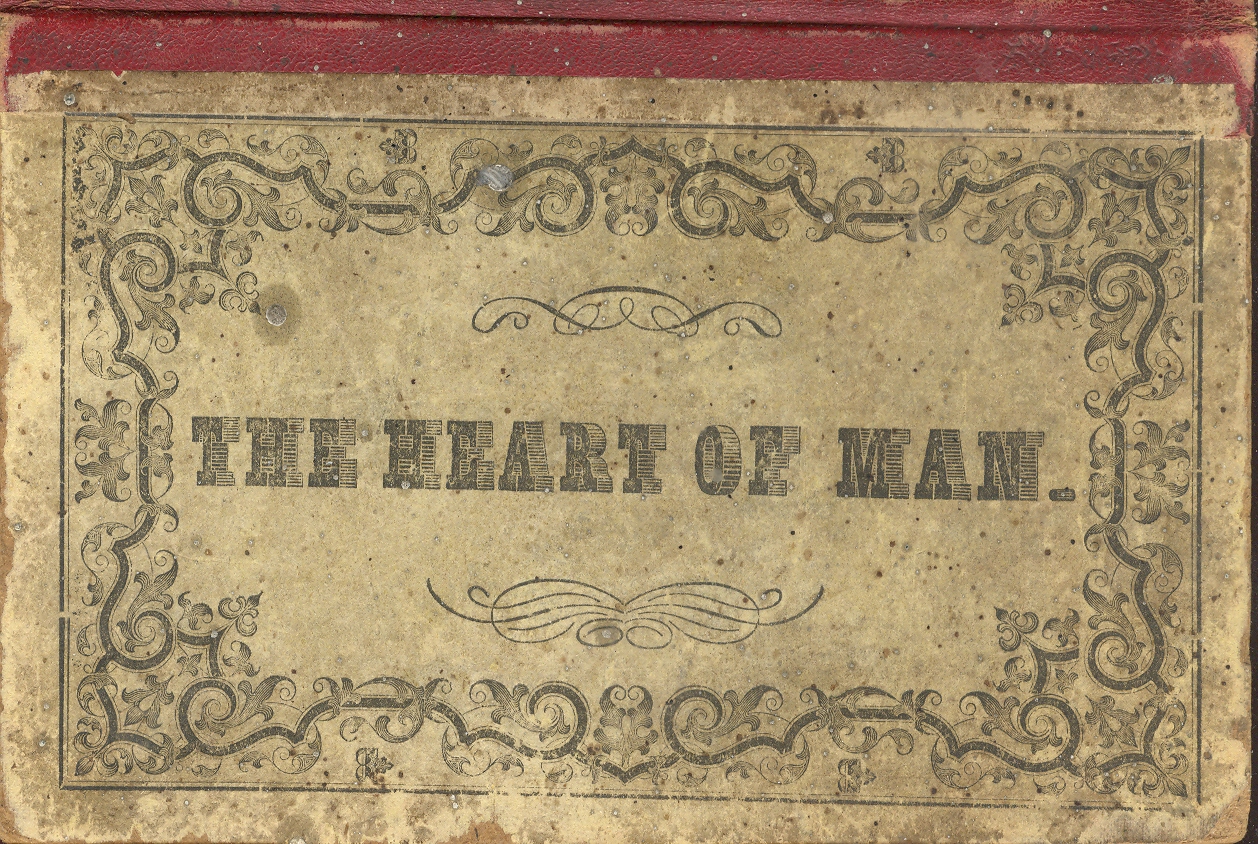
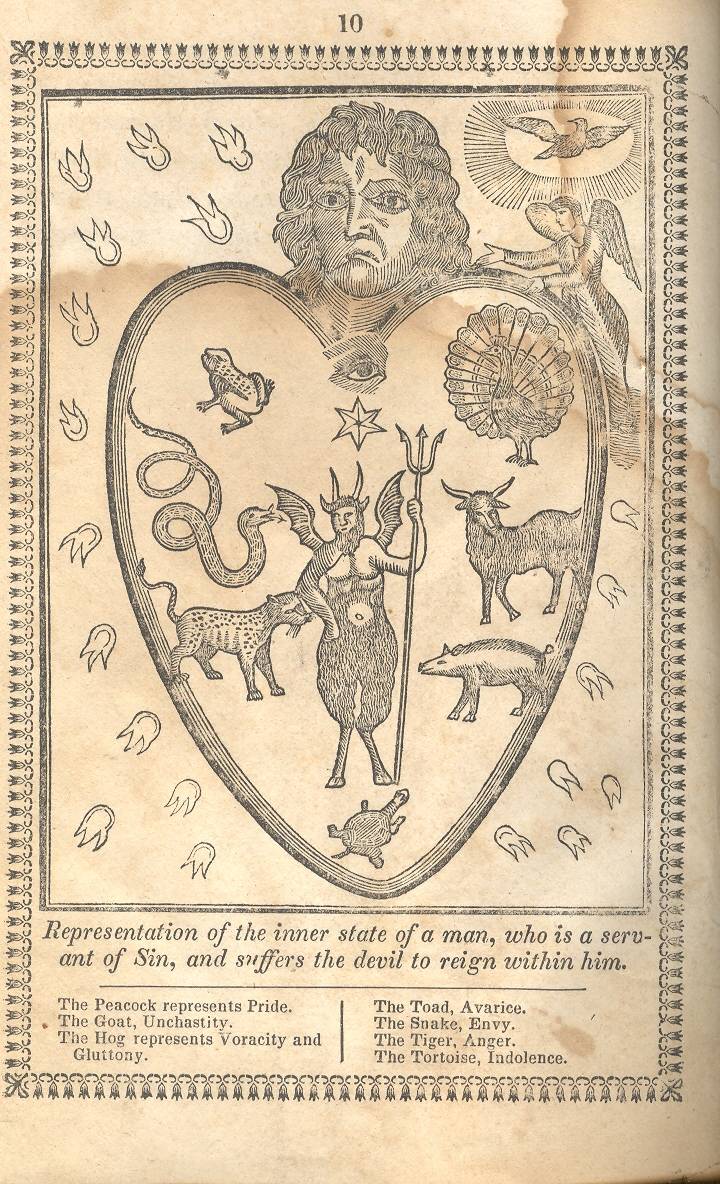
    edition here is The Heart of Man, either
    a Temple of God or the Habitation of Satan1,
    and
    is a very heavy-handed 1842 illustrated edition from Harrisburg (PA) version of
    a French text of 1732.  It is illustrated
    with ten versions of the state of the heart, ranging from perfect grace to the installation
    of the Beast, and several points in between, the degrees of gaining and losing
    each station. 

    0--heart of man satan 1

    The first image shows the heart of man completely dominated
    by Satan, with Man the sinner’s troubled face (along with the mark of Cain (dominating
    his wayward organ.  The emblematic
    animals infesting his heart include the peacock (with its misleading
    haughtiness), goat (“a lascivicious, stinking animal” representing “unchastity”
    and impurity), hog (gluttony and intemperance), snake (seducer), tiger (cruelty
    and ferocity) and tortoise (indolence). They chase from the hear the holy ghost
    and an angel, and allow the presence of Satan (front and center). 

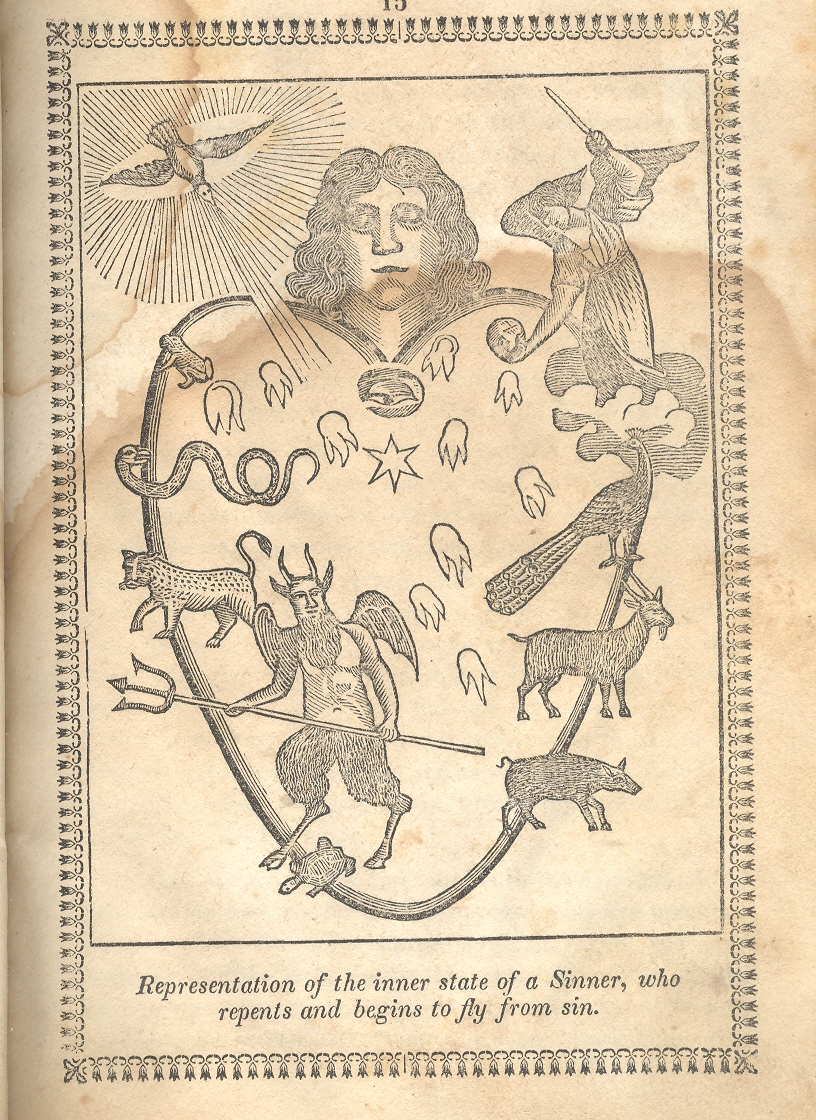
    The second image is interesting in that it shows the
    movement of a bad/evil/wicked heart to a more pious one, though it is just in
    the transition stages.  In my experience
    it is uncommon to see an emblematic illustration of a half-way point of, well,
    anything; this woodcut seems to capture, to be a snapshot so to speak, of the
    human heart undergoing transformation. 


    Notes:0--heart of man satan 2

    1. The original title was something along the lines of Spiritual Mirror of Morality, in which every
    Christian, who desires his salvation, may view himself, know the state of his
    soul, and profitably learn to regulate his life according to it
    . Hardly gender-neutral,
    the title makes four specific gender references to men. 

    ·Posted by :

    ·in:

    — —

  • Found Dadaist Art–Floating Eyes and Ears, 1650 & 1807

    JF Ptak Science Books LLC Post 857

    Dada found--tp I’ve
    written a few times in this blog (here, here and here) about what I think is
    found/unintentional antiquarian Dadaist art and would like today to continue
    that thread with the following two unusual pieces of art.

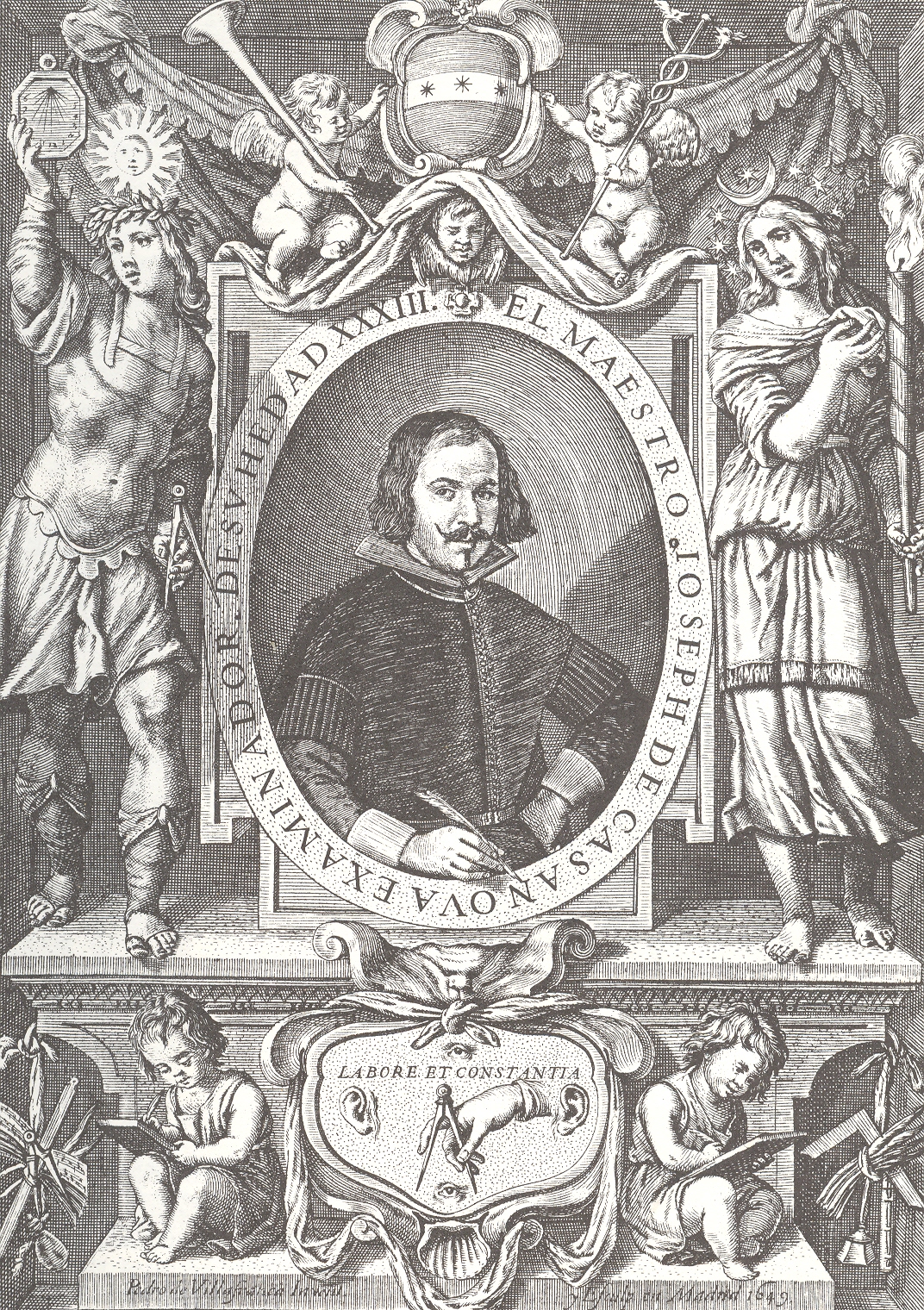
    The first
    is a detail from the title page of Joseph de Casanova’s Primera parte del
    arte de escrivir todas formas de letras
    (1650). This is not the Casanova (Giacamo,
    1725-1798) who most people would initially think of—the seductive womanizer of
    the 18th century—but another, earlier, Spanish Casanova (1613-1692)
    who was important in the history of round hand script and the lettera bastarda.  Joseph Casanova ‘s evolutionary handwriting
    style was considerably lighter and easier than most styles, and his influence
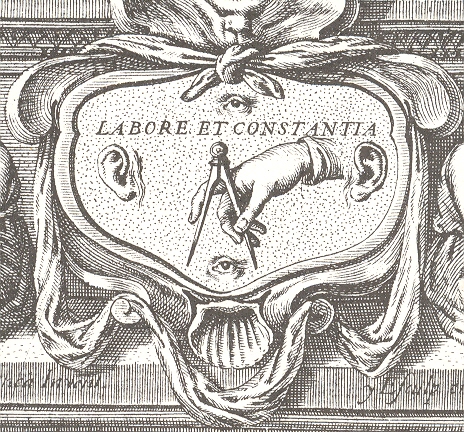
    in changing handwriting practices was substantial.  What is interesting for me is the detail at
    the bottom of the engraved title page for his book, the emblem containing  “Labore et Constantia”.  Labor and consistency, decorated with a hand
    and compass, ever watching and listening with ears and eyes above and below.Dada found--tp detail

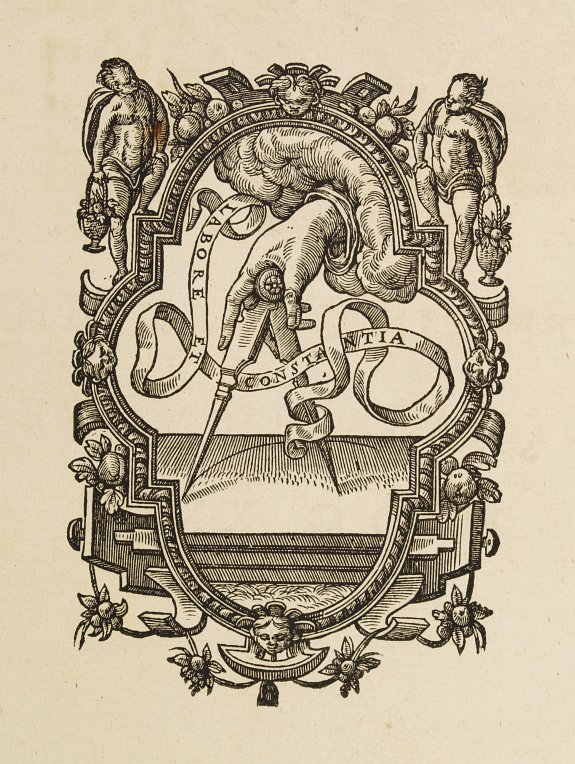
    [This
    design comes from (at least) one earlier source—the printer’s device for Christoph
    Plantijn (Antwerp,
    1583), though without the eyes (below).] I like the floating aspect of the disembodied
    body parts, floating in their little sea of constancy, ruled by a compass. 

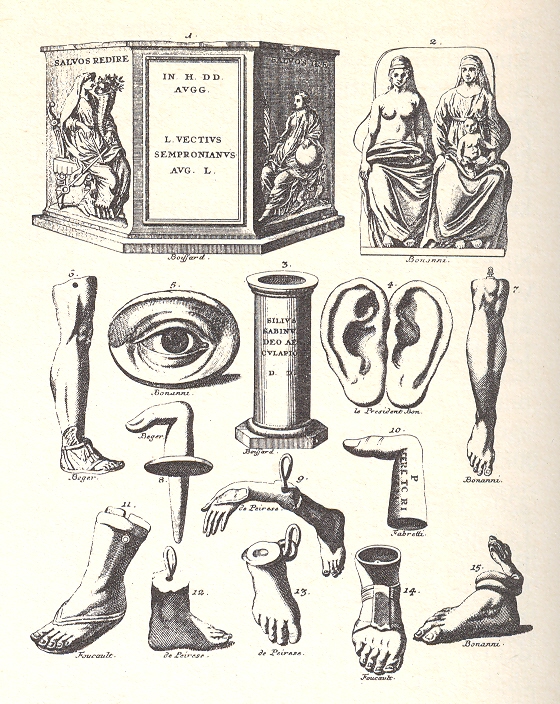
    Dada found--multiples  The
    second image has another set of disembodied eyes/ears (among other things) and
    has all the flavor of the dada/surrealist flourishes of the frammenti of Piranesi.
    This comes from Bernhard von Montfaucon’s Greichische,
    Romische und andere Alterthuemer…
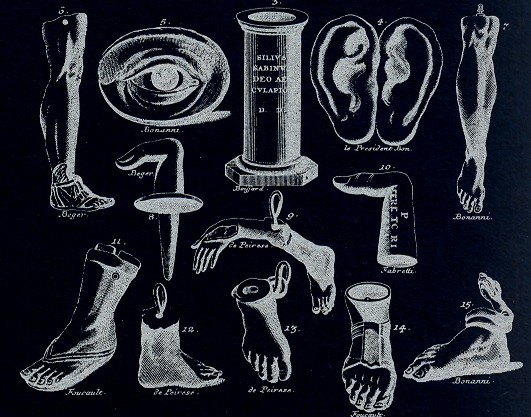
    (Nurenberg, 1807). When taken out of
    context, as a disembodied image, the von Montfaucon certainly has a dadaist taste
    for me, especially if you edit the image a little.

    Dada-found labore 

    Dada found 2--multiples