A Daily History of Holes, Dots, Lines, Science, History, Math, Physics, Art, the Unintentional Absurd, Architecture, Maps, Data Visualization, Blank and Missing Things, and so on. |1.6 million words, 7500 images, 4.9 million hits| Press & appearances in The Times, Le Figaro, Mensa, The Economist, The Guardian, Discovery News, Slate, Le Monde, Sci American Blogs, Le Pont, and many other places… 5000+ total posts since 2008.

Category: Iconography

  • Beautiful Title Pages 6: Losing Your Head—St. Denis and the Cephalophoric Title Page

    JF Ptak Science Books LLC   Post #90
    Blogtphead_off096

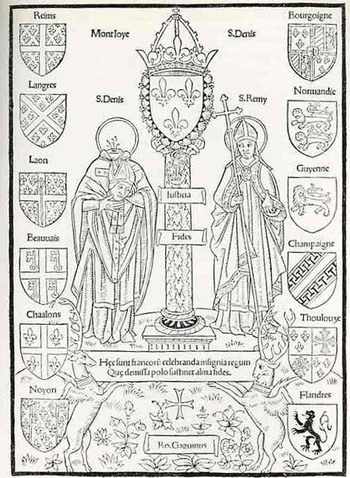
    Robert Gaugin (1433-1501) produced this fabulous illustration for his Compendium de origine et gestis Francorum, a 180-leaf history of France, printed in Paris in the second week of 1500.  (This is actually the fourth edition of this work which first appeared in the year 1495, which would officially make it incunabula.)

    St. Denis and St. Remy are pictured here standing on either side of a column supporting the fleurs-de-lys, and surrounded by the coats of arms of various French cities and provinces. 
    Blogtphead_off096_det

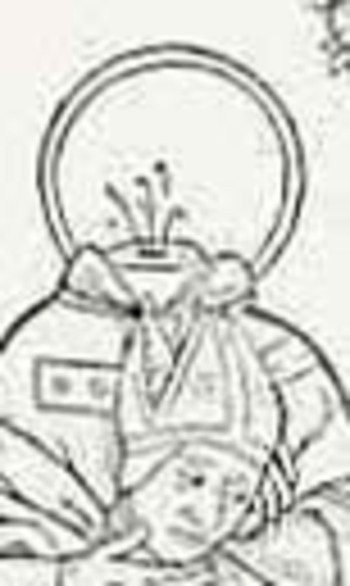
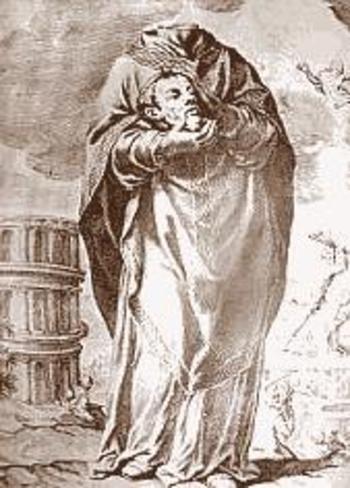
    So far as I can limitedly determine this is the first title page featuring a headless, or decapitated, human.  And that human is St. Denis of Paris, also called Dionysius, Dennis and Denys, the third century bishop of Paris who was martyred about the year 250.  It is said that after being beheaded by the Romans at the highest point in the city of Paris (now known as Montmarte, “mount of the martyr”), Denis picked up his head, held it in his hands, and walked two miles in this fashion, preaching all the way.

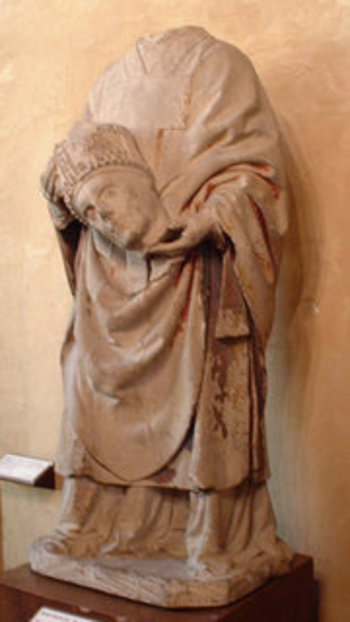
    St. Denis however was not the only beheaded person to carry his head, nor was he anywhere near being the only saint to do so. As a matter of fact there is an entire category of saints who carried their heads following beheading, called Cephalophores.  This special class of saints
    Denis_bertrand

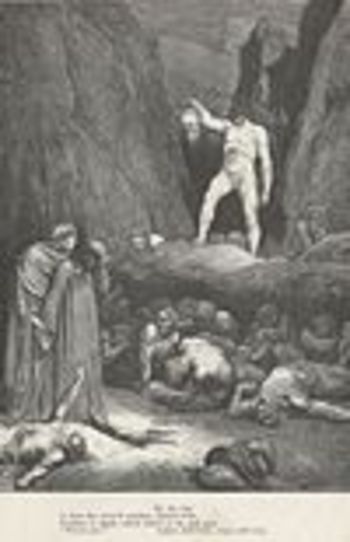
    include Paul of Tarsus, Saint Ginés de la Jara, Saint Gemolo , Aphrodisius of Alexandria, (pictured below)  Nicasius of Rheims,  Cuthbert of Lindisfarne and Oswald of Northumbria, while others of this category though not saints include Lucian of Beauvais, Nectan, , Osyth, Quiteria, Winefride and Wyllow. Cephalophores also make many appearances in literature, most notably in Dante’s Inferno (8th Circle, Bertrand, pictured left) St_denis_2
    ) and in Sir Gawain and the Green Night. St_denisaphrosdius

    But none I think appear on a title page of a book earlier than this 1500 example of St. Denis.

    As a very occasional note, St. Denis is pictured here with one halo–sometimes he has two. 

    ·Posted by :

    ·in:

    — —

  • Beautiful Title Pages 5: Chocolate, Morals and the Birth of the British Museum

    JF Ptak Science Books LLC   Post #89
    Blogtpchocolate095

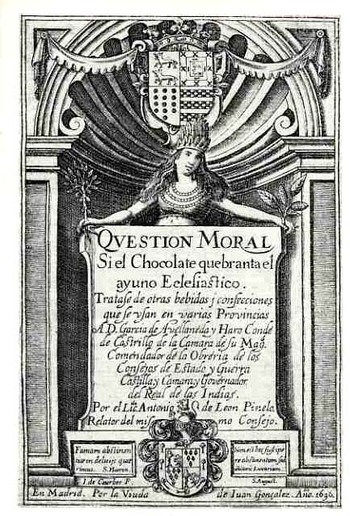
    This lovely title page is from the book Question Moral Si El Chocolate Quebranta El Ayuno Eclesiastico, (on the Moral Question of Chocolate…), printed in Madrid in 1636, and said to be the first book on American drinks.  León Pinelo. a Spanish-colonial historian (1589 – c. 1675), born in Cordova de Tucuman, (Argentina),  and educated in the College of the Jesuits of Lima (Peru), and then leaving for Spain by 1612, where he wrote this (and other) books.   HE was a significant scholar and an accomplished bibliographer, and compiled a very extensive dissertation upon the history, uses, preparation of chocolate, as well as other drinks in general of the Americas, touching on concoctions of Indians of New Spain, Peru, Nicaragua and Guatamala. 

    The title page is very dimensional, with the central figure, an Indian woman holding the scroll of the title, with a miniature coca tree in one hand and a four-leaved branch from the cocoa tree in the other. 

    Leon Pinelo in no way “created” the chocolate drink, but he was the first (and extensive reporter of it and certainly remained it most extensive annotator of the drink for centuries. Columbus was aware of the drink by his fourth voyage in 1502 but said relatively little about it.  The Aztecs had been using the cocoa been for a thousand years before that.  (It has been remarked that the drink was so extraordinary and special that it was served in one-serve golden goblets that were disposed of after the chocolate was consumed). 

    Perhaps the great King of Chocolate though was Sir Hans Sloane, who in addition to much else he did in his life traveled to Jamaica, where he assembled a fabulous plant collection for shipment back to England.  He also “discovered” chocolate there, improving the native presentation of the drink (which he evidently found to be nauseating) by perfecting a milky solution with it—and *that* it was brought great wealth to Sir Hans.  With that wealth Sloane continued to add to his extraordinary collection of natural artifacts, amassing one of the greatest cabinets of curiosity in England and the continent.  In addition to his own collecting and minor purchases Sloane used his chocolate money to purchase the fabulous collections of  William Courten (who, for example was an extremely wealthy Brit who financed the colonization of Barbadoes among other things before finally going bust), James Petiver, Nehemiah Grew, Leonard Plukenet, the Duchess of Beaufort, the rev. Adam Buddle, Paul Hermann, Franz Kiggelaer and Herman Boerhaave.  Death’s dance found Sloane in 1753, who left his entire collection to England, and it was this bequest that formed the opening, golden, sagacious nugget of the British Museum. 


  • The Big Cycle—the Beginning and the End of the World and the Weight of All Things, Depicted 1445-1550.

    Blogcyclethe_endJF Ptak Science Books  Post #82

    (1)  The End

    I came to this post through the interest in an image that shows life as we know it in its very last teetering stage, at the crystalline moment just before the bullet hits the bone, just before the wave breaks, just before the shade swallows the light.  The image is incredible, seemingly far beyond the reach of the 15th century, far above its naïve absolutism, showing a tower of water, the oceans risen from their depths and towering over the mountains, just before the cascade and inundation begins.  It is by Antoine Vérard  and was published in 1493/4 in André Bocard’s (b. 1453)   L’Art de bien vivre et de bien mourir .  Those little poking-out bits are indeed fish, the sign of life and the aymbol for Christ in that unimaginable column of Earth-killing water, one of the Christian indicators that the Judgment Day was near.  Actually I think that we’ve moved far beyond Judgment at this point, and that the print shows the watery effectuator of the warnings and promises heaped down on the readers of Revelations and Apocalypse, among other things. 

    (2)  The Beginning
    Blogcyclebosxc_beginnng
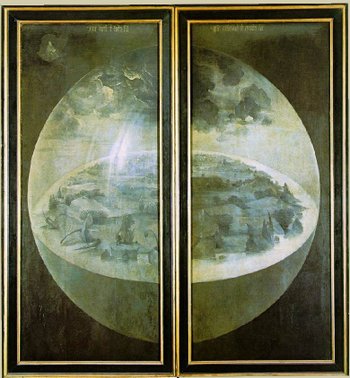
    I love this painting by Bosch showing the creation of the universe , mainly because we associate the hyper-imaginative old man (Bosch, not God) with dripping and dire images of the other end of the space time continuum.  This view of the cosmos is quiet and benign—Bosch to me seldom *waits* for things to happen, as in this painting, which seems all about anticipation and possibility.  The canvas is empty, quite unlike the very full, kinetic, no-time-for-reflective-action images that we usually associate with this painter.

    (3) The Beginning of the Beginning and the Beginning of the End.

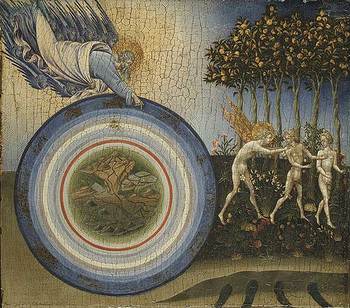
    The Bible is a relatively long book, but the space between creation and the (quick?) ultra-final desiccation of Paradise happens in such short word-distance from one another that you can barely get comfortable in your chair before the race to the end begins.  (My wife Patti Digh says that this action is so quick because we need forward action in the telling of the story—we need the wolf to make Little Red Riding Hood more interesting.) 
    The painting, Creation of the World and Expulsion from Paradise, is by Giovanni di Paolo, and was completed in 1445.
       Blogcycledi_apolo  
    The expulsion part was particularly gloomy for all non-human things because, as I am told, it is from this point (day?) forward that animals no longer live in harmony with one another, and that their vast majority is made to eat each other, consuming each other for energy sources, in a vast, incredible orgy of killing and death.  That’s quite a price to pay for human insouciance.  It seems to me that if you added up the weight of everything on earth that killed other living things for energy versus the weight of everything else gaining energy from the sun or chemically or whatever, that the later would compose only a fraction of the killers’ weight.  (As Gus McRae says in Lonesome Dove,”the Earth is just one big boneyard”. 

    One interesting part of this painting is di Paolo’s depiction of the nine spheres of creation, which he depicts in eight.  (The earth at center, followed by the elements   water, air, and fire, then the moon and planets, then the fixed stars with signs of the zodiac, the primum mobile and finally the undefined Empyrean heaven, the place where God and all of its components sit.  Perhaps di Apolo felt that he could not contain the Empyrean, and so left it unbounded.

    (4) The Cycle of Cosmic Life
    Blogcycle_of_life_eden_4
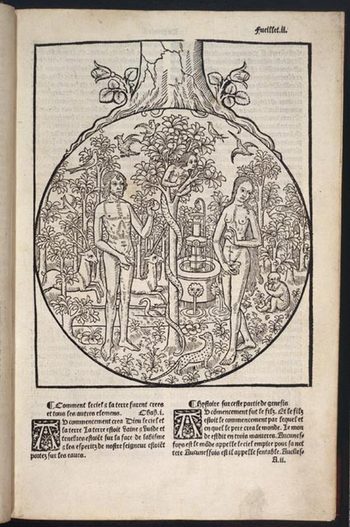
    This interesting woodcut by Antoine Verard in his French Bible of 1517 shows Adam and Eve in the Garden in the opening moments of Genesis, its incubating sphere seemingly at the root of a great tree, which, for all  of its great beauty, seems backwards. Perhaps the message would be different if you put the Garden at the top of the tree, the tree of life; having the garden and its quick demise (where did the garden “go”, anyway?) seems to symbolize death at the root of all that followed the expulsion, as great trees all wind up lichen-bait at some point.

    (5)  The Cycle of Life on Earth

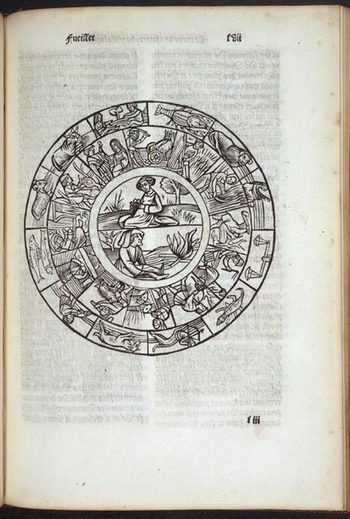
    This wonderful woodcut from Jean de la Garde’s  The Heart of Philosophy (1504)—an amalgam and witches brew of hermetic and astrological texts and conjectures—and is perhaps the most brilliant of the sixty-two woodcut illustrations in the wide-ranging, over-reaching book.  The complex message here shows the influences of the earth and cosmos on the life of humans, the astrological signs and symbols of the seasons and etc. all bearing down very hard on the flower in the lap of the woman at the center of it all. It just seems so odd that there should be so much forebearance and such an extraordinary concentration of effort to be brought to bear against a solitary womb.  With all of that reigning down on us, I wonder how it is that we are expected to breathe?
    Blogcycle_of_life_life_2

    ·Posted by :

    ·in:

    —

  • Digital “Computers” 1450-1750: Memory and Calculating on the Fingers and Hands

    JF Ptak Science Books Post #81  (Expanded)

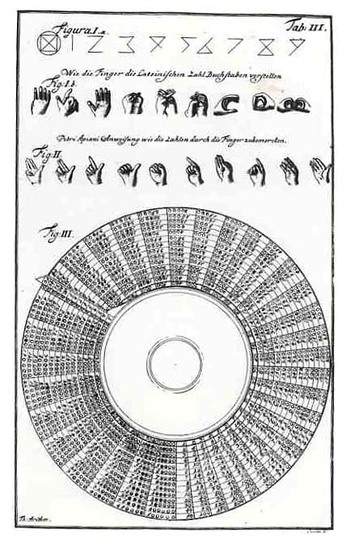
    Bloghands_memory072_2
    These lovely images weren’t intended to show people living in the Renaissance and Baroque eras how to actually record data on their hands—they were intended rather as templates to show how they could use their fingers and hands for calculating and as memory devices.  Much like Frances Yates has shown us so beautifully in The Art of Memory and how info and data was stored in imagined and compartmental palaces in the mind (relying upon images), the hands were also used as a theatre of memory in addition to extended calculation. 

    These mnemonic devices were necessary—especially during the Renaissance—because of the general lack of and access to affordable vellums or paper and writing instruments.  Having notebooks filled with memoir or history of calculation was generally not something that was happening for even the not-wealthy but not struggling class.  These mental images were used widely in the areas of religion, palmistry, astrology mathematics, astronomy, astrology, alchemy, music, and other such fields. 
    Bloghands_big074_3

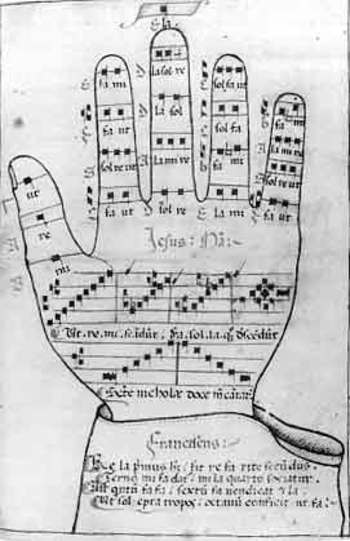
    The first image (from a German manuscript) of the hand-theatre was found and deciphered by Claire Richter Sherman (Folger Shakespeare Theatre) and is religious in nature, an intentional piece of memory for the devoted and for devotions.  The needs of religion were splayed out as the hand was opened and fingers flexed, and working from thumb to pinkie, from finger tip and joint—“do God’s will, examine  your conscience, repent, confess”, and so on, and above all be content with your lowly penitente stature.  If there were 28 of these admonitions or reminders at different points of the hand and you memorized them all, it would be a much simpler time to recall and keep them in order if you merely had to touch a part of your hand where that memory should be to invoke what it was you were supposed to do.  Therefore you could theoretically cast about with your creator with your hands in your pockets—if you had pockets. 

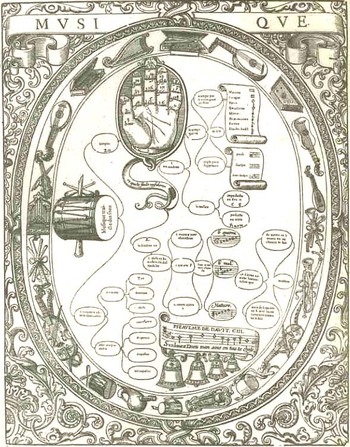
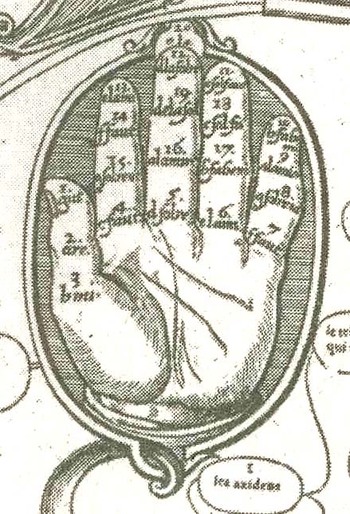
    The next two images (including the enlargement of the hand section) are from a work from 1587 entitled Musique and are attributed to John Cousin the Younger (1522-1597).
    The basic premise for this device—it seems to me—was to be able to order the different chords of 20 different instruments. 
    Bloghands070_2

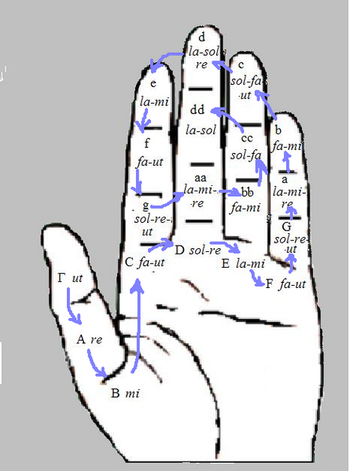
    Another musical hand mnemonic was the Guidonian hand, a survivor of Medieval times, and possibly named after Guido of Arezzo (a musical theorist), and was an aid to singers learning to sight sing.   

    The entry for the Guidonian hand in Wiki explains it use rather well:  “The idea of the Guidonian hand is that each portion of the hand represents a specific note within the hexachord system, which spans nearly three octaves from “Γ ut” (that is, “Gamma ut”) (the contraction of which is “gamut”, which can refer to the entire span) to “E la” (in other words, from the G at the bottom of the modern bass clef to the E at the top of the treble clef). In teaching, an instructor would indicate a series of notes by pointing to them on their hand, and the students would sing them. This is similar to the system of hand signals sometimes used in conjunction with solfege…”
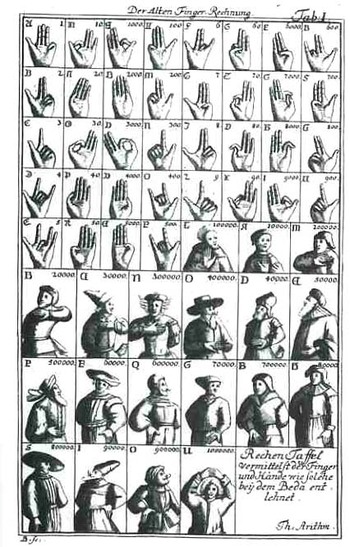
    Bloghands_bodies071

    The final two examples come from Jakob Leupold’s  (1674-1727) Theatrum Machinarum (1724)—this was a complex work involving nine sections and addressed the theoretical  aspirations of engineering (load, flexure, that sort) and its applications to its daily practitioners.  In one section of the book he sought to explain the connections (and correlations) of hand motion and symbolism to the origins of the number systems, carrying it out further still into body language, so that two people conversant in these symbols could talk and bargain between themselves in economic/body terms.  Barbara Maria Stafford, in her Artful Science, Enlightenment,

    Bloghand_guido

    Entertainment and the Eclipse of Visual Education (1994) points out the long history of this tradition, and that it reached far back into misty time:  Leupold knew that Appian, the Venerable Bede, and Aventinus had been fascinated by manuloquio, or natural language with the hands.  He thus linked counting to a global….medium of prearranged gestures…”

    Bloghandguido_2_2


    ·Posted by :

    ·in:

    — — —

  • Science and Art; True Science or Science Fiction? #1: Tinguely, Oliver Byrne, Vredeman de Vries and the Theatrophone

    JF Ptak Science Books   Post #79

    Blogrealtinguely
    There are encyclopedias to be written on the not-obvious in the history of science, dictionaries of “what is it”, codexes of “is that real?”, handbooks to distinguish things that look like scientific apparatus but are actually works of art, and vice versa. This is my first installment looking at the occasionally squishy visual line that distinguishes images that are “true” scientific creations from those that are not. 

    Case #1.  FALSE 
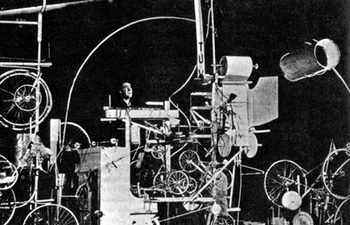
    Our first example comes from Jean Tinguely (1925 – 1991)  a Swiss painter and sculptor, best known for his Dadaist kinetic sculpture, officially known as metamechanics. This photo shows Tinguely in the midst of trying to make his self destructing sculpture, Homage to New York (1960), self destruct. His collection of wheels and cogs and connected motors and techno bric-a-brac, which in their way stood for the embarrassment of overproduction and  self-satisfaction with material goods, embarrassingly failed to self destruct during its unveiling at MOMA.

    Blogrealbyrne
    Case #2. TRUE.
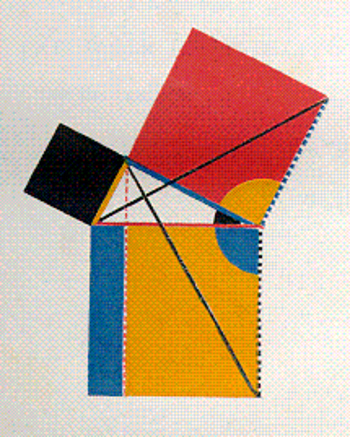
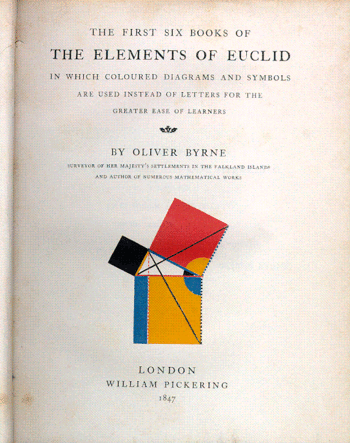
    Oliver Byrne’s semi-insane but gorgeous interpretive work of the first six books of Euclid  published by William Pickering in London, is problematic.  Byrne’s use of color in place of letters in defining and explaining the propositions just doesn’t work very fluidly–it is a great, perhaps the great, example of something that is visually pleasing, beautifully rendered, and sort of functionless.

    Blogrealbyrne_tp
    Blogrealtelegraphone_2

    Case #3. TRUE
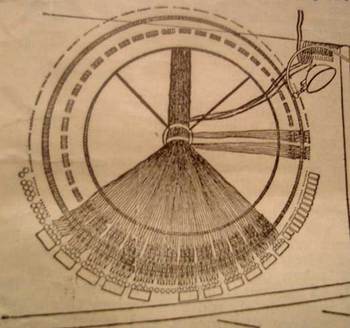
    This is the distributing board of the central London “theatrophone”, a telephone relay device that “broadcast” theatrical and symphonic productions to telephone subscribers.  The idea is base on installations of this device during the International exposition in Paris in 1881.  The article appears in Scientific American, Supplement No. 1002, March 16, 1895.  The second image is the switchboard in the central office of the Theatrophone Company.


    Blogrealvredmanbw_2

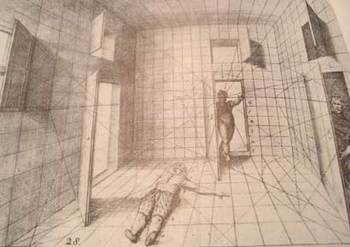
    Case #4, TRUE:  Hans Vredeman de Vries (1527 – c. 1607),a Dutch Renaissance architect and engineer, produced a superb book on perspective in 1604, from which this image was selected.  Of course we manipulated it a little in p-shop, dumping it into mosaic, cheating a little, but, well, there you have it. Vredeman’s production was luscious and smart, and was highly utilized and prized for hundreds of years as a
    useful tool in determining perspective.  It’s a mysterious image, bizarre, even–why, for example did the humble artist use a prone/dead/injured human there on t he floor when he could’ve selected something more benign? The odd figure entering the room through the secret door adds to the general threatening atmosphere of this interesting image.  Base line though–it is undeniably an excellent instructional on drawing with perspective.


    ·Posted by :

    ·in:

    — —

  • Beautiful Circles in Science #1: the Astronomy and Cosmology of Fontenelle and the Plurality of Worlds, 1686.

    Blog26apfontenelleJF Ptak Science Books Post #69

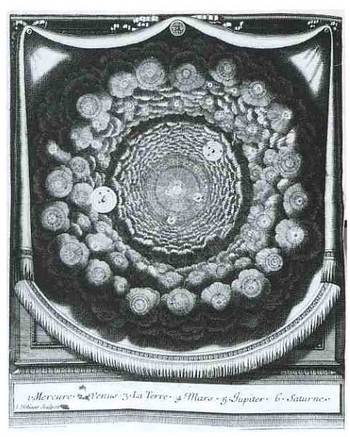
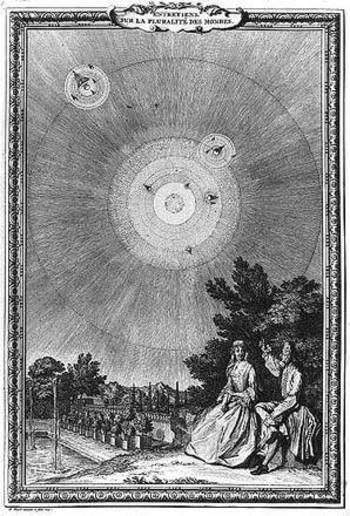
    This first lovely image belongs to Entretiens sur la
    Pluralitie de Mondes
    (Conversations on the Plurality of Worlds), written by the
    great French philosophe Bernard le Bouvier de Fontenelle in 1686 (just a year
    before publication of perhaps the greatest work in the history of science, Newton’s Principia
    Mathematica
    ). The Plurality was a
    best-seller by the best-selling Fontenelle. An excellent attempt by a rather
    restricted writer to engage the population-at-large, writing a high-pop book on
    what was basically the history of astronomy and cosmology of the preceding
    century. Copernicus was a major feature
    of his imaginary conversations with a muse as he wandered through a
    metaphorical garden of questions, with the observations of Galileo and Cassini
    also very prominently featured.

    Fontenelle’s Pluraltiy was amended, added to, and fattened
    up for a long time, the author adding material to it constantly for years to
    come—the book went through at least 33 editions during Fontenelle’s
    hundred-year-long life (1657-1757). This
    engraving was meant to be allegorical, illustrating a Copernican planetary
    system which was surrounded by galactic clouds comprised of other solar systems—prescient
    and forward thinking, as it wasn’t until the last 15 years or so that a solar
    system was discovered outside our own. (This until recently was a tremendously difficult
    feat to accomplish—instrumentation and practices now are advanced, but it is
    still an extremely difficult task to locate extra-solar system planets and
    systems.) 

    Plurality
    What makes this engraving so particular and attractive to
    me, and the reason why it is listed first in this series of scientific circles,
    is because of its beauty and “deep depth”. The artist certainly related the compound nature and depth of the
    universe, revealed to us from behind drawn curtains. Our solar system is featured prominently, with hosts of other solar systems borne on each puff of extragalactic clouds, reahcing, or descending, “all the way down Or up)”.  Fontenelle believed in the infinity of world
    and the enormous-by-reason possibilities of the universe, as we see in this
    extra from Plurality:

    I shou’d think it very strange, that the Earth shou’d be inhabited as it is;
    and the other Planets shou’d be so entirely desolate and deserted: For you must
    not think, that we see all the living Creatures that inhabit the Earth. For
    there are as many several species and kinds of Animals invisible as there are
    visible. We see distinctly from the Elephant to the Mite; there our sight is
    bounded, and there are infinite numbers of living Creatures lesser than a Mite,
    to whom, a Mite is as big in proportion, as an Elephant is to it. The late
    invention of Glasses call’d Microscopes, have discover’d thousands of small
    living Creatures, in certain Liquors, which we cou’d never have imagin’d to
    have been there. And it may be the different tastes of these Liquors, proceed
    from these little Animals, who bite, and sting our Tongues and Palates. If you
    mix certain ingredients in these Liquors, (as Pepper in Water,) and expose ’em
    to the heat of the Sun, or let ’em putrefie, you shall see other new species or
    living Creatures. Several Bodies, which appear to be solid, are nothing else
    but Collections or little heaps of these imperceptible Animals; who find there
    as much room, as is requisite for them to move in. The leaf of a Tree, is a
    little World inhabited, by such invisible little Worms:
    To them this leaf seems of a vast Extent, they find Hills and Valleys upon it:
    And there is no more Communication between the living Creatures on the one
    side, and those on the other, than between us and the Antipodes.
    And I think there is more reason, to believe a Planet (which is so vast a Body)
    to be inhabited. There has been found in several sorts of very hard Stones,
    infinite multitudes of little Worms
    ,
    lodg’d all over them in insensible varieties; and who are nourish’d upon the
    Substance of these Stones which they eat. Consider the vast Numbers of these
    little Animals, and how long a tract of Years they have liv’d upon a grain of
    Sand. And by this Argument, tho my Moon were nothing but a confus’d heap of
    Marble Rocks, I wou’d rather make it be devour’d and consum’d by its
    Inhabitants, than to place none at all in it.”

    CONTINUE:

    ·Posted by :

    ·in:

    —

  • Graphical Display of Data—Picturing BIG Numbers, U.S. Aircraft Production in World War II

    JF Ptak Science Books  LLCBlogwwiiplanes

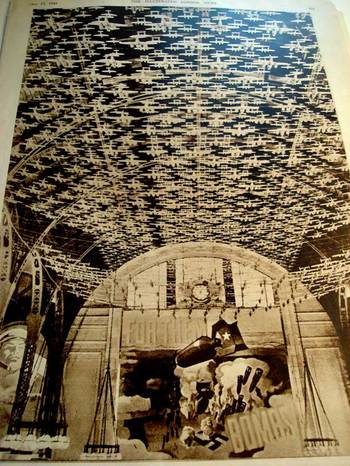
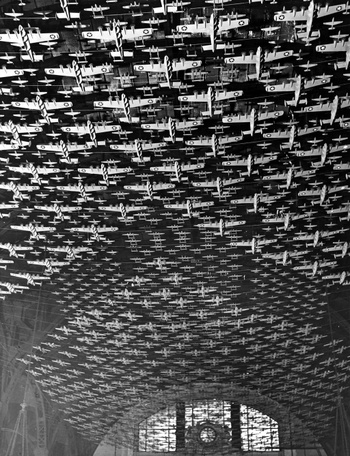
    This widely circulated and published photo appeared in 1942 (particularly in LIFE Magazine in 17 September 1942 and the Illustrated London News in the next month), and showed 4,500 aircraft models suspended from the ceiling of Chicago’s Union Station   It is the result of an inspiration derived from President Franklin Roosevelt’s assertion that America would produce 185,000 war-focused aircraft in 1942 and 1943. 

    The planes in this photo were hanging 60-feet above the floor of the station, with wing spans between one foot and four feet (for the bombers).  It was a fantastic, blustery, iconic effort to show what it meant to look at 4500 planes—and these paled in comparison to a drawing (which I unfortunately do not have) that appeared in the Illustrated London News on 21 February 1941, showing the entire production fleet of 185,000 aircraft—a column of planes one mile wide and 117 miles long.

    Blogworld_war_ii_airplanes_delano

    Using this photo then to interpolate that full production figure of 185k, you’d have to piece 48 of these photos together to show full production, or a version of this photo that was 8 inches wide and 32 feet long.  (The second image of Union Station and the planes is by FSA photographer Jack Delano.)


  • The Nature of Things & the Display of Information: Alhazen and Optics, 1572

    Blogoptics040

    JF Ptak Science Books LLC
    Alhazen, (pseudonym of Abu
    Ali Hasan Ibn al-Haitham), born in Basra, Iraq, and who
    lived from 965-1039, was perhaps the greatest of all the great Muslim
    physicists, and was also one of the greatest physicists with an interest in
    optics of all time. Considered to be “the
    father of modern optics”, he was an original thinker and an historian, an overall
    scientist,  preserving the ancient,
    accentuating the modern and creative in his own right.

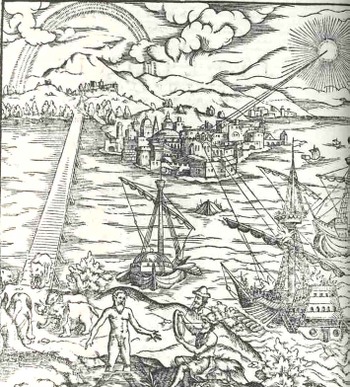
    The woodcut illustration—deceptively
    complex but rather simple once you focus– from his book
    Opticae
    thesavrvs. Alhazeni Arabis libri septem, nuncprimum editi. Eivsdem liber De
    crepvscvlis & nubium ascensionibus…
    demonstrates a number of optical principles–if
    you look hard enough. (The Opticae by the way was about the only one of his 200 or so books to have survived the destructive powers of time and neglect.)  In the foreground we see tow examples in the
    field of optics of keen interest to Alhazen. The man standing in the puddle up to his knees in water shows the
    distortion that occurs due to refraction (an area in which he greatly improved
    upon Ptolemy’s understanding) The guy to
    the right of naked knee-distorted man is probably using his mirror to keep an
    eye out on what was happening behind him (it looks as though the person he’s
    spying is not him but someone hiding behind the hillock). This small defensive use of the mirror pales
    in comparison to what was happening as a cause of mirrors directly behind
    him: the galleons are definitely being
    set ablaze by the Archimedean-like use of mirrors in the city on the far side
    of the harbor (like Syracuse), and we can see that one of the ships is already
    nearly sunken.

     The bridge (with the loitering
    elephants ?) is set to exhibit the knowledge of perspective, even though this
    is not the best example of receding background– it was through
    Alhazen
    that a very considerable part of that science found its way into Medieval and Renaissance
    culture, particularly in the artwork of  Ghiberti,
    Alberti, Leonardo, and later, Poussin.  Roger
    Bacon (13th c), Pole Witelo (Vitellio) and most of the other
    Medieval Western writers on optics based their optical work primarily on Alhazen’s
    work. ‘ (The use and choice of the
    elephant on the bridge is a mystery to me, particularly since we don’t see one
    on the other side of the bridge, which would’ve been helpful to illuminate the
    perspective bit.)  The rainbow in the background is there simply
    to remind us of the already well-known association of its formation and
    light. The
    setting sun might also hint at
    Alhazen’s discussion of the density of
    the atmosphere and the relation between it and  height—he would go on to discover that origin
    and breadth of twilight, the height of the atmosphere, and many other things
    back there one thousand years ago. This woodcut
    hints at only a few of his great achievements.


    ·Posted by :

    ·in:

    —

  • Beautiful Title Pages 1—Oswald Croll’s Chemistry, 1611

    Web_blogcroll3_2027_2

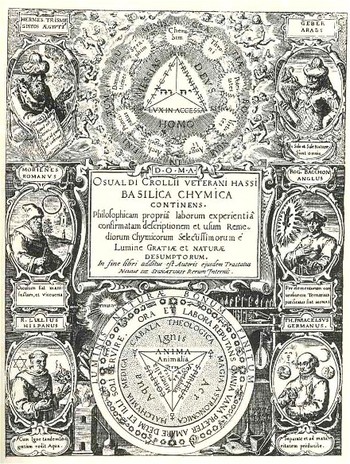
    Oswald Croll is a big name in the history of chemistry.  At a time where so many other Big Names were writing books about chemistry as a science, Croll wrote a scientific book of chemistry.  Paracellus, one of the greatest of these big names, wrote rather vaguely and in a sense secretively about his preparations and compositions, as well as their use and applications; Croll on the other hand writes in great and exhaustive detail about just such things that Paracelsus leaves out. 

    The title page to his Croll, Oswald. BASILICA CHYMICA. Continens Philosophicam propriam laborum experientiam confirmatam descriptionem et usum Remediorum Chymicorum Selectissimorum e Lumine Gratiae et Naturae desumptorum. In fine libri additus est Auctoris ejusdem Tractatus Novus De Signaturis Rerum Internis, was printed in 1611—probably two years after Croll’s death—and is a gorgeous display of allegorical and historical images. The allegorical parts are a bit out of my range, but the historical figures are easy enough (being identified!), and include Hermes Trismegistrus, Geber, Morienes, (the great) Roger Bacon, (the magnificent) Ramon Lull and Paracelsus.

    I like the Croll as the beginning of a series of images of beautiful title pages in the history of science.


  • Roe v. Doe & Great Anonymous works: Darwin, Newton, Malthus, Paine

    JF Ptak Science Books  Post 13

    There was a brief point in Charles Darwin’s publishing life when the old (then young) man got stiffed.   Darwin’s magisterial contribution to Narrative of the Surveying Voyages of her Majesty’s Ships Adventure and Beagle between the years 1S26 and 1836…, (published in 1839) appeared in the third volume,  (by far and away the most important volume), and was issued without his name on the title page, which as it turns out was okay by the standards of the day.  The real oddness turns up in  the publisher’s ads that appeared in the later issues of those volumes in late 1839 for what would be a separately-issued volume of Darwin’s contribution (Journal of Researches into the Geology…), where there was no mention of the author’s name. (Captain Robert Fitz-Roy,  the man whose name adorned those early volumes, was the Captain of the Beagle and a man of high accomplishment and some pioneering meteorological ideas.)  
    Anonymouspaine

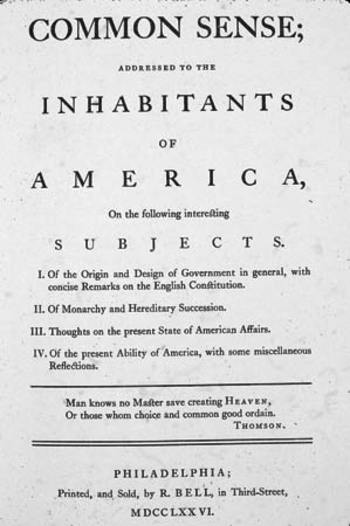
    The history of world literature ancient and modern abounds in silenced or self-silenced authors—there is even a four volume encyclopedia to help you identify the unidentified. . Political and religious work are also particularly heavily laden with unattributed or disguised efforts—the U.S. Constitution and the Federalist Papers are of course both anonymous (and of necessity), as was the most beautiful work of Voltaire.  The Declaration of Independence, on the other hand, and also of necessity, was not.  What is that  they say?  Anonymity is the best defense against the tyranny of the majority”?  It still feels a little Orwellian to see the unattributed source in the newspaper or read an anonymous editorial.   On the other hand Thomas Paine’s On Common Sense may not have made it into print if its author had been required to identify himself. 

    Art is perhaps the longest-lived area of anonymous work, the signed canvas being a relatively recent invention.  There are thousands of years of unknown hands and eyes represented in millions of works, but really we only get solid confirmation of the intellectual origin of a work through the invention of the ornament of the signature, and this just within the last 500 years.  And even after this defacement begins to appear there is still a relatively stout history of semi-anonymous works coming from painting studios doing work “in the manner of ____”.  Of course there were other considerations at play here, what with guilds and patrons and all—the artist was one person in a lengthy bureaucratic trail of aesthetic production.

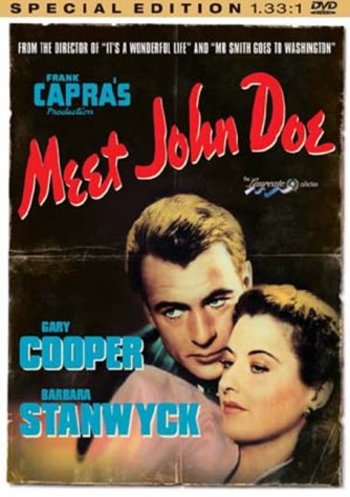
    Anonymouscooper Anonymous seems to come more into play in our present culture via the need for a place holder—when tallying and accounting the death of unknown people, for example, the name “John Doe” or “Jane Roe” is used (in the U.S.) to take up the forever empty space calling for The Departed’s name. (Our most famous “Jane Roe” is Norma McVorvey of Roe v. Wade; I think the Gary Cooper film (“Meet John Doe”) still ranks the highest for the male equivalent.)  Something has to go there in that empty space, and so it does–the placeholder name. (The practice of using such names is actually pretty old, and is practiced worldwide. See HERE  for an entertaining look at multi-cross-cultural “John Doe” equivalents.)
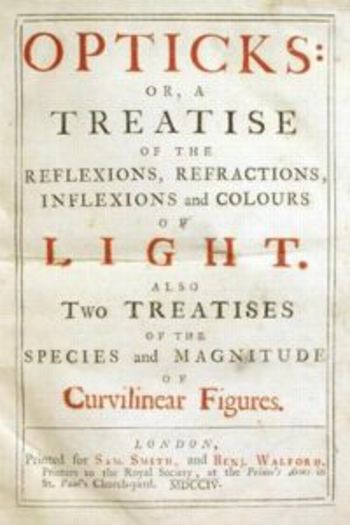
    And now that I’ve had some time to think about non-Darwin examples from the sciences, I’m a little stumped.  Robert Boyle is a good example, what with more than a dozen of his works (at least according to John Fulton’s bibliography) were published without his name carrying the title page-but these were the philosophical and political works of a scientist, and not scientific.  Same too for Pascal, who wrote his Pensees undercover—and again, not scientific but by a scientist.  Isaac Newton published his Annoymousopticks_2 Opticks without his name on the title and in fact only used his initials in the preface as his personal identifiers. 

    That leads us to a final example of Thomas Malthus, who really did publish the first printing of his massively important Essay on Population without his name—it would make an appearance soon after, though, in the second edition of this contentious work making the first edition of this great near-scientific work one of the most influential anonymously published  books of the last 250 years.   

    An unusual example of “anonymous” was Copernicus, the ultimate anonymous author of a scientific work because he intended not to publish i fearing reprisals for his challenging and revolutionary work. He waited until he was basically nearly dead to have his effort put into print, and so overcame his anonymity issue in print to adopt a biological anonymity enjoyed by the dead, his body loosened from the grip of his name so far as reprisals went.  He was free from fear of all anxiety and moral espionage at this point, and he did see the work brought to public display. with his name very boldly displayed on the title page. 

    ·Posted by :

    ·in: