A Daily History of Holes, Dots, Lines, Science, History, Math, Physics, Art, the Unintentional Absurd, Architecture, Maps, Data Visualization, Blank and Missing Things, and so on. |1.6 million words, 7500 images, 4.9 million hits| Press & appearances in The Times, Le Figaro, Mensa, The Economist, The Guardian, Discovery News, Slate, Le Monde, Sci American Blogs, Le Pont, and many other places… 5000+ total posts since 2008.

Category: Iconography

  • Black Sky and Morning Arrows

    JF Ptak Science Books  Quick Post
    Ripa757

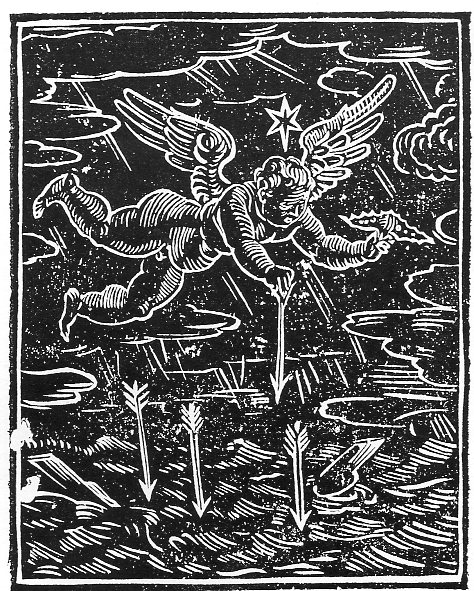
    I’ve just written a short post on the beautiful key to iconography by Cesare Ripa, Iconologia overa descrittione d’imagini delle virtu, viti, sffetti, passioni humane, corpi celesti, Mondo e sue parti…, which was published in Padua in 1611.  The version I used was an 18th-century English translation with new illustrations–now though the translation was very appreciated, the images were not so.  As I pointed out, they do serve the purpose of illustrating the specifics in iconography, the images were not that pleasing.  I wanted to include here an example from the original, and in particular the imagery of “Dawn”.

    It is a gorgeous thing, a very striking, very strong woodcut showing the messenger of the new day coming, attacking the night with arrows of dawn. 

    I enjoy he earlier, more robust images for this iconology, even though there are many variants to choose from–there were more than 40 editions of this work since its first non-illustrated edition in 1593–but given it all I much prefer the early 17th century flavor. 

  • A Few Examples of Renaissance Icons in Science Emblemata

    JF Ptak Science Books   Post 1885


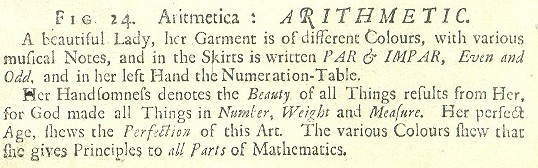
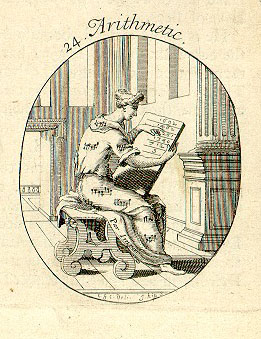
    Iconographia arithmetica image

    These images come from a later (and English edition) of Cesare Ripa’s essential keybook to Renaissance iconogrpahy, the Iconologica overa descittione d’imagini delle virtu, viti, affetti, passioni humane…first published in the early 1590’s with Ripa’s artwork.  I don’t much like the English version of his work, nor do I care that much for the artwork (inferior in most ways to the great craftsman-like feel of the Renaissance images), though it does serve the purpose of place-holding the symbolism and explaining the elements of the icons.

    I’ve chosen a few emblems for the sciences to illustrate this important work of deduction and explanation, as it would be an aid to anyone interested in the art of the Renaissance–and that would be an interest at virtually any level.

    I chose “Arithmetic” as my first example because of the lovely parallels found in the folds of Arithmetic’s dress–musical notation, underneath which we see the faint “Pars Impars” (even and odd) to help settle the old scores of symmetry.  The connection between music and mathematics is thousnads of years old, and though I might’ve used “mathematics” rather than its oldest branch (of “arithmetic”) to show the ancinet connection between music and numbers, it should be remembered that not every aspect of arithmeic is standard, and that there is a good and strong relation between music and “higher arithmetic” (number theory).  In general I just like the emblzoned connection here between the two, showing a temporal sequencing representation, a placing of music in relation to number right out there in time-and-space,an adept of the mental image of music. There is no doubt that when a viewer was finsihed with this image that there is a lasting property of the mathematical properties of sound and teh harmony of number.  Its not exactly “music of the spheres”, but it does work. 

    • Iconographia arithmetic

      Good transliterated description are to be found on the Alchemy Website, here; the English-language version cane be found here.


  • A Partial Alphabet of Thai Onomatopoeia–Words for Usually-Unusual Noises

    JF Ptak Science Books   Post 1882 

     [‘Joom’]–Sound of a pebble being thrown in a pond

    [“Seet’]–Sound of someone eating something very spicy

    I’m not sure that the idea of phonoaesthetics comes into play with the concept of onomotopeia–perhaps they’re mutually exclusive. Or inclusive?  Does cacophony fight euphony in lists of words that are composed to sound like the thing they represent? Or perhaps it is a given quality of this state that some of these words must sound cacophonus–“zok”, “thak”, or even “ptak” (which I saw in an issue of Sgt. Rock in the mid ’60’s as the sound bullets make when they strike a wooden dock)–simply because of what they represent, and must be so. 

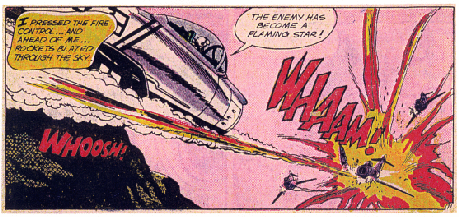
    Then of course there’s the issue of onomatopoeia that look like or presented like the sound they are describing. For example, the word “Whaam” that appeared in comic book and which was famously derived as art by Roy Lichtenstein.  File:Roy Lichtenstein Whamm Original and Lichtenstein Derivative.gif

    When researching this I came upon cross-cultural examples of onomatopoeia–big an diwde and beautiufl and very far-ranging. It is a rich literature, and the examples are varied and deep. TO display an example I chose a list of  of Thai onomatopoeia, all of which have been collected by the author of  Weird Vibrations, who collected  these many fine examples one-by-one and for whose work in this and other areas I deeply enjoy and appreciate. I include them below in an odd alphabet of oddness–all that I’ve done here is separate them into a handy assembly, but let’s make sure that all of the credit of collection and transliteration belongs entirely to Weird Vibrations.

    For example:  “[Seet]  Sound of someone eating something very spicy” is a curious word, mainly because I’m not sure what this might  like unless “seet” is a quick ontake of breath.  “Joom” is a lovely word, and it really does sound like a pebble striking a pond surface.  Here are the others:

    Thai Onomatopoeia (alphabetized to the English-language action rather than the Thai transliteration).  Try sounding them out–many sound like their sounds, which might give a little credence to Mr. John Locke’s theory of knowledge (or not).

    A

    [Gra It Gra Eeuan]  To delay action through words

    B

     [Guy] Sound of someone bragging

    [Krok Kraak]  Sound of fluid bubbling in the stomach

    C

    [Gra Jaawng Angaae]  Sound of children crying annoyingly

    [Khaak]  Sound of coughing something up


  • The Archaeology and Secret Evolution of Meat–a Collection of Posts

    JF Ptak Science Books    Quick Post

    I’ve collected some of the unusual posts that I’ve done on this blog regarding the hard tendencies and shallow measures of meat. 

    The Ineffable Religiosity of American Meat Memory, here.

    000 meat red 2011


    Women Meat Pioneers of 1943, here.

    4-1 prop meat

     Anatomy of Womanly Desire–Aprons, Plastics and Meat, here.

    Women--growing Kelvinator453

     “The String Department” and “Curled Hair Machines” at the Meat Plant  (here)

    Blogsept3_hair485

    Spam, Smeat, Spic, Prem, Mor & Arf: Food by Any Other Name  (here)

    +++spam ad

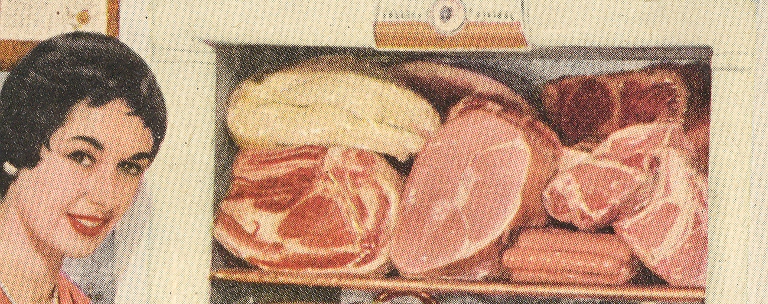
    States of Perfection: the Refrigerated Archaeology of Meat, here.

    March 6 refer meat det

    Food, Food Packaging and Creating Desire: the du Pont Company, WWII. (here)

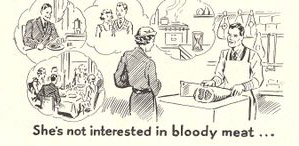
    Selling to Simple Women, 1939:  “She’s Not Interested in Bloody Meat”, here.

    Women--bloody meat

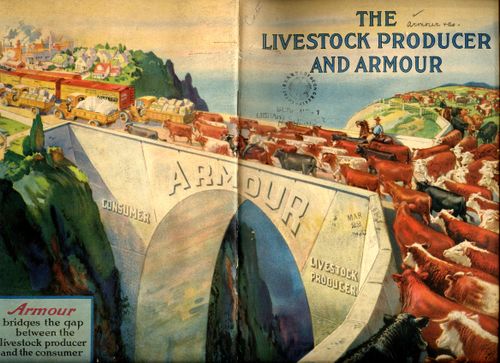
    The Importance of Bridges in the Invisible Evolution of Meat, here.

    + The Kodacolor Bridge of Evolving Meat


  • The Evolution of the Rock: the Progress from Exisitng to Thinking and Back Again, 1510

    JF Ptak Science Books    Post 1818

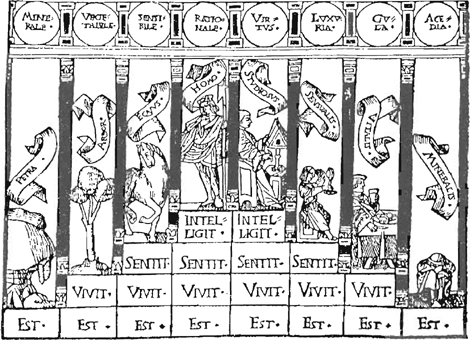
    This delightful semi-progression of existence was found in Charles de Bouelles’ beautifully titled Que hoc volumine continuentur; Liber de intellectu; Liber de sensu; Liber de Nichilo; Ars oppositorum; Liber de generatione; Liber de sapiente; Liber de duodecim numeris; Epistole complures, and printed in 1510 in Paris.  It is, in a way, in a light way, truly a representation of a literal progress of the state of things, perhaps from an  Aristotlean point-of-view.

    illustratie

    I’ve no real expertise in this matter whatsoever, and I don’t know the de Bouelles book, but I can do a bit of interpretation of the woodcut, which displays different stages of the existence of all manner of things–of all things.

    It starts at left with a rock, with an inanimate object (“Minerale”, and then “Petra”:, with the overall statement of its being, “est”–that it, it “exists”.  This is the common basis to all eight stages of progress:  “est” all the way across, and all the way down. 

    Next are the plants, the “vegetables”and “arbor”, which live (“vivit”); followed at close heal by animals, “equus”, which have”sensibilite”, or senses. and sense, “sentit”, which is a shared ability of four of the eight stages.

    The shared height of progress comes next, in man, of “rationale”, who is capable of thought (“intelligit”); these factors are shared by the scholar (“studiosis”, who comes next, “virtus”).   It is next that we start our descent, back to the simple existence of things, to the “est”: the sensate, living, existing luxuriant, observing himself in a mirror, determined to see all that was possible to see.  “Luxuria” follows, a man eating, enjoying nothing but the pleasure of consumption, simply “living”/Vivit”.  And then, lastly, to “acedia”, to the indolent man, sitting, performing no task, doing nothing:  existing, “est”.  Up and down, back to the rock. 


  • Playing the Money Card–What it Really Looked Like

    JF Ptak Science Books   Quick Post

    We’ve all heard of the saying, “playing the money card”  but until this morning I’ve never actually see it, so far as I know.  While looking for WWI aerial combat games in the patent records I stumbled across “Capture the Kaiser”, a card game created by Charles Hopkins  (which was entered into the register at the Patent Office in November 1917 and received the patent less than three weeks after the end of the War)–it was a game of pursuit/capture using 45 cards in which players used the various strengths of nations (airplanes, submarines, battleships) to secure the outcome.  It seems pretty much like a standard game of “War” with a few exceptions, one of which was the “finance card”.  It was one of the strongest cards in the deck, or so it seems, rivaling that of another interesting bit, the “fate card”.  In any event, it was interesting to see the root of power portrayed so in a card game for kids.


  • Geology of Images: Finding Pre-biotic, Neo-Dadaist Images in Antique Astronomy Prints

    JF Ptak Science Books  Post 1768Astro mictroscope--6b943

    Sometimes when you look hard enough you will see (if not actually “find”) what you’re looking for; determined to  make a discovery, you can sometimes force yourself into believing that what you’re seeing is what it was that was needed to be seen .

    The  microscopical world of astonomical antiquarian prints is an interesting one–and in some ways, modern ways, are  on the Robert Hooke/Micrographia magnitudes for the remarkable magnified worlds that their detail reveal–but mostly right now I’m interested in the odd/beautful designs that are hidden in larger scientifc engraved presentations.

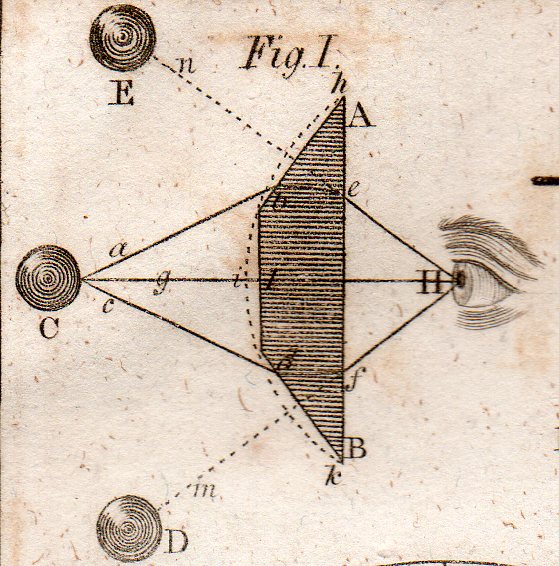
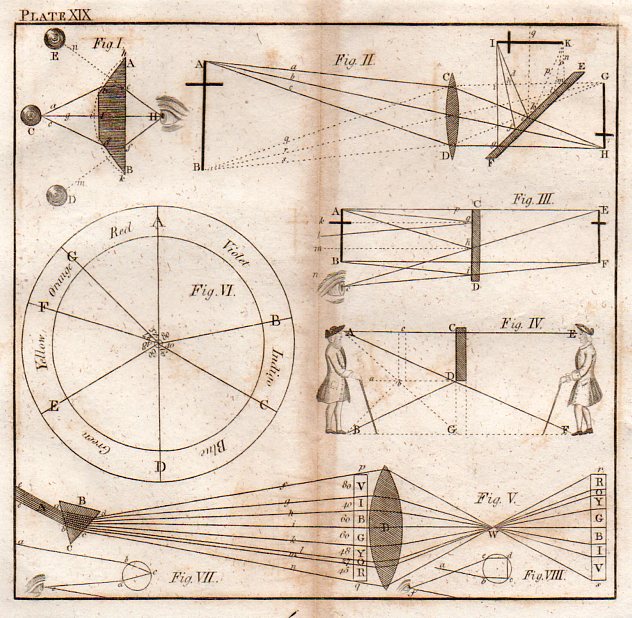
    Astro mictroscope--6942 [Even in fairly famous scientific images lke the one above–explaining the rainbow–there are all manner of unexpected artistic finds outside of their significant scientific contributions.]

    These images from the title of this post, on the other hand, are just simply “there”–all you need is a little magnification and some sharp vision, and the things come to life.  When looking hard at these images and seeing the teaming non-representational artforms that swim through so many of them it seems remarkable to me that these things weren’t seen as art before Kandinsy finally “discovered” this  artform in 1911.

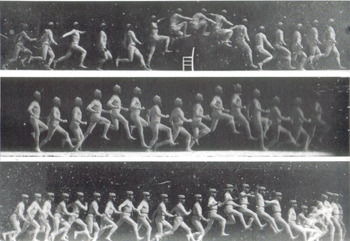
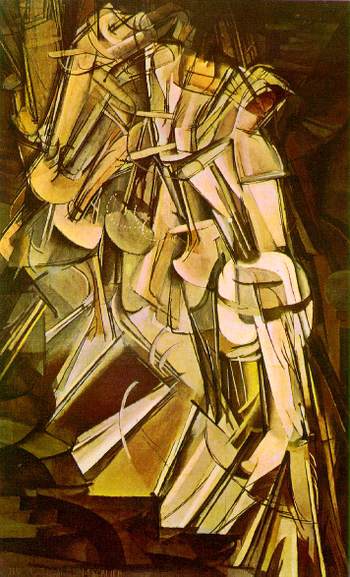
    (For example Mr. Marey produced a very remarkable Nude descending-like series of photographs 40 years before Duchamp–but the Marey images were observed scientifically, and I’m unaware of anyone who ever wrote an artistic appreciation of that work before 1900.  [Marey left, Duchamp right.] But that is another story.)

    Blogfeb_22mareyBlog_feb_22_nude

    For us today with almost 100 years of Kandinsky/Klee/Duchamp/Braque/Malevich under our belts it is relatively easy to see the artfullness of the pieces and bits of these engravings–not so a hundred-plus years ago, and harder yet for 200+. 

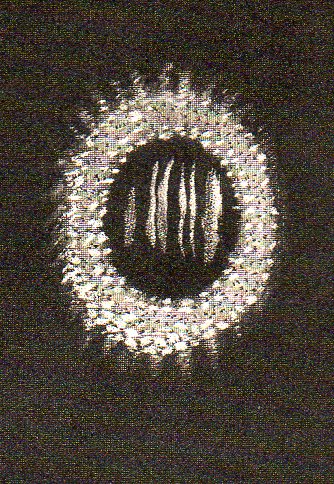
    For example, there are some things that take on an absolutely pre-biotic flavor, like material that we’d come to see a half-century ago, as in these details from an 1850’s  French lithograph on nebualae:

    Astro mictroscope--3b931


  • The Ouroboros and Infinity

    JF Ptak Science Books    Post 1762

    Ouroboros390
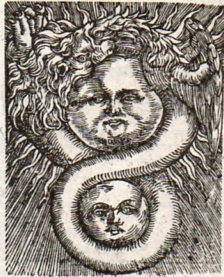
    The ouroboros–and in this particular case, the double, over-and-under ouroboros–is an interesting and ancient symbol.  In my experience, the single unit is to be expected, but the double seems uncommon. The symbol (“oura” or tail and “boros”, eating, in Greek, one who eats one’s tail) stretches back into the dim and dusty past, at least to the Egyptian Book of the Dead, and is Plato’s first living thing–its is the primordial unity, the rebirth of forever, death/life/birth/rebirth, continuing into infinity, the great world soul…a kind of Western equivalent of the Taoist Yin Yang.

    There’s much more to be said about this symbol, especially by such people as Erich Neumann and Carl Jung, but I’ll resist, mainly because it is just too complicated for me to make an intelligent statement. (I’ve tried to read the Great Mother as well as The Origins of the History of Consciousness by Neumann, but only made my way around the edges of the first, and picked through the interesting bits of the later.  Jung is someone I’ve never had much luck with.)

    The first symbol, and a gorgeous one it is, comes from the Theatrum chemicum (1659-1661, and published in six volumes by Lazarus Zetzner in Strasbourg), and shows the combination of what was supposed to be an alchemical highpoint:  the spiritual coming together of sulfur and mercury, elements of what the practioners believed were the basic constituents of all metals and minerals.  And of such stuff miracles were understood to be made, except that of course, they weren’t–the fact that this stuff never worked to produce something more substantial than mercuric sulfide wasn’t due to the theory or practice or thought but to the “fact” that the mercury and sulfur used in the process weren’t “pure” enough.  That said, the Theatrum was a very important work, the largest collection of alchemical works ever gathered and published together–it was also evidently much appreciated by Isaac Newton, who was said to consult it often and who owned the set in his library.

    A more classical appearance of the ouroboros (De Lapide PhilosophicoTriga Chemicum (Prague 1599) compiled by Nicolas Barnaud), depicting a dragon seizing the polarities of its soul, ultimately uniting them: 

    File:Ouroboros 1.jpg

    And in the discussion of the ouroboros and philosophical aspects of infinity it should be mentioned that there is some connection between it and the mathematical symbol for infinity, which seems to arise from (the remarkable and original) John Wallis’ De Sectionibus Conicibus, which was published in 1655.  Wallis employed the old Roman symbol for 1,000 to use for the mathematical infinity, which of course is the ouroboros on its side.  (Wallis it should be noticed was also among the earliest people to put into print the symbol for pi, as well.)

    ·Posted by :

    ·in:

    — — — —

  • Big G’s: Grim & Gross Saturn: Grandville, Goya, Galileo and the German Gnostics

    JF Ptak Science Books  Post 1752

    Blogsaturn_large
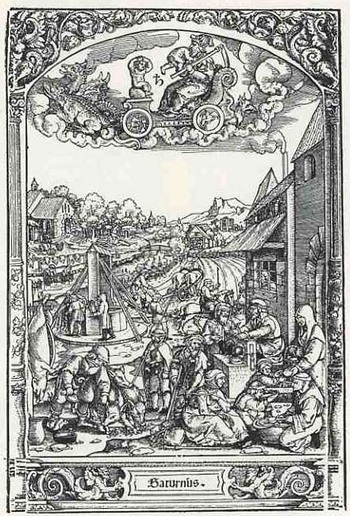
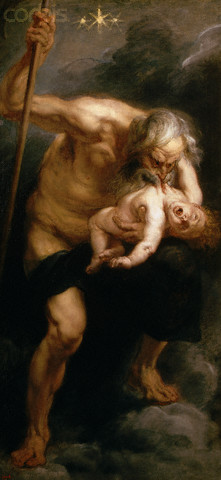
    I was getting ready with what was supposed to be the real post for today when I stumbled upon this woodcut of the Roman god Saturnus.  What makes this image so terrifically compelling is how benign it is—in its weird, mechanical, disinterested observational manner the artist conveys almost nothing about the act that we witness as the god plots his way across the sky in its celestial chariot.  Saturn (equated with the Greek Kronos, and the Titan father of Zeus, and also the name of the gaseous oblate six planet) commits acts of horror, and becomes, again and again, perhaps the greatest coward of the Roman pantheon of questionable deities. 

    It begins with Saturn being told his future:  that at some point in his life his son or sons will supplant him, catch him, replace him and kill him.  And the best thing that Saturn can think to do is to methodically eat his children, and he does manage to consume all but one—Zeus—who then fulfills the prophecy; but then again, who wouldn’t?  There is really very little like this in mythology—and, really, why should there be?
    Blogsaturn_ldetaileating

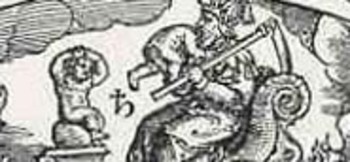
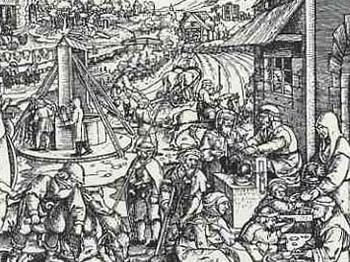
    Our artist—or engraver—is George Pencz (1500-1550), alive and dead very neatly at the century and half-century mark, and his work (“The Life of the Children of the Planet Saturn”) is illustrated in Folge der Planeten .  The image of Saturn racing along with his son’s head in his mouth looks naive compared top the rest of the illustration, which is a very lively, if quiet, depiction of the industry that his dead sons would have applied themselves to if they hadn’t been consumed by their father.  The illustration of Saturn is very disturbing to me, particularly when you notice the son-in-waiting, who is watching his father eat his brother, and in an incredibly pathetic and heart-breaking way is trying to protect himself by holding his head.  I think it is so very moving because it is a perfectly logical (from a child’s point of view) reaction to an unimaginable terror, and perhaps this is how Pencz can best deal with the vile god.
    Blogsaturn_ldetailallegory

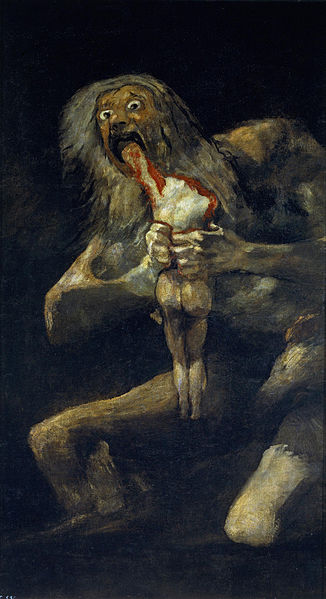
    Images of Saturn really are legion, but there are a host-and-a-half that are pretty upsetting, like the one above, and the one coming, below. I think that the one that is the test against which all others are measured is by Francisco Goya, who during his “black period” painted the truly terrifying image of Saturn devouring his child right on the wall of his house in 1824 (or thereabouts). It really is bad stuff. The scene as painted by Peter Paul Rubens isn’t much better.

    Saturn goya Saturn rubens


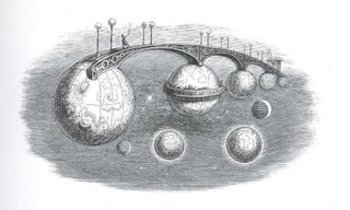
    Admittedly, J.I.I Grandville (1803-1847) didn’t conceive of this series of bridges as a plausible means of interplanetary travel and is in all probability an allegorical creation, but the image does–in an odd way–allow a dialogue on the idea of moving from planet to planet, which was still pretty solitary thinking in the mid-19th century. Although this didn’t have a direct effect on the perception of man’s place in the solar system, it did have a great and direct impact upon a vast number of illustrators and cartoonists who followed in his considerable wake.

    BlogfuturegrandvilleThis image comes from Grandville’s Un Autre Monde, published in 1844.
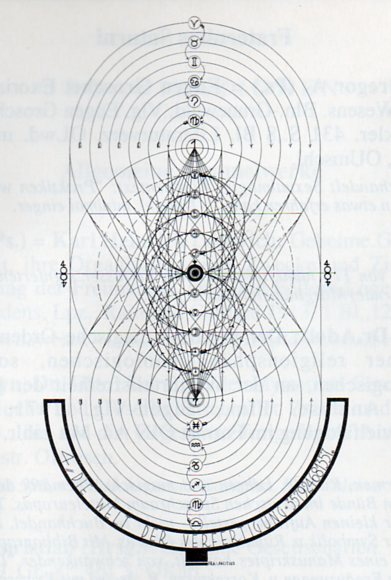
    In addition to an interplanetary bridge that there is another singular creation here in Grandville’s cosmos–a balcony constructed of the rings of Saturn (if indeed this was supposed to be Saturn–it is as advantageous as not to think of it in this way) and if we think of a balcony being a place to watch and observe, then we are brought instantly to W.G. Sebald’s Rings of Saturn, which is a textural masterpiece, and mostly I guess a novel about everything that Sebald observed in his walk through Suffolk.  (Another Saturn-related work of fiction is Sirens of Titan, by Kurt Vonnegut,  a very mature and insightful 1959 novel which really has nothing to do with anything here; I just needed to throw that in, what with him being a master storyteller, crank and human-caricaturist-observer and all…)  And so by 1844 it comes to pass that one French caricaturist/imaginist comes to draw an extraordinary and impossible land/space bridge between the planets only 234 years after Galileo  first glimpsed Saturn’s “handles”–give the optics of his telescope Galileo didn’t see the rings of Saturn as such, seeing rather two “extra bodies” on either side of the planet  It would take another 65 years and accumulations of observations by some of the greatest names in the history of astronomy (Galileo, Casini, Hevelius, Huygens) to show that the disk (singular) on Saturn was actually a series of rings.  (I should add that the first photograph of Saturn’s rings is not made until 1883.

    Saturn gnosis303
    Which somehow brings me to the troubled world of the “Saturn Gnosis”, the Fraterniti Saturni.  Actually the only place I’m getting to here is a picture (above), which I tried to understand before I realized what it was, and how much of an expanding hocus-pocus (otherwise defined as  “woo woo” in the words of James Randi) rabbit hole of diminishing returns it leads to, a dizzying history of competing complexities and nonsense.  But the image (found in a book edited by Eugen Grosche, (Offizielles Publikations-Organ der deutschen Gross-Loge Fraternitas Saturni Orient Berlin,  1929), comes from a psycho-sexual-astrological-magical group (one of a number of such associations in Germany and particularly Berlin in the 1920’s), and seems no less a part of reality as does Grandville’s Saturn.  Sameness ensues when you try to approximate the volume of limitless emptiness, or belief.

    ·Posted by :

    ·in:

    — —

  • Designs in Flowers, 1635

    JF Ptak Science Books   Quick Post

    This lovely, and short, pamphlet was published by Baltazar Moncornet in Amsterdam in 1635 as Livre de fleurs et de feuilles pour servir a l’art…Dessins de fleur pour orfeverie, with designs by Francois Lefebvre. Slender and tall, there was an engraved title followed by five plates for the entire production.  It is a very fine work, hard in detail, and worthy of close inspection.

    http://www.beauxartsparis.fr/ow2/catzarts/images/BIBMasson2911_02-60494.JPG

    ·Posted by :

    ·in:

    —