A Daily History of Holes, Dots, Lines, Science, History, Math, Physics, Art, the Unintentional Absurd, Architecture, Maps, Data Visualization, Blank and Missing Things, and so on. |1.6 million words, 7500 images, 4.9 million hits| Press & appearances in The Times, Le Figaro, Mensa, The Economist, The Guardian, Discovery News, Slate, Le Monde, Sci American Blogs, Le Pont, and many other places… 5000+ total posts since 2008.

Category: Information, Quantitative Display of

  • Proust Suits and Pressurized Cabins

    JF Ptak Science Books   Post 1341


    If I put my literary specs on and do a little free-association,  what I see in these two figures is a Proustian thing, characters in search of time, freezing time, preserving it. Time, and everything else, everything that can be associated with a human experience captured and recaptured, recirculated, resuscitated, replayed, re-envisioned, remembered, recognized, over and over again.  Kind of like a memory hell, in a way, only in Proust’s hands it all sounds and tastes so beautiful. Another peek without those wicked mega-specs and I see two robots from a pulsing Disney film, actions in search of characters–the possibilities are endless, particularly if you develop a little narrative. The real story of what is happening here is complex version of a simpler solution.

    Pressure404

    And the key to it all: hypoxia.

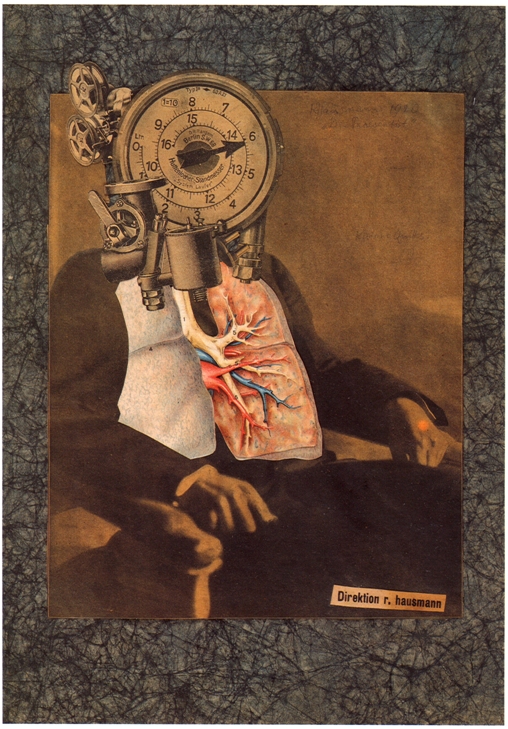
    But I can’t leave this without at least a mention of Raoul Hausmann, whose “Self Portrait of a Dadasoph” is related to this line of collecting consciousnesses:

    hausmann

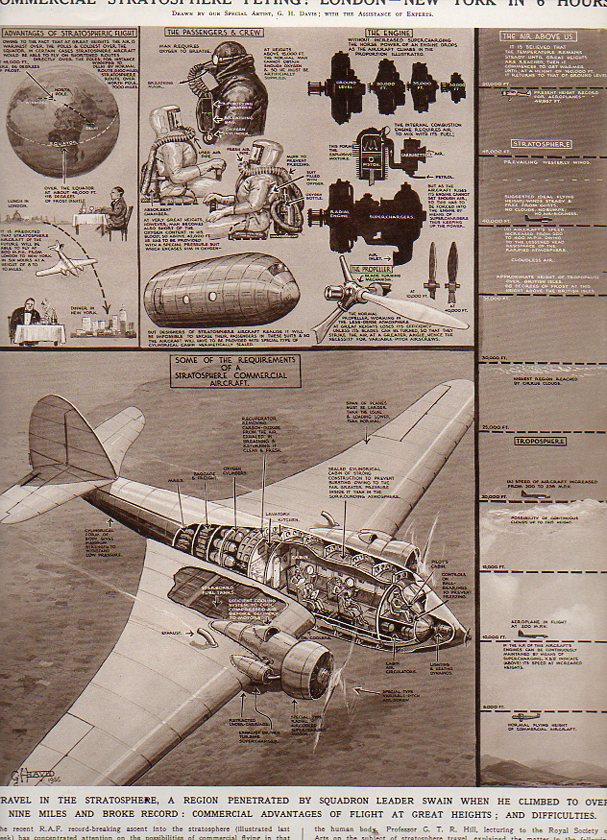
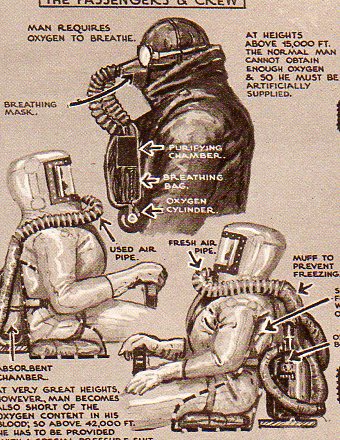
    When this next image was published in the Illustrated London News in October 1936 the practical application of tropospheric flight was just about a reality.  I should really say “popular” more so than “practical”.  It presented two approaches to a looming problem in the progress of aviation–reaching altitudes in excess of 10,000 feet begins to present a host of problems to the passenger of that aircraft.  The solution was to combat the pressures of high altitude flight, one of which was to pressurize each passenger and crew member in their own “space suit”.  The combination of the artist G.H. Davis1 and the technical assistant compared this solution to the problem with a more simple and elegant solution.
    Pressure405
    And that was relatively simple, at least in thought experiments: rather than pressure everyone individually, you could place everyone in a pressurized environment within the aircraft.  And this is the point that the artist/techie make–earlier engineers came up with simple solutions to traveling at high altitudes–they just weren’t simple enough.  And compared with the better design, the initial, simple, designs look a little monstrous.
                                   
    Notes:

    1. I include Mr. Davis as an iconic figure in the history of 20th century technical illustration–he has been featured on this blog many times.


  • Reading Symbolism in Raymond Lull’s Portrait

    JF Ptak Science Books  Post 1333

    Raymon Lull is perhaps the most famous Catalan given to the world–he is also one of the most famous people in history with the most names. (He was also known as Ramon, Raimundo and Raymond, Raimundus and Raymundus Lull, Lully, Llull, and Lullus and Lulio, among others.) Seriously though, he was a very interesting thinker who went far beyond the norm, and then some, his creativity overmatching the possibilities of the parenthetical sciences of his time, and stretching timeless logic as well as he went along.  But so it goes, as they say; he did do aggressive work and at the very least it was for the most part quite pretty-sounding.  And as he pushed up and against existing thinking it was up to that confronted thinking to push back–which sometimes happened and sometimes didn’t. He studied the law, alchemy, botany, religions, and may well have written the first novel ever to appear in Europe (at least it was the first in Catalan)–I think that you could say, overall, that he was a rationalist. 

    • The original engraving is available at the blog’s bookstore, here. 

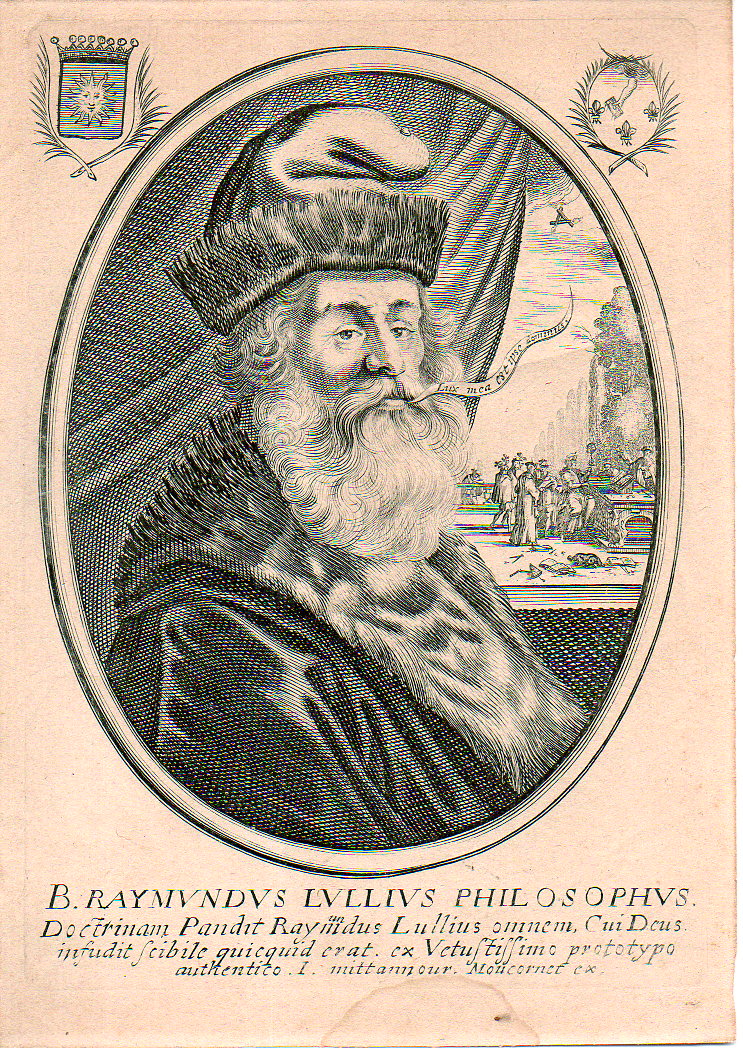
    This engraving is one version of many that I’ve seen online, and may be the original–this is a pure guess on my part, my reasoning is so mainly because there is so much more added detail than in any other versions of the engraving.  the added bits in the corners, and of course the scene revealed by the pulled-back curtain.  The engraved lines are also very sharp, very pronounced, not like some of the other version which look a little less defined…this one is razor sharp. (The image is available for purchase from our blog bookstore.)

    Lull087

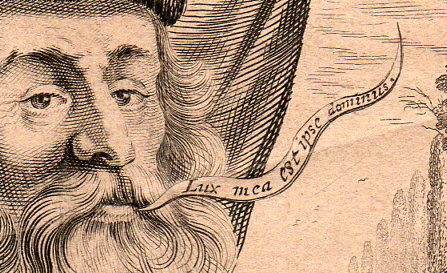
    The word balloon (and by the way I wrote a post here two years ago on the history of word balloons) coming from Lull’s mouth is Lux mea est ipse dominius “My light is that of the Lord”, a claim for divine inspiration, guidance, fortitude.  Beyond all else Lull was a Christian, and a Christian to some severe fault–he was very involved in the conversion of Muslims, and was also an (utter) expulsioist in regards to the Jews.  The Christian philosophies of Lull are clearly shown in this 17th century portrait of the man. 

    Lull371

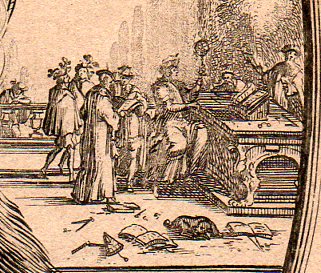
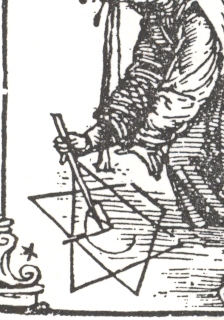
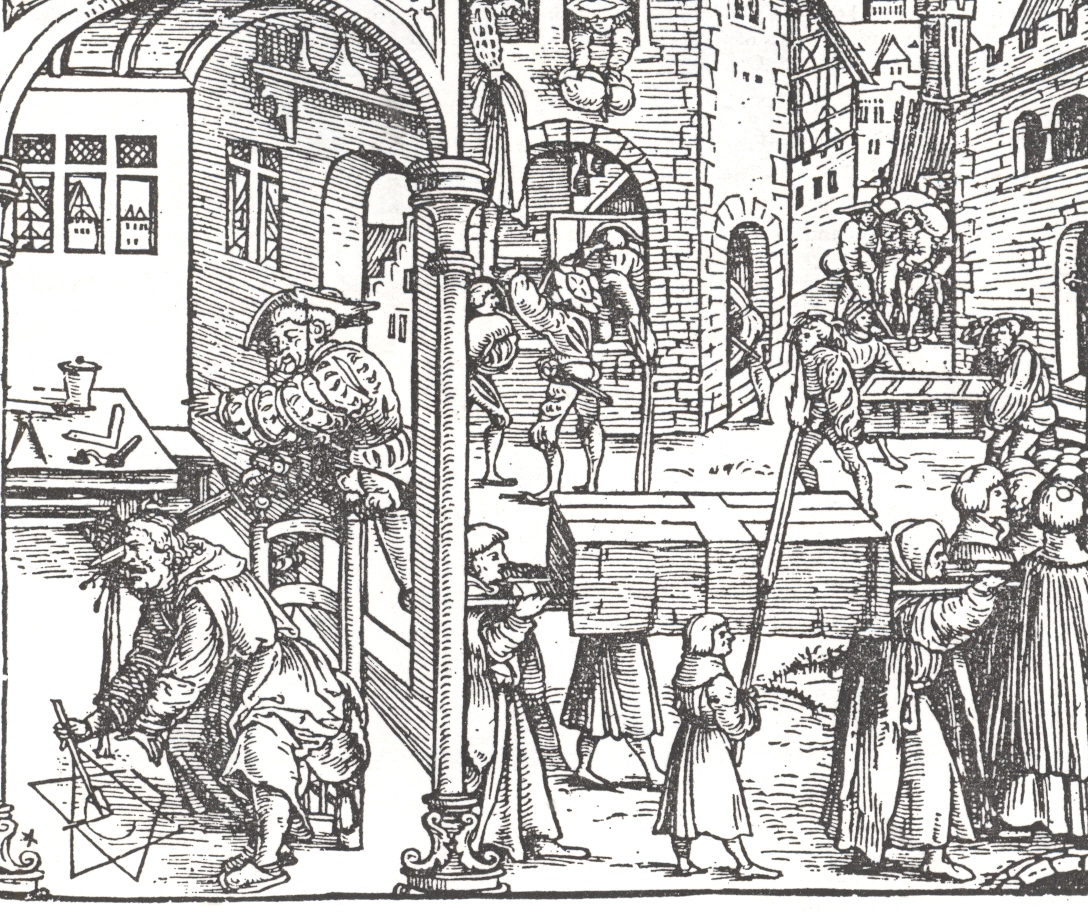
    And in the scene that is not seen in the other reproductions of this portrait online we see a small host of interesting sci-philosophical instruments cluttered around what seems to be a giant working with an astrolabe.  (This fellow is a head taller than the other people gathered around him, and he is most definitely sitting down on a high stool, making him taller still.)  We see dividers and various measuring devices, plotting instruments, and even a pair of specs, which would’ve been very uncommon in in the 13th century.  I’m happy to see a dog sleeping through the ruckus.

    In the sky in place of the sun is a triangular collection of burning candles, or they seem like candles, which continues a very old tradition of symbolizing unity, and in this case, in  a Christian theme, a god surrounded by the holy trinity… related symbols appear frequently in images depicting the Old Testament creation cycle. 

      Lull373

    Continuing this theme, if you look in the right upper corner of the engraving there is another interesting symbol–a hand issuing from a cloud with a book, sourounded by three fleur de lis.  This is in obvious reference to the balloon statement, the hand of god issuing a book, or knowledge, to the recipient (which would be the reader or Lull); the fleur de lis, a French lily, was often used in Renaissance and Baroque imaging as a representation of the holy trinity, and of purity and chastity, spirituality.  Or  perhaps it was just a flower. 

     My own interest in Lull–aside from the  great beauty in which his ideas were encapsulated and presented–is in his idea generator, and the possible influence it had on later thinkers like Leibniz who may have built on his interesting breakthrough to produce one of the earliest arithmetical calculators.  Lull’s own calculator (which I wrote a little about here) is simple and elegant, and may actually be powerful for some–it was a series of discs that when turned would relate ideas and letters and numbers which were by serendipity intended to generate unexpected ideas to think about.  For the 13th century this was a major idea, and I like it even today. 


  • Survivors on the Little Train to Hot Showers–WWI Photographs, 1918

    JF Ptak Science Books  Post 1329

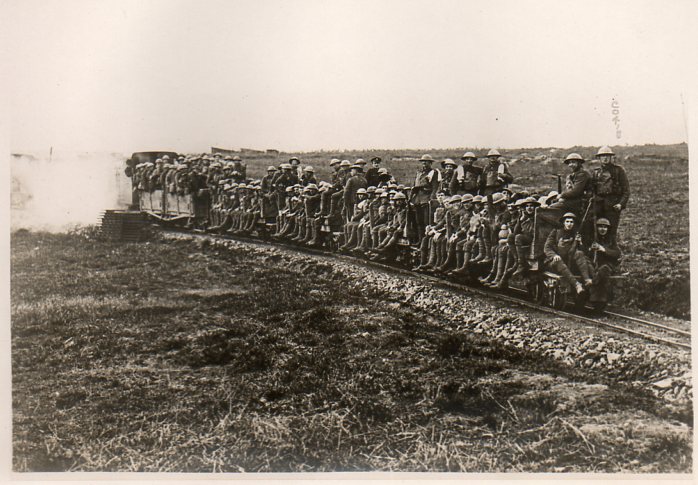
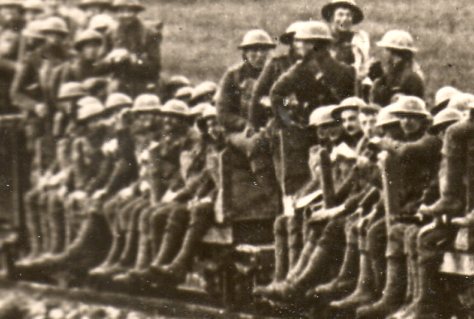
    I suppose there there was little to lift morale more than to have troops return to divisional from the front line to enjoy a hot shower–outside of course than to be brought home away form the fighting, entirely.  These soldiers were about to enjoy what I am sure was a well worn break from the action. (The original photo is available for purchase at our blog bookstore.)

    Marching railway car355
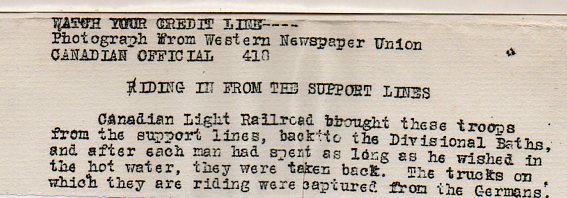
    The soldiers were riding a narrow gauge railroad, brought to France from Canada, headed back to safety and “the baths”. 

    [Also, in keeping with my previous post, to represent all of the casualties of WWI you would need this trainload of men to extend from NYC to L.A. and almost all the way back again, about 6,000 miles of people.]

    Marching railway car356

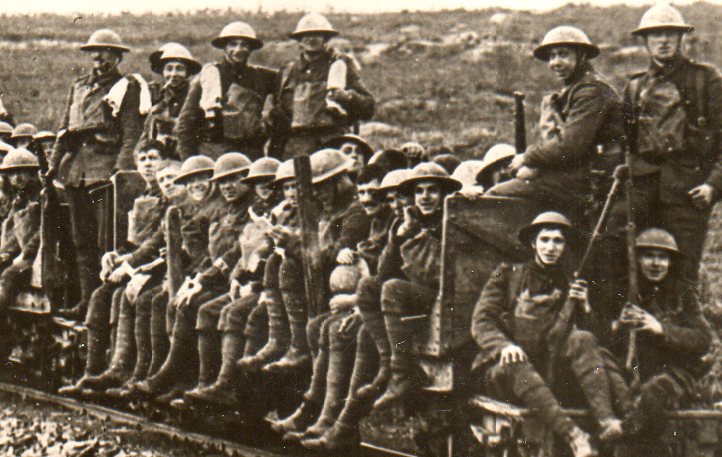
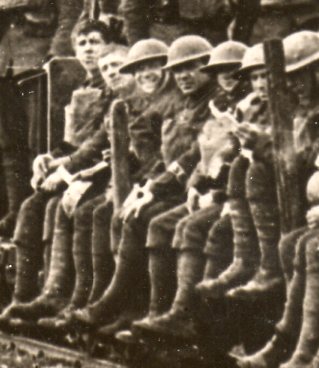
    And this, below–I see the soldier at the far right is reading a letter, I’m guessing a letter from home, as he has his knees tucked up maybe trying to protect its contents from prying eyes.  The soldier to his right is engaging in the age-old custom of reading someone else’s mail over their shoulder, desperate for any news from anywhere.  Who knows–maybe the guy was sharing. 

    Marching railway car357

    And then–as we are told in the caption for the photograph–they were given as much time in hot water as they wanted. And then:

    Marching railway car txt361

    I think the return trip would’ve looked much different.

    Marching railway car358

    Marching railway car txt360


  • Ghost March–Doughboys in London and Four Years of Mist, 1918

    JF Ptak Science Books   Post 1328

    .003%  That’s what I reckon this column of soldiers would represent of the total casualties of WWI.

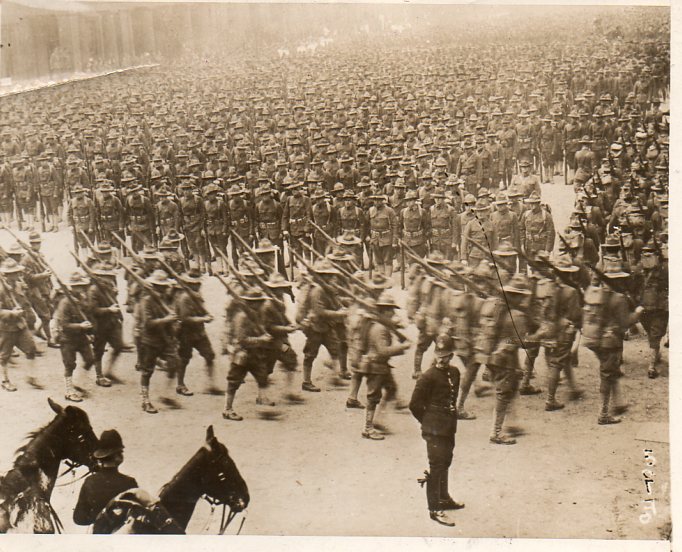
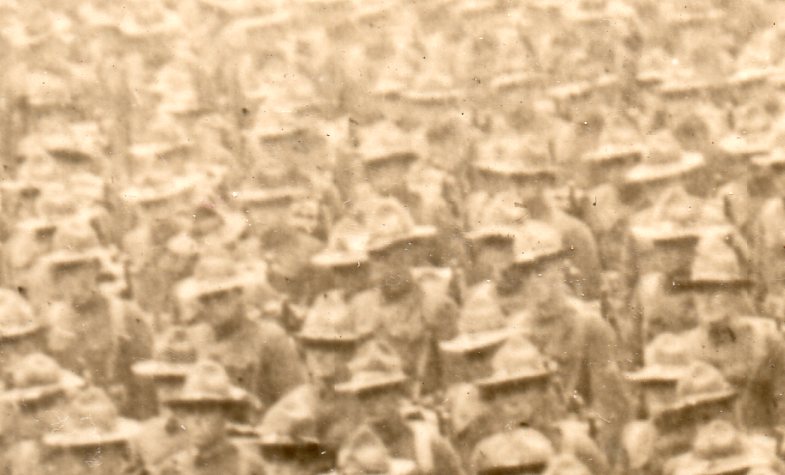
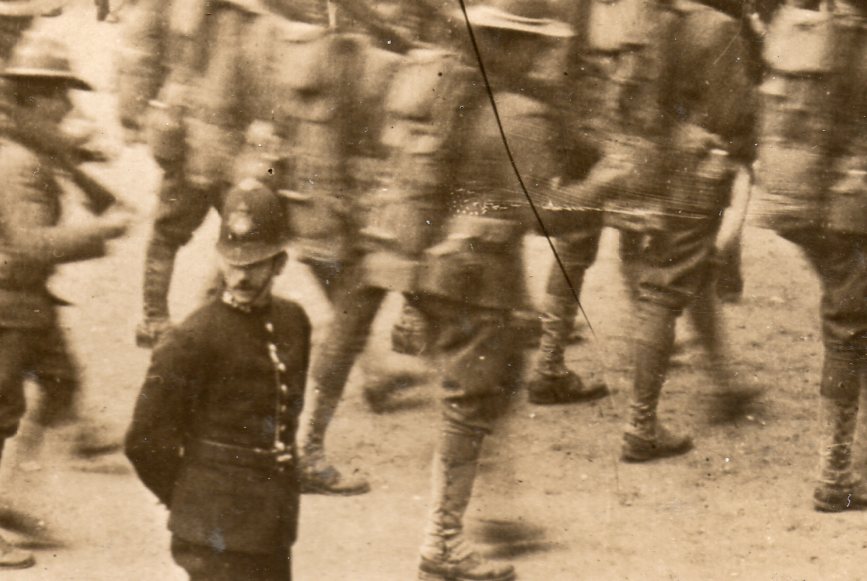
    Generally images like this are a virtual image-host for me, a bucket of ice cold water thrown onto a sizzling summer sidewalk, all sorts of ideas steaming from it.  But for photographs of Doughboys1 marching, especially assembling for parade, this one struck me a little more oddly than most, giving instant pause, making me concentrate on the haze, or dust, that allowed the columns of soldiers to blend into one another and fade, losing their boundaries with their mass receding into a dull blur. 

    Marching london 350

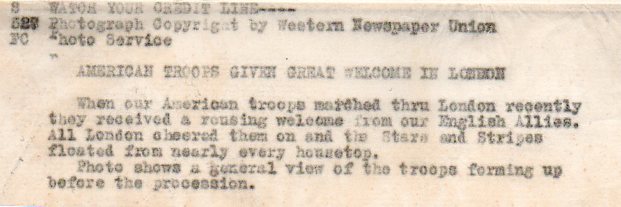
    The Western Newspaper Union was selling this image for insertion in newspaper or journal stories about the war, for a small use fee.  There were a few American organizations like Western Newspaper that were created to photographically cover the war, using pools of photographers who would distribute their work anonymously and which was available for common, general use for a small charge.  The photographs allowed out were certainly restricted and censored, though in my stash of these of objects (numbering about a thousand) I’d say that 10% of them look pretty edgy to my eyes.  Most of the action of war was not covered, but then again this aspect was still fairly technically difficult in 1918.  Images of pain were almost never allowed, and certainly not pain of Allied troops.  Aid stations were almost never covered as well, as were dead bodies, or at least those again of Americans or Brits or French or Canadian.  The imaging of the war was certainly under a fair amount of supervision and control. (The original is available for purchase through our blog bookstore. here.)

    Marching london det352

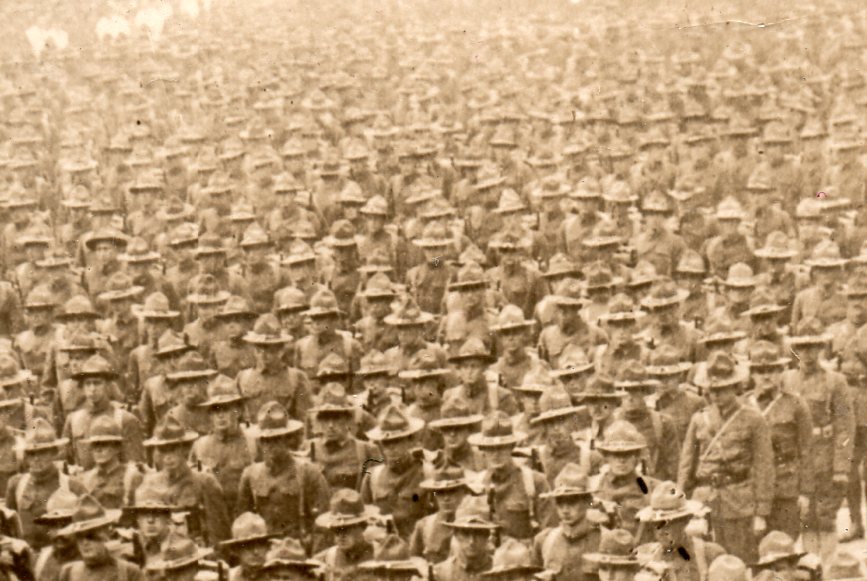
    The image shows American troops assembling for a parade through the streets of London before being deployed.  The mistiness of the composition looks like a statistic to me, these men standing for those who had come before and fallen.

    Marching london det353

     The U.S. lost .13%  of its population to casualties (125,000 killed and 205,000 wounded) during the war–a war which by the time America got here had already been visciously fought for three years, costing dozens of millions of lives.  The figures for everyone else weren’t nearly so “fortunate” as the U.S.:  New Zealand’s 18,000/41,312 killed/wounded amounted to 1.6% of its population.  The U.K. lost 2.19% (964,000/1,663,000), Italy was 3.48% (650,000/953,000 plus 650,000 civilian casualties), while France suffered a 4.29% (1.4 million/4.27 mil) blow of its total population to war.  Things were worse on the other side:  Germany 3.82% (2 mil/2.4 mil plus 426,000 civilian deaths, and the Ottoman Empire 12% (400,000/771,000 plus 2.1 million civilian deaths.   Worst of all was the Ally  Serbia, suffering a catastrophic 16% loss of its population to war, including 275,000/725,000 plus 426,000 civilian casualties.  As gruesome as the numbers were, the Americans felt only a small percentage of the total sting of war–by 11 November, more than 21 million soldiers would have been wounded, with 9.7 million soldiers and 6.8 million civilians killed.  It was an enormous price.

    And that’s what I see in the mist of what may be something like 10,000 soldiers on display n this photograph.  .003%  That’s two of these columns every day, twice a day, for the entire 1550 or so days of the war.   

    Marching london cop351

    Marching london txt354

    Notes

    1.  The origin of the term “Doughboy” is unclear, or varied, or rich, but it is at least pretty oldm beginning around the time of the Mexican American War in 1846-1848–evidently when the soldiers marched through dry, tough terrain they wound up being covered by earth with the color of dough.  Doughboy.


  • The Guts of Mathematics, Archimedes’ Dog, and the Greaseless Anatomy of Machines

     JF Ptak Science Books  Post 1326

    “…with his blood he confused the lines of his art”—On the death of Archimedes, in Valerius Maximus

    “….Bark, bark bark!”–Archimedes’ dog

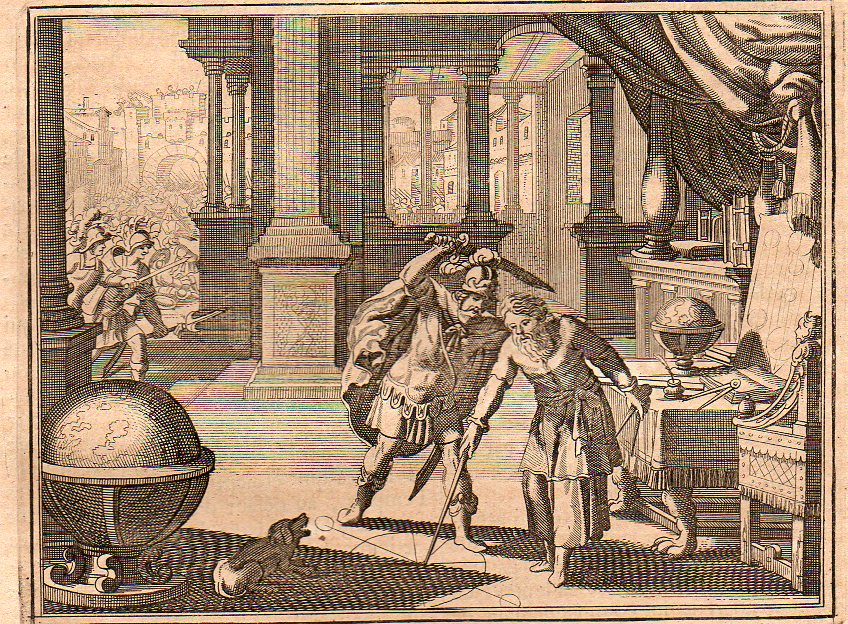
    I came across this unusual and not-web-reproduced image of an infamous scene in the history of mathematics, the murder of Archimedes.(The original is available for purchase from our blog bookstore.)  There have been a number of depictions of the event, a few dozen artists it seems–including Daumier and Delacroix and others whose name do not begin with “d”–who have chosen to try and capture the moment.  (The website at  NYU reproduces some of them;  Drexel also has a very good space devoted to Archimedes and is a great source for quotes dealing with the event.) This one comes from (I think) Histoire Universelle published by the ubiquitous Peter van der Aa in Amsterdam at the turn of the 18th century, and falls in line with many of its comrades in that it depicts the tragedy in the second before it occurred.  One thing it has that other scenes do not–a barking dog.  Maybe it belonged to Archimedes, maybe not.  But there was a dog depicted here, and it was barking at the scene, probably barking at the man about to stab the mathematician, which means it would’ve been the mathematician’s dog.  But Archimedes certainly didn’t hear the dog if he couldn’t be interrupted by the battle outside his door or the Roman who yelled at him to turn.  (I believe Roger Clemens when he says that he didn’t realize he was throwing that bat fragment at someone, saying he was in the zone.  It happens.)

    Archimedes 1705348
     Archimedes dog 1705349

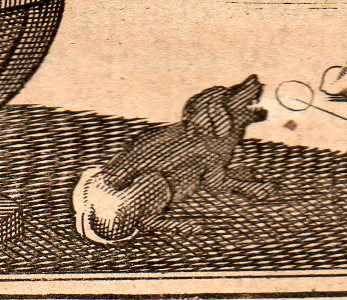
    And a detail of the dog: shows him barking from a reclined position.  Jarred awake by the intruder, he sees the  action just before the critical motion–not quite awake, no time to stand, the dog (snarling with teeth barred) tries its best. (I am romanticizng the dog part of course. My own dog, Bluey, now 14 or so, simply stared at the people who walked into my house last night with their luggage, thinking that mine was the bed and breakfast where they had their reservations.  He sat and stared, and they stared at him.  Missing their destination by one house, how disappointed they must’ve been to think that their retreat was filled with an old dog, kid toys, a dead Christmas tree, and the rest of the jumble.)

    I’m not aware of any artist who steals the moment quite so graphically at Jost Ammon (below) does, though. He also makes no effort to remove the millenium-old event from his own Renaissance environment.

    ==blog==july 8==arch 2

       Seldom do we see a maxim so vividly depicted as with these lines from Valerius Maximus:  Archimedes trying to hold a thought in his head while a Roman soldier comes tugging at him, Archimedes pushing the soldier away to protect the geometrical work that he was scribbling in the sand, and then having his head full of thoughts spilled onto the drawing he was trying to protect.  What we see in the detail is almost exactly (or on the verge of being exactly) from the Valerius quote fragment  “…with his blood he confused the lines of his art”:  Archimedes has spoiled his geometry in the moment before his cleaved head releases the control of his muscles.  It is a nasty image, the pissed-off Roman soldier—who theoretically was just looking for spoils in the looted city of Syracuse—having had enough of the three-second hesitation by the old man and reacts badly, beheading him the hard way. (I’ve written about this pirnt earlier in this blog, here.)

     ==blog==july 8==arch This is definitely the great CSI moment in the history of mathematics, so far as Mr. Ammon is concerned.  There is no chance not to see that there is no heraldry to the moment, no faint-away moment, just blood in the sand. 
    And for some reason–except for the dog part–all I can really think about here is the anatomy of the machines that were shown by the great Precisionists of early 20th century art, the artists who depicted the modern industrial landscape and its tools with fantastic precision and modern-Gothic-y grace. 
    The artists who found modernity–a modernity found mostly in America–in massive factories, and shining metal, and spokes and gears and all of the other components of factories. There was of course the Marinetti manifesto preceding all of this, and the 1913 69th St Armory Show,  and the coming of the French (Duchamp and Picabia  & Co.) in 1915 and the Tzara/Huelsenbeck/Ball Dadaist 1916 movements and the rest….but what I’m reaching for is the slightly later work, the early ‘twenties, with Hartley and Stella and Sheeler And Demuth and Schamberg (and even the early O’Keefe).  This is where I think we see machine art, an oddly realistic semi-cubist something, depicting the power and form and grace of the machine itself rather than the expression of its dynamism. 
    But what happens (for me, anyway) is this–that when the guts of the machines are revealed, that when we see inside to the components, the very anatomy of modernity, we see a clean, rustless, oil-less, greaseless, world.  Big and heavy, massive things of terrific density, and they smell like nothing except their own immobility, which so far as I know smells like nothing.  As much as I find these artworks beautiful, I miss that their core wasn’t represented–I’d would’ve liked a little more mess.  This is antithetical I’m sure to the message, but it is the essence of the machine. 

    Zoom Image
    [Charles Sheeler, Stacks in Celebration, 1954.] And humans didn’t often make it into these images–as much as I like the artwork of Louis Lozowick, I like it more when he peoples-up his ultra-tech/urban images.  That’s another story. 

  • The Importance of Mistakes: Kircher’s Table of Transformations, 1664

    JF Ptak Science Books   Post 1325

    The great semi-mystifying polymath Athanaseus Kircher (1602-1680) lived for a long time and filled his life with ideas and words,  producing dozens of books during his time on Earth, some of which were never published even though written, some manuscripts lost forever. His was a massive output of extraordinary breadth.  He wasted little time what I can see, writing on a spectacular range of subjects, enlightening people, confusing people, generating great theories and some bad ideas. 

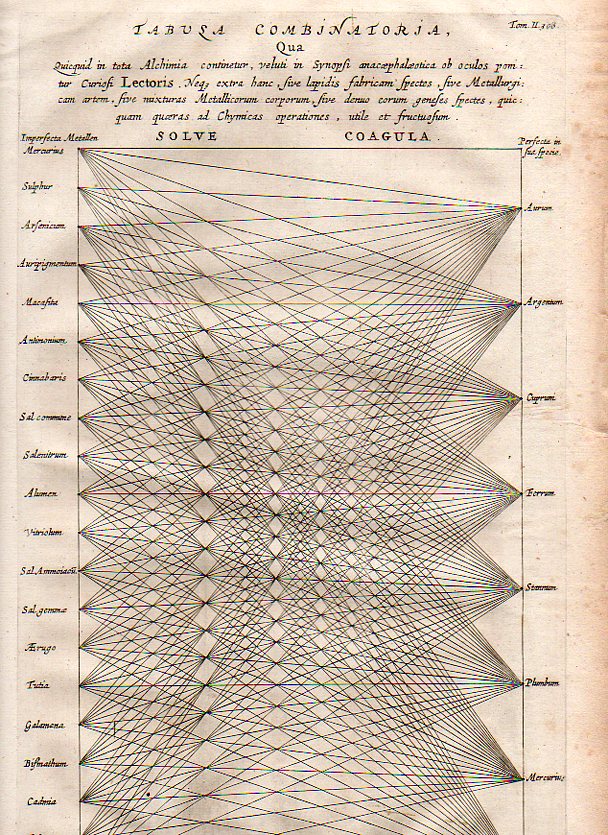
    The image below comes from his Mundus Subterraenus, published in 1664, and which was concerned mainly with geology and the theory of the Earth.  He postulated the structure of the interior of the Earth, the origin of heat, the source of the tides, the composition of light, and of course the existence of the Virgin Mary in amber.  There was also a fair amount of work on one of his side interests that populated a number of hs works, alchemy and the search for the organization of materials. 

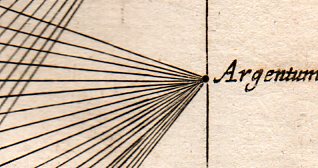
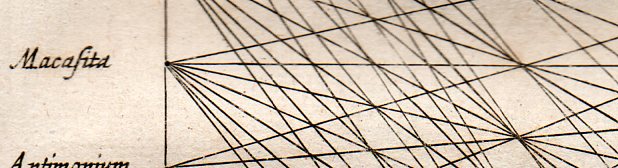
    This image, “Tabula Combinatoria” (combinatory table or table of combinations) was an attempt to classify the alchemical transformation of metals and nonmetals via solve and coagula (mediante igne solvuntur et coagulatur),  of solution and coagulation, a Curiosi Lectoris of  Chymicas operationes, in a search for the key to all transformations, the prima materia. [The original erngraving is available from our blog bookstore, here.]

    Kircher as I said exceeded his learning and logic all throughout his life, usually with positive results to us here in his future; but in this case, his alchemical quest–like the million words and countless hours and lead-based brain damage undertaken by Sir Isaac–proved to be a dry hole.  But dry holes like mistakes in general are not necessarily without importance–they are valueless if and only if nothing comes of them, or nothing is recognized in i n the method of leading to the mistake, or if by our using the mistake it didn’t allow you to pursue something else.  Science life is filled with almost nothing but error to the observer–it is our job to do something with the stuff that doesn’t work. 

    Kircher tabula345
     [the image is continued but trailed off of my scanner.]

    Kircher tabula b346

    Kircher tabula c347


  • Tramp-Speak of Antiquarian Road Warriors: ABC’s of Tramps, Hobos and Vagabonds

    Elsewhere on this blog I’ve written a little about dictionaries and words–Sam Johnson, Ambrose Bierce, specialized dictionaries, canting dictionaries, dictionaries of vulgar and coarse language, dictionaries of first uses, dictionaries in distinct fields.
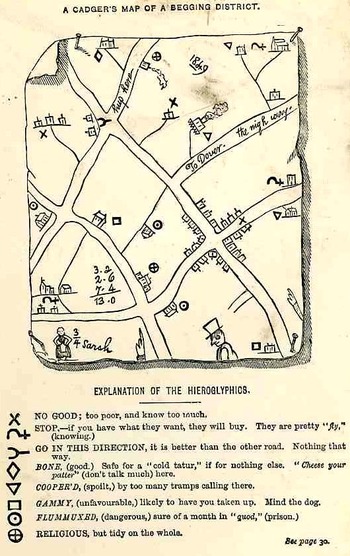
    Bloghobo_b200Hobo dictionaries, guides to hobo slang, are different from those of robbers and thieves and rogues.   They may borrow from one another, but the hobo language seems a little more dignified, and not as directed towards crime as that of, well, the criminals.  An even greater distinction is the hobo alphabet, a Morse Code if you will, a hieroglyphics, for hobos-to-hobos, written in chalk without the benefit of electricity. (I’ve written about that phenomenon here, though I’ll at least reproduce an extraordinary map of a “begging district” found as the frontispiece to the lusciously-titled The Slang Dictionary; or, the Vulgar Words, Street Phrases and Fast Expression of High and Low Society… printed in London by John  Camden Hotten, in 1870.)

    Back to words.

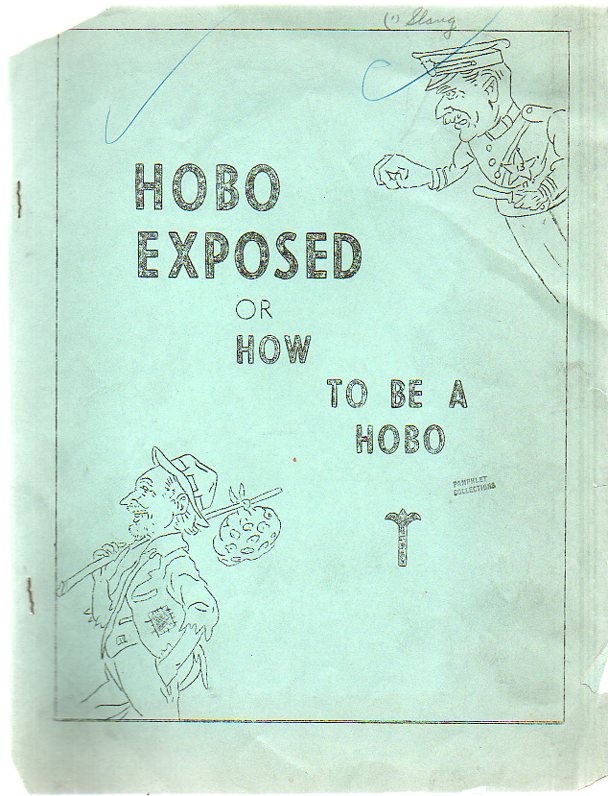
    Part I:  Hobo Slang Collected by a Common and Perhaps Hobos lingo title344 Make-Believe Hobo
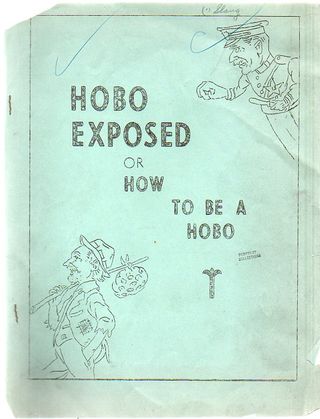
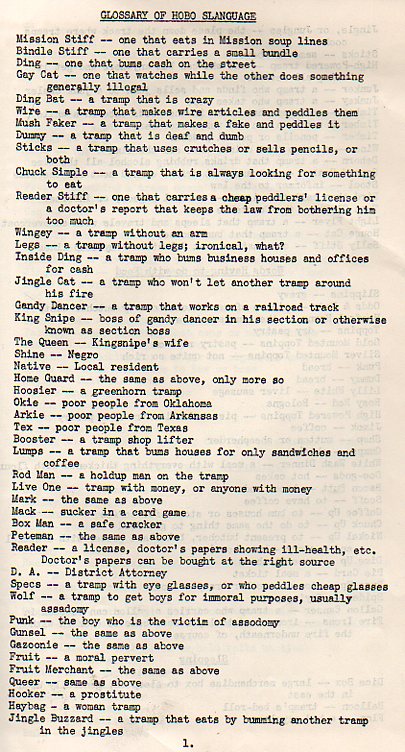
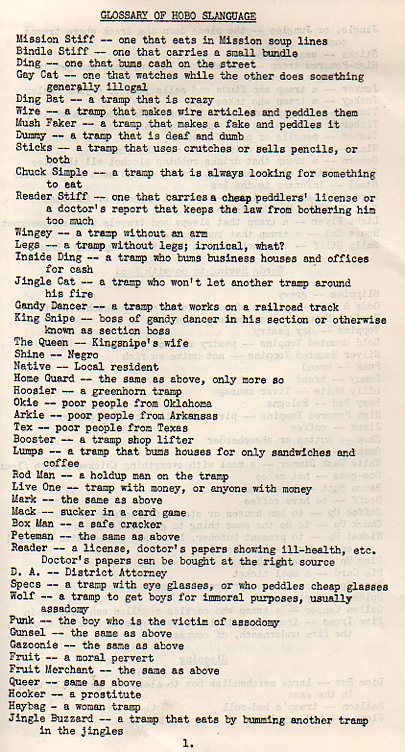
    Hobo Exposed, or How to be a Hobo, at pamphlet  with no claim for a writer but copyrighted by “Kelly’s Specialities” in 1946,  is dedicated to Sun Down Slim, Boston Blackie, Sticks Red and Commissary Blackie.  [This item is available at our blog bookstore.] It gets right to the point of my interest, the Hobo Slanguage.  The collection here is not quite as road-elegant as the collection of the Hobo King, below–not that it is less “regal”, just more common and less imaginative. 

    For example, “Wingey” is the name for a hobo without an arm; “Sticks” is a tramp who sues a crutch; “Legs”, well, you know.  On the other hand I find “grouch bag” (which was a bag of Bull Durham tobacco worn around the neck, which was either valuable enough to be worn that way to keep people out of your pockets or you just didn’t have any pockets), “hogger” (a railroad engineer), “dice box” ( a large discarded merchandise box to sleep in), “slippins” (gravy), “canned heater” (an unfortuate tramp who drinks sterno), “Jingle Buzzard” (a tramp who begs food from other tramps) and so on.

    There are many others:
    Hobos lingo a341
    [This section continued below.]

    Part II: Hobo Slang Collected by the King of Hobos
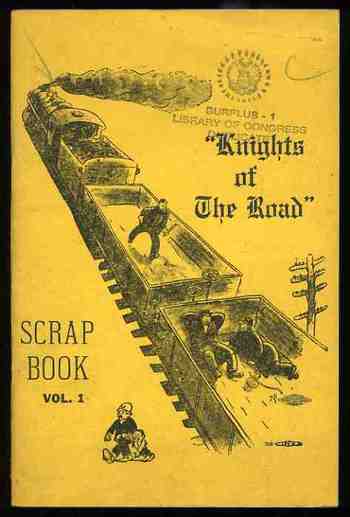
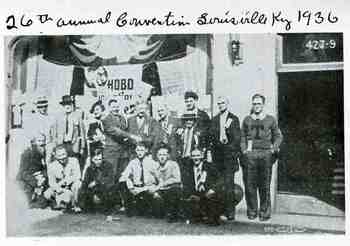
    1blog_oct_8_hobo_cvr785 There have been many Kings of the Hoboes, and Emperor of the Hobos, in the history of American Hobodom.  The most widely recognized of all this royalty is, probably, Mr. Jeff Davis, who was elected King of Hobos each year from 1908 to 1935, until in 1935 at the Pittsburgh meeting of the annual “Hobos of America” his minions gave up elected him King for Life. Of hobos, that is, the Knights of the Road; he was also a real hobo, unlike the pretenders, who in general were not. (Nels Anderson in his Men On The Move, written just as the Depression was broken, (1940) observed: “Whatever else may be said of King Jeff, his romanticizing the hobo is not without a basis in reality, and his poetic interest in the species arose from experience. But King Jeff has placed on a pedestal a man who belongs to the past. The hobo belongs with the pre-Hollywood cowboy and the lumberjacks of the Paul Bunyan legends.”)

    Mr. Davis was certainly very effective in getting the message out—on freedom and responsibility to irresponsibility—and was a great organizer and popularizer. He helped to establish hobo meetings, newspapers and literature (a sample of which is at left). He also had a few movie appearances: in The Arkansas Traveler, 1938 and The Bridge of Sighs, 1915, he ably played the role of a hobo.
    1blog_oct_8_hobo_cvr786

    And what about the missing counterpart of Jeff Davis–Queen of the Hobos? There were certainly allot of women hobos during the Depression; Harry Hopkins estimated that there were something like 13,000 “sisters of the road” who were out and about in the 1930’s. I guess the most famous of them though was one who did not exist; and what parts of her that were real were mostly those of one man: Ben Reitman. Sister of the Road (1940) was supposed to be an autobiography of legendary Boxcar Bertha, but it was really an assimilation of Reitman’s own experiences sprinkled about those of women from his life. Reitman, who was described (by himself) as a “hobo, whorehouse physician, musician and tour manager/lover of Emma Goldman” (??) was probably not without enough experiences to float another character or two, had his story of Bertha wind up in the hands of exploitation movie maker Roger Corman. The good news about that though was that Corman gave the project to the very young Martin Scorcese who produced an odd and not bad film on no budget, and Boxcar got to live again.

    But what brought me here to begin with was Davis’ breakdown of some very colorful hobo slang, all of which was found int eh little yellow pamphlet (pictured above), and published as a “reference manual” in 1947.  And so:

    Gay Cat.  Someone who “beats it from town”, settles down with a job and puts together some money so that he can get on the road again.

    Gandy Dancer. “Is a hobo shovel stiff, a muck-stick artist”, a common laborer

    Pearl Diver. A hobo dishwasher and who works for his meal.

    Mush fakir. A hobo umbrella mender with a patch kit and a second-hand umbrella strapped to his back. (Evidently these guys were put out of business when larger stores began offering umbrella repair on their own.)

    Bindle stiff. A hobo who carries his stuff in a sack on a stick, including toothbrush, “but he does NOT carry blankets”.

    Kywah. An honest hobo pitchman peddling soap, perfume, jewelry, novelties, pens, knives and potatoes peelers.

    Kewah. :Makes and sells articles such as willow stands…”

    Scenery Bum. “A young tramp who bums it around the country, just for the fun of it.”

    Ring-tail. “An ignorant, harmless tramp.”

    Fuzzy tail. “A smart aleck tramp, jack of all trades, a fourflusher, big bluff, false alarm, and piker of the worst sort, who most always carries a “punk kid” or “road kid” (a runaway boy).”

    Dingbat. “An old tramp professional beggar who dings the main stem (begs on the main street).”

    Stew bum. “An elderly tramp who wastes his time continually drinking rot booze.”

    Jungle Buzzard. “A tramp who loves to eat but is too lazy to get the ingredients for a mulligan stew. He eats what is left when the gang leaves the jungle fire.” Yum.

    Road Yegg. “A vicious tramp of the petty larceny type, a cheap crook.”

  • Ships in the Skyline–Artistic Display of Quantitative Data

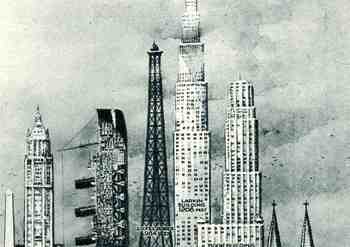
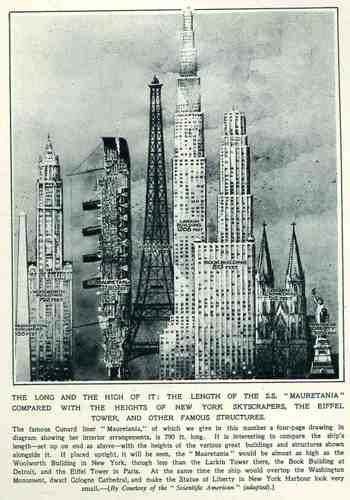
    This wonderful display (appearing in The Illustrated London News for 26 March 1927, page 518) of quantitative data isn’t quite as whimsical as it appears in detail, though I can think of onlyBlog1sept_16_ship_skyline_detail5_2 a few (antiquarian) times that I have seen a ship made part of a cosmopolitan vertical cityscape.  It is a great way of comparing two disparate, out-of-place equals, and certainly can get the idea of the size of something as stand-alone and solitary as a great ship to children (and adults, too) by comparing it to something as obvious as a tall building.,  This time its really just comparing the length of the SS Mauretania with the heights of some famous and notable buildings. (The Mauretania, 1906-1935, was a fabled, luxurious and fast ocean liner of the Cunard line; it was refitted for a resurgent oceanic service at about this time.)   In the larger, expanded second image we see the Mauretania stacked up against (from left to right) the Washington Monument (555′), the Woolworth Building (792′), the Mauretania  (790′), the Eiffel Tower (984′), the Larkin Building (proposed at 1208′), the Book Building (873′), the Koln Cathedral (512′) and the Statue of Liberty (305′).  The Larkin Building (not the F.L. Wright structure of the same name) was a proposed super-tall of 110 floors for 330 W. 42nd Street that was proposed in 1926 and not canceled until 1930, and which would’ve been the tallest building in the world. (For an interesting site on the cancellation of tall buildings, see HERE.)   In any event, this was a big ship–the largest in the world when it was launched as a matter of fact–and the drawing is wonderful.   Upon closer inspection, there is a terrific amount of detail in the cross section of the ship.)     (This original print is available at our blog bookstore.)                                             
    Blog1sept_16_ship_skyline564


  • The Compass of Music

    JF Ptak Science Books  Post 1252

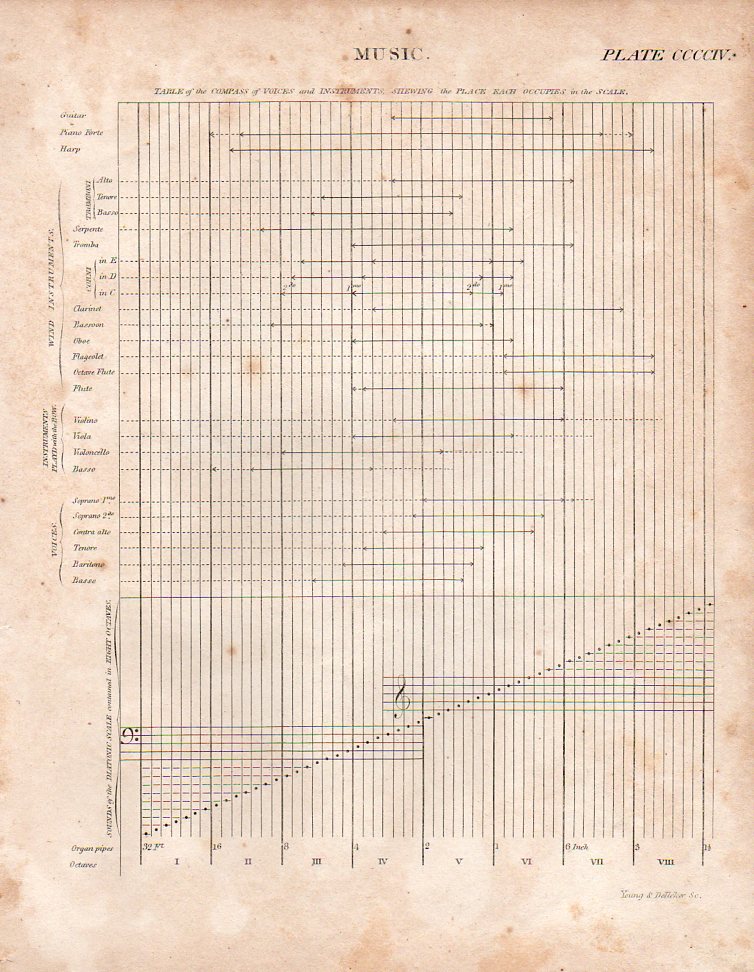
    This engraved plate from Abraham Rees’  Cyclopedia… is the wonderful invention of Alexandre Choron (1771-1834), and appeared (perhaps for the first time in an English press) in London in 1814.  It is a concise and interesting display of the comparisons of the reach of instruments along the eight octaves, and is a very strong example of clear and useful graphical display of quantitative data. 

    Music compass a949
    The full subtitle:  “Table of the Compass of Voices and Instruments, Shewing the Place Each Occupies in the Scale”.  (The original print is also available for purchase through our blog bookstore.)

    From Grove Music Online:

    Choron, Alexandre(-Etienne)

    (b Caen, 21 Oct 1771: d Paris, 29 June 1834). French writer on music, instructor, publisher and composer. While still a boy, he taught himself Hebrew and German and acquired a permanent interest in scientific experiment and a fascination for music theory and the techniques of composition. Although he reached the age of 16 before taking music lessons, he had already attained elementary skill on keyboard and other instruments. He greatly valued a friendship with Grétry which began in his 20th year and which suggests that he moved to Paris after his father’s death.


  • The Lost Memories of Things in the Way of the Horizon–Ugly Roads, 1922

    JF Ptak Science Books   Post 1303

    “There’s nothing so perfect as imperfection.”–Somebody.

    “The great unconquerables in the geography of human thoughts and ideas are the bad ones.”–Nobody.

    Bad ideas don’t so much go away as they get recycled. They can be replaced by good ideas or bad, but the ”original” bad ideas seem to linger on and on.  They are perhaps the indomitable inheritance of society, real and imagined.   

    Bad human-produced landscapes are an outgrowth of bad ideas, calamities large and small that come and go, the old replaced by something new that is good or bad or indifferent. With the landscape, the original landscape itself–apart from the idea that brought it about–is generally lost forever once it has been replaced.  There is no Bad Idea Spirit that brings it back whole again, unlike the generic Bad Idea, which can live on and on, unencumbered by history, like a Greek play or some deeper mythology.

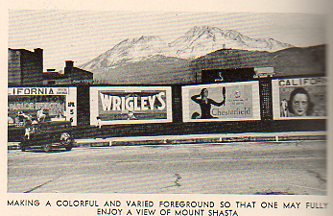
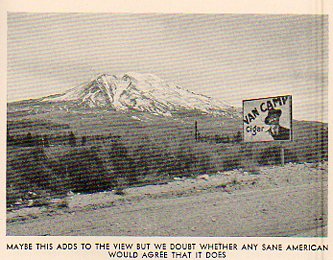
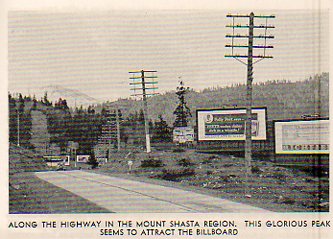
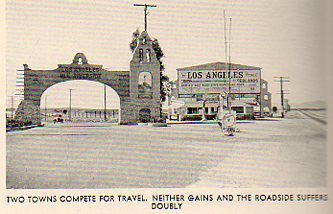
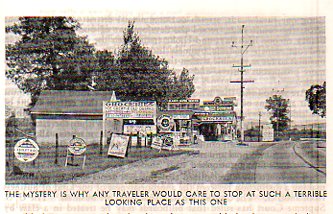
    Roadside billboards 273 Theoretically society is supposed to learn from recognized bad ideas, so as to not repeat them etc., which is one reason why we keep track of them, in the vain hope that someday someone somewhere in the history of our future will kill particular bad ideas off one by one. 

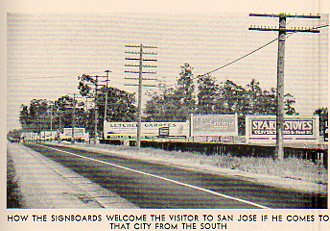
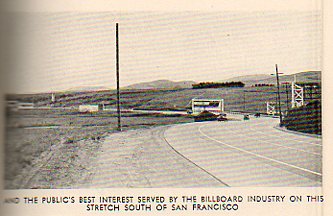
    Roadside billboards 274 In the meantime we can dwell on what we have, though with the removed bad idea landscape, it is more difficult.  That’s why it is important every now and then to familiarize ourselves with them when the opportunity arises, which is just what happened with this innocuous-sounding pamphlet, The Roadsides of California, a Survey1 (1922, and available for purchase at our blog bookstore)  Its not like it’s Pandora’s box–we can open this one and just a few, limited baddies come out, and fall limply to the floor.  But what we see is interesting, a slice of our memory of the horizon–a part of our “progress” that we’ve tried to excise–and what we can see now are the removed and forgotten things. 
    Roadside billboards 275 Roadside billboards 276

    Roadside billboards 278
    Roadside billboards 280 Roadside billboards 281 Notes

    1. This is actually an interesting pamphlet, an early attempt at removing the quickly generated ugliness that was cluttering new roads for the explosion of automobile travelers.  As quickly as cars were made in the new decade of the automobile, billboards and roadside attractions followed.  This pamphlet identified this phenomenon as a problem.