A Daily History of Holes, Dots, Lines, Science, History, Math, Physics, Art, the Unintentional Absurd, Architecture, Maps, Data Visualization, Blank and Missing Things, and so on. |1.6 million words, 7500 images, 4.9 million hits| Press & appearances in The Times, Le Figaro, Mensa, The Economist, The Guardian, Discovery News, Slate, Le Monde, Sci American Blogs, Le Pont, and many other places… 5000+ total posts since 2008.

Category: Information, Quantitative Display of

  • First Photograph of a Smell, Revisited

    JF Ptak Science Books

    It leaves me with such a cozy feeling to not find what I think is an obvious-but-odd phrase in Google.Dsc04716

     And that’s what happened with “the first photograph of a smell” (or “photograph of a smell” or odor, for that matter),  as shocking to the senses as it might be.

    There are long and interesting lists of firsts in photography: the first color photograph (Maxwell, 1867, but impermanent), the first photograph of a human face, the first photograph of the moon, the first photo of a planet, and so on, tirelessly, until we see how many derivations of “firsts” there are. (We can go from first photo of human to first photo of a human face to first photo of a human in motion to the first photo showing human hands to the old human recorded by photography tot eh first photo of a couple to the first photo of a human with a tool and on and on.) There is a shorter list of “first photographic non-photograph of a photograph” (?!) that I wrote about in an earlier (illustrated) post, but we won’t go there today.

    Here is a “first” though that I think hasn’t been dealt with too terribly much: the first photograph of an odor.

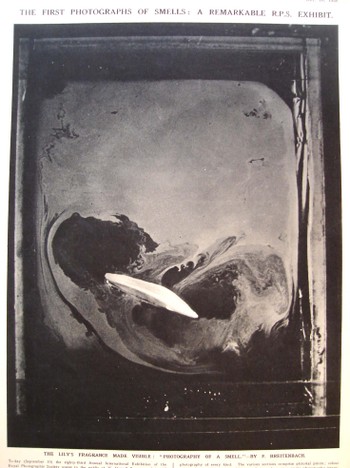
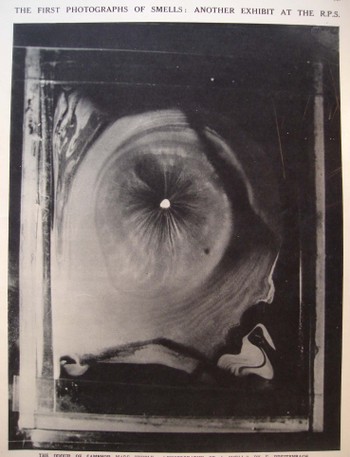
    These beautiful images appeared in the 10 September 1938 issue of The Illustrated London News and were exhibited at the 83rd Annual International Exhibition of the Royal Photographic Society, and were made by H. Devaux (who evidently, according to the snippet of an obituary that I can see from Science magazine, was a plant physiologist and “pioneer of surface physics“Dsc04717
    who died in 1956). The note accompanying the photographs read: “The emission of an odor involves volatillisation of material. If an odiferous material is enclosed in a cell a few millimeters above a clean mercury surface, it is possible to collect on the surface of the mercury a monomolecular layer of the volatillising or odoriferous substance. If the mercury surface initially is covered with talc powder, the gradual formation of the monomolecules layer may be observed as the talc is gradually pushed away from the point immediately below the specimen of material.”

    The photos are that of the odors of a lily and of camphor. I don’t know which is which, and a good story could be made up for either photo belonging to either item. Needless to say, these images are as gorgeous as they are unexpected, especially considering that they were made in 1938.

    {Both images are avaialble for purchase from our blog bookstore.]

    FOOTNOTE:

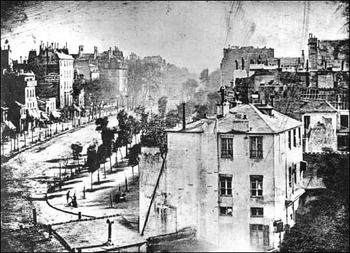
    I’d just like to add here the first photograph of a human being–well, actually, it is the first photograph that just happens to capture a human in the emulsion (discussed Blogoldest_human_photo_2 very nicely on the Doug’s Darkworld  blogsite.  Since the  exposure time was so terribly long for this image to be made, the moving people and horses and carriages on the street, all of the city-life bits, were necessarily spectral, invisible, to the photograph.  Only the stationary items were captured, and the only people captured here were two figures in the foreground, doing something or other that made them still for at least five minutes–long enough for their anonymous but famous photonic impressions to be captured.   Mr. Doug and others seem to think this is a man getting his boots shined–I agree.
    Blogoldest_human_photo_detail


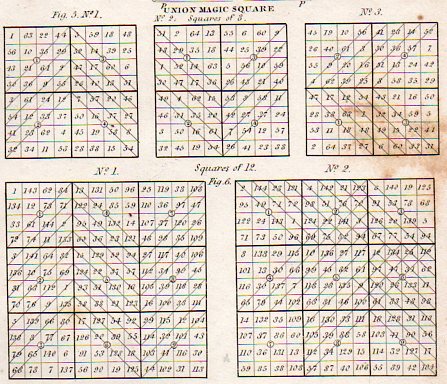
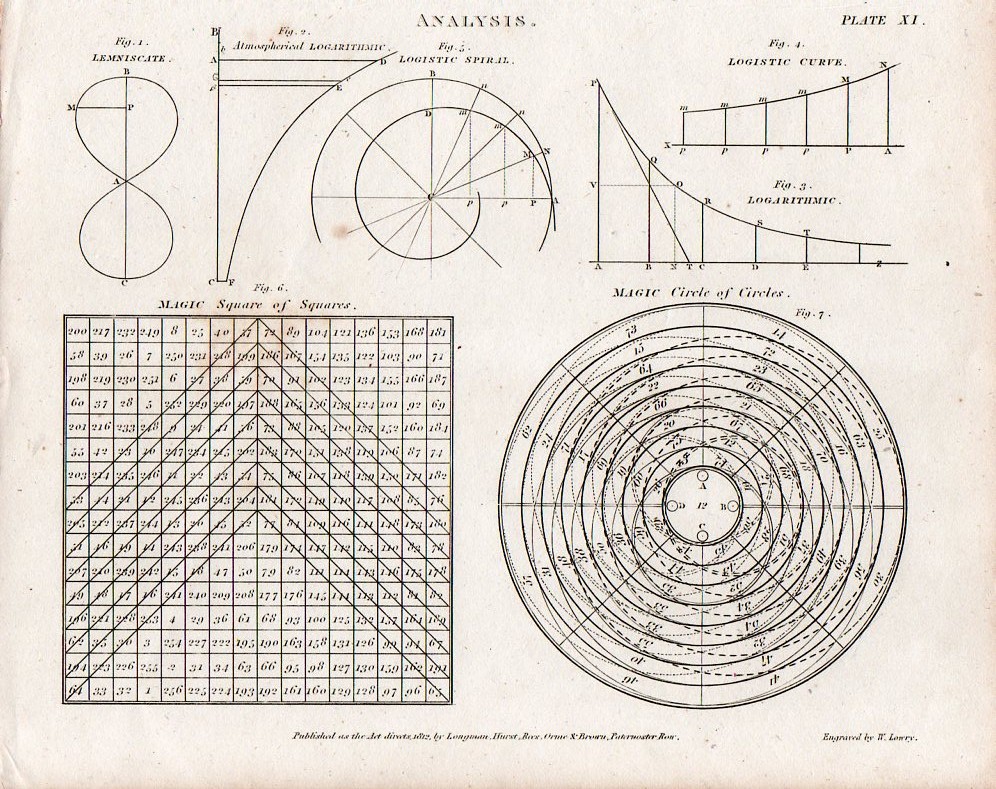
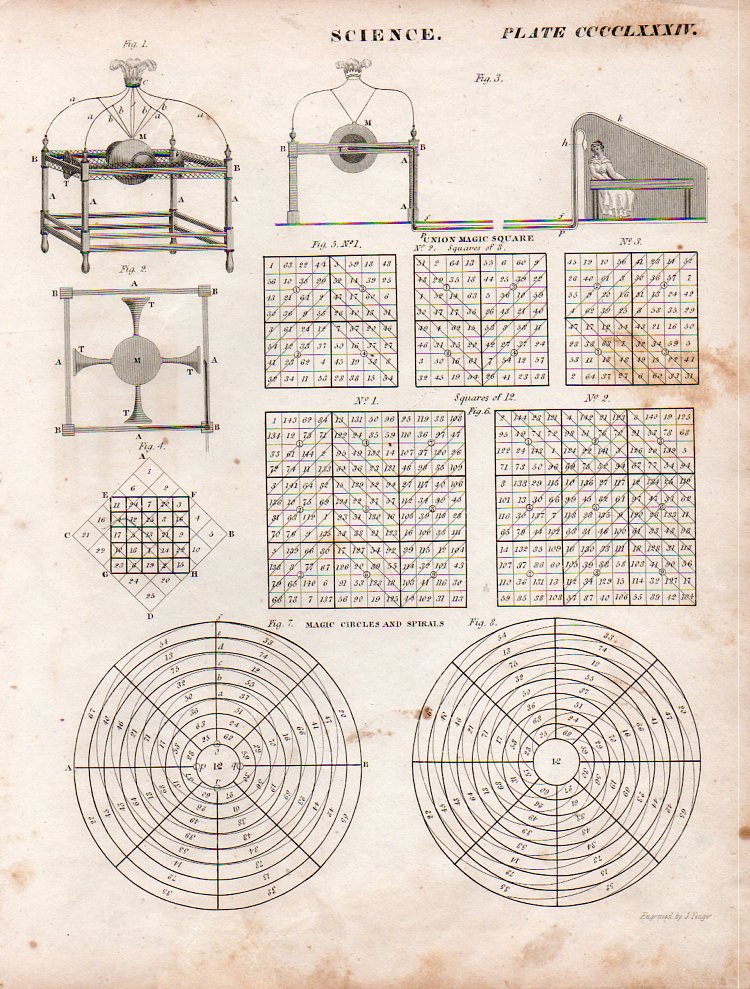
  • Logic Trees, Magic Squares, Magic Circles and Magic Square of Squares

    JF Ptak Science Books LLC  Post 1238

    [Associated posts: The Mother of all Renaissance Logical Graphs, The Knight’s Tour, Porphyry and Boethius and Census Art and the Display of Quantitative Data, 1860.]

    Magic square and circles det sq881
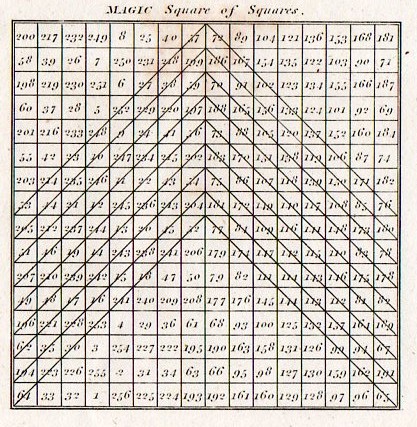
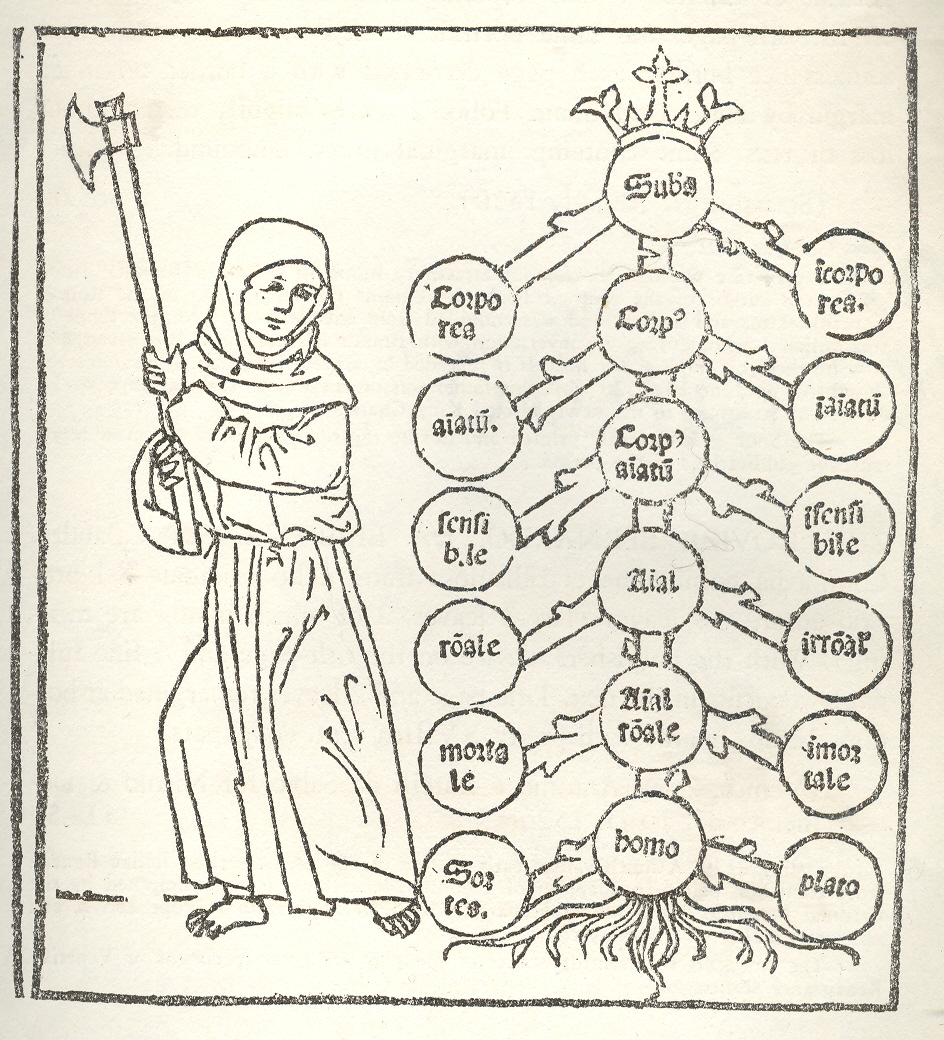
    Well now:  I don’t know what the provocation or inducement is here to hurtle this axe-swinging monk to attack Porphyry’s Tree1, though it would be interesting in a forensic sort of way to know what the tree’s section might reveal. The “tree” was a diagrammatic creation of a 3rd century Syrian mathematician/logician/philosopher named Porphyry who– much taken with Aristotle (and with the Categories in particular)– developed a systematic approach to the organization of thought in diagrammatic form.1--logic tree

    What’s inside a tree of logic and memory?  Is there a  xylem-y/phloem-y stuff besides a three-dimensional representation of the structure of organizational thinking?  Or is the 2-dimensional rip a fatal blow to other dimensions, and like Eddington’s Turtles, it’s a simple slice of Flatland all the way down?  

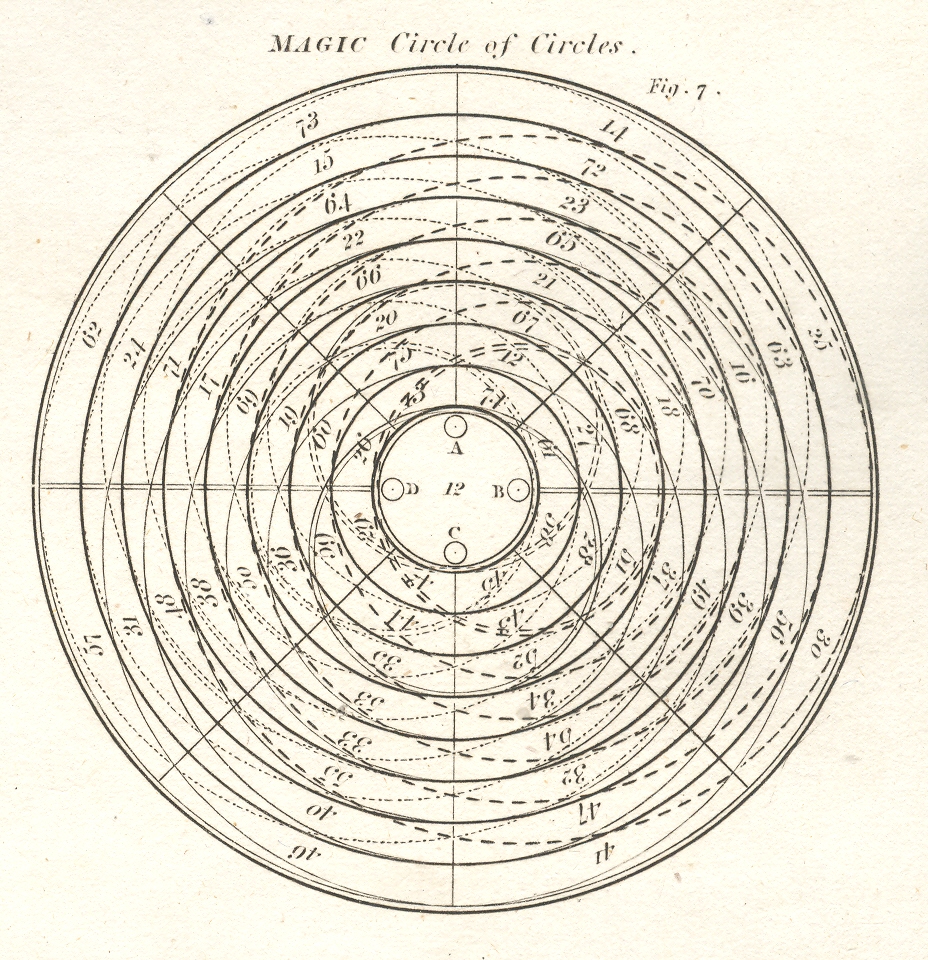
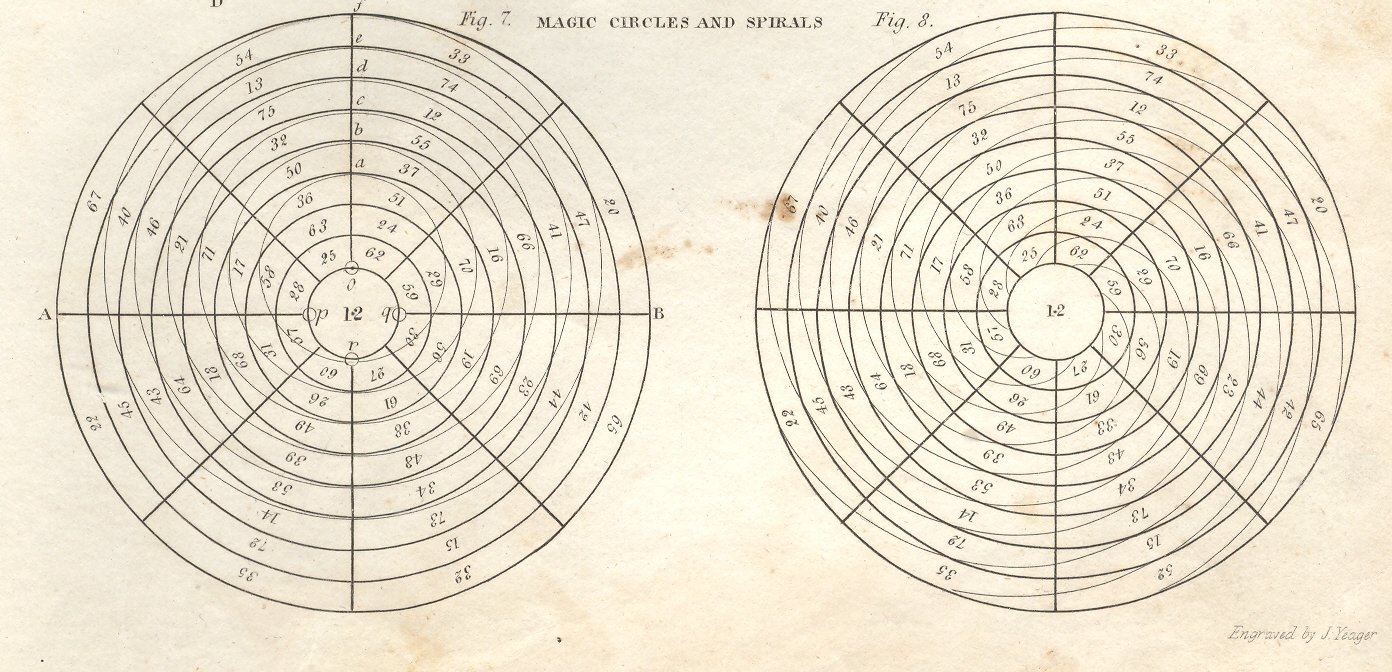
    Perhaps Porphyry’s tree rings would look like this, a magic circle or spiral, which would make some sense, and would bring to bear an associated use of turtles—or tortoises, I should say.  It turns out that perhaps the very first use of the magic circle, rolling back its origins through the Islamic world to India and to Persia and then to Japan,  and then finally to China where, in about 2000 BCE, the magic square appears in an image with the Emperor Yu,  inscribed on the back of a tortoise.

    1--logic tree magic circle 

    1--logic tree magic cricles

    [Magic circle source:  Abraham Rees Encyclopedic Dictionary , printed 1805-1815. The originals are available from our blog bookstore.]

    Magic squarezz and circles det883

    Magic square and circles880
    Magic squarezz and circles882

    Notes:

    1. This image appears in the rare Destructio sive eradicatio totius arboris Porphirii : magni philosophi ac sacrae theologiae doctoris eximii Augustini Anchonitani ordinis fratrum Heremitarum Sancti Augustini, cũ quadã decretali eiusde, published in 1503.


  • Footnotes in the Future–Swift, Lull, Borges and the End of Writing

    JF Ptak Science Books   Post 1155

    “The most ignorant person at a reasonable charge, and with little bodily labor, may write books in philosophy, poetry, law, mathematics, and theology, without the least assistance from genius or study.”   Jonathan Swift, in Gulliver’s Travels

    “Hell is the kingdom of the animal that swallows up the memory of all things… Between life and death there is no destiny except memory. Memory weaves the destiny of the world..”  Carlos Fuentes, Terra Nostra

    “A people without history/ is not redeemed from time, for history is a pattern of timeless moments” — T.S. Eliot, Four Quartets.

    The future history of writing–it will tell us–was already written before it was written.   In the future, when everything that can be written has been written and everything spoken has already been spoken, perhaps the first footnote in the history of already-done things will be to Jonathan Swift.  The experience belongs to us through Lemuel Gulliver1, who after surviving two trips (one to Lilliput in which Gulliver is twelve times the size of

    Written468

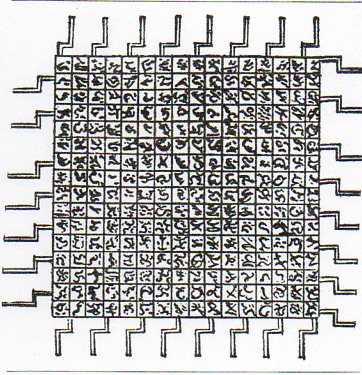
    everything else, and the second to Brobdingnag where he is one-twelfth the size of everything) comes to a third (of four2) in the land of Laputa.  It is here where he encounters a conversation machine that, when cranked, produces anything and everything, the known and unknown, the original and the copied, and have the thought and spoken
    word belong to the manipulator of the machine.  Everything that can be said is in that box, waiting to come.  The 20′ square was occupied by cubes with words on their sides, with 40 cranks and 40 handles and 40 operators to manipulate the mechanical vocabulary and associated scribes to record anything that made sense, and would be the springboard of “knowledge”operating without a manual or an intelligent primum mobile. (The image of the machine–which bears some resemblance to an integrated chip–appears in the third edition of Swift’s book, and as you can see is not a well-drawn thing, missing a row and a column and a crank here and there. A fuller description is found below.)

    Writtenc machine470

    The idea of a universal knowledge or an expanding, forever-library is very old, particularly if you expand the concept a bit to include Aristotle and the Tree of Porphyry3.  While not exactly a generator in the sense of Jorge Borges’ Library of Babel or the Swiftian machine, the ancients did 1--logic treeproduce very interesting, elegant, beautiful ways of story information and ordering information.  The Tree of Porphyry is far more concise–an abbreviation-compared to the infinitely expanding hexagonal rooms filed with books and attendant librarians in the Borges’ universe.  Or the Ars Magna/Thinking Machine of the 13th century Ramon Lull (also known as Ramon, Raimundo and Raymond, Raimundus and Raymundus Lull, Lully and Lullus and Lulio), the ultimate organizer of how sentences can be made and knowledge produced/uncovered (particularly if you want to please the logic of the church and the Creator), and which was almost certainly known to Swift (and which was also written about, described and worried-over by Borges4).  There are many other early figures in this category to be sure (Lewis Carroll, William Jevons, and even in a way Mr. Venn, not to mention Leibniz and his calculator,  and the changes in scientific method and (English/Dutch) mathematical concentration on applied mathematics of the 17th century that made thinking about the industrial revolution possible)), but that would be left to (at least) a longer post.  (The Lull wheel, below.)
                               

    How long will it take to digitize everything that has ever been written, or recorded, or composed? Several generations? Ten?  It may well come to pass in shorter time than we think; and when you compare this control of recorded human history to the centuries that will follow in developing “computers”, how can we possibly know what will become of all of it?  In the coming centuries and their attack on intelligence, when in the future the brain is a harvest of the computer, perhaps intelligence finally submits, and everything that can be done has been done, the progress of humanity snubbed to a stub. Or expanded exponentially.  It is such a tough call to make…

    Notes:

    1.  Jonathan Swift, Travels into Several Remote Nations of the World, in Four Parts. By Lemuel Gulliver, First a Surgeon, and then a Captain of several Ships.  1726.

    2. The third voyage was Part III. A Voyage to Laputa, Balnibarbi, Luggnagg, Glubbdubdrib, and Japan. The fourth finds humans as pets/inferiors in the island of the Houyhnhnms, a land of intelligent horses.

    3. The “tree” was a diagrammatic creation of a 3rd century Syrian mathematician/logician/philosopher named Porphyry who– much taken with Aristotle (and with the Categories in particular)– developed a systematic approach to the organization of thought in diagrammatic form.

    4. Borges J. L. (1999) ‘Ramon Lull’s thinking Machine’ in The total library: non-fiction 1922-1986 (Edited by) Weinberger, E., trans. Allen, E. Levine, S. J., and Weinberger, E. London, Penguin, on pp 155-160.

    It is interesting to note that Lull, who gave up everything to follow his calling into the church (and who was antagonized by the belief that his very act of missing his left-behind life to be a sin against god’s choice of him to follow his “career path”) was demonized by the church soon after his death, his works prohibited reading for hundreds of years.  He was resurrected in 1958 though on a path towards sainthood, a doctor of the church.  

    A description of the Swift machine:


  • Making Tubes of out Holes–the History of Holes, Extended

    JF Ptak Science Books  Post 1184  [Part of this blog’s History of Holes series.]

    Taking inspiration from Edwin Abbott’s Flatland1 (a superb book  excursion into perception and difficult envisioning in which a two-dimensional world tries to comprehend three-dimensional objects) I’ve decided to extend my History of Holes section with their extruded, cylinderized extension cousin–the tube.  After all, If you take a hole by its edges, shack it out, rough it up, reposition and throw some sides on it you wind up pretty much with a tube, which could be seen as elongated holes with (generally) defined beginings and endings. Sometimes.  This is a natural continuation of my series on dots, which can be regarded as holes, or points, and thus into tubes.  “Spots” on the other hand really doesn’t work into the dot/hole thing, as spots can be irregularly-shaped, and I like the dots/holes to be more rounded than the potentially jagged spot, or blotch.

    When you start thinking of tubes, though, they turn up everyhwere: from gigantic cannon, to impossible flying machines, to telescopes, pneumatic railways and delivery systems, test tubes, subways, pressurized health restorers, television screens, and so on.

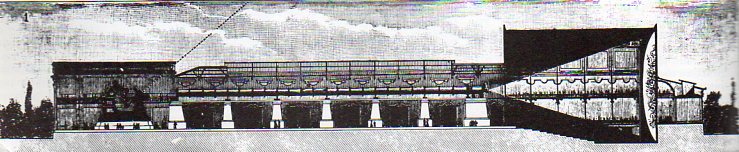
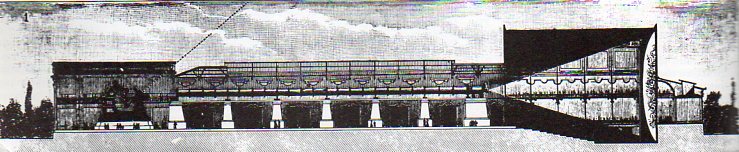
    I’m not sure where this idea came from–perhaps in the post on massive tubeless telescopes (here), reminding me of the most massive tubed telescope, the longest telescope with a tube, belonging to James Bradley, who produced a monster over 200′ long. Connecting the tubeless and tubed telescopes was the image that I had in mind; the hole following naturally from that. Anyway the Bradley  tubed construction–antithetical to the DNA/carbon/membrane nanotubes–were enormous for their time, and as moveable tubes are still very impressive.  Another massive telescope was constructed on speculation for the Paris Exposition of 1900 {the cross section of which is depicted below)–it was 187′ long, spectacularly made and exhiited, and could find not a single buyer.  Positioning the scope of course would’ve been very problemtaic. 
    Tube 1500 ft telescope621
    There are other, more massive and mobile tubes, like, say the smokestacks of the Titanic (which were 24×19 feet, with a fall of 150′ from the top of the smokestack’s sweep to the boilers)–these weren’t mobile in and of themselves, but they did move, if only for a short time (laterally), and then for a very short and cold time (vertically).

    http://www.titanic-titanic.com/pic/funnel_bogie.gif

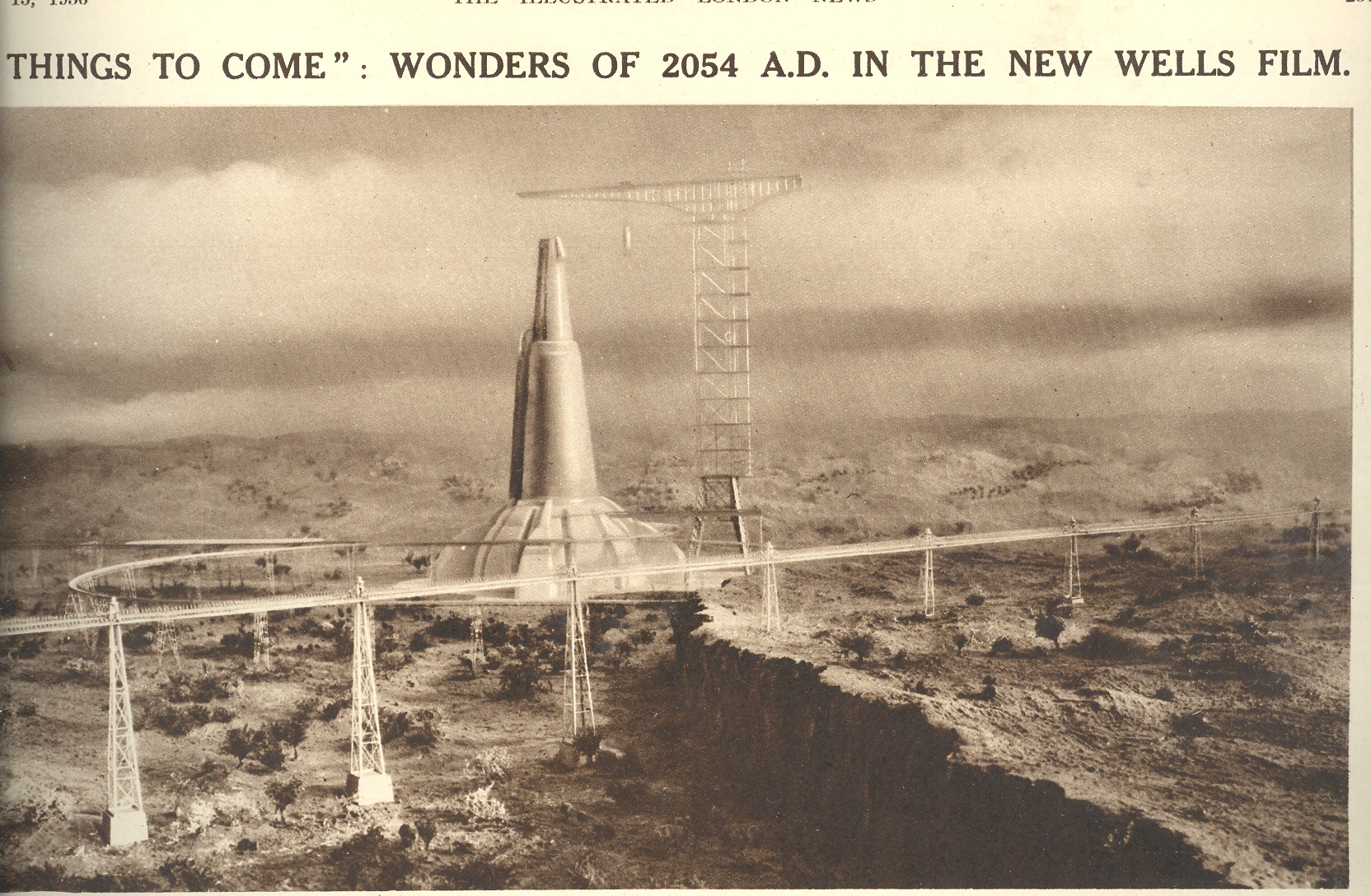
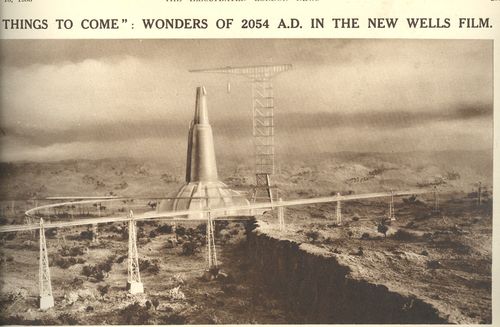
    Massive, monster canons have existed for many years in idealized and theoretical, speculative worlds, like Tom Swift and his Monster Canon.  In the history of early imaginary big gun tubes H.G. Wells’ Babel-like cannon (pictured below in a still from the movie Things to Come (1936), an adaptation his The Shape of Tings to Come (1931)) is fabulous–1500 feet tall, with I figure a  750′ base, it launched a 75′ tall capsule beyond the Earth’s
    Blog jan 6 wells

    gravitational pull with a spectacular explosiveness that would’ve made its occupants into instant jelly.  (Paul Drye points out that one of the biggest sci-fi guns comes to us via Arthur C. Clarke, who had his Lunar inhabitants fashion a gun by drilling into the Moon’s surface until they reached a depth where it would tap and “shoot” molten rock at attacking space ships.  This is more of a hole than a tube, and as such probably ranks it as the biggest hole gun ever constructed, even in science fiction. In the same veinish vein is Robert Heinlein’s railguns, seen in The Moon is a Harsh Mistress.  It has been suggested that E.E. Smith may have concocted gravitational weapons enabling planets and entire galaxies as wepaons, but I’m not sure about this, and they’re definitely not tubes.)

    Just to round out the Solar System cannonry a bit, here’s an example of a gigantic tube coming from the fabulous Frank R. Paul for Stanley D. Bell’s “Martian Guns” found in the January 1932 issue of Wonder Stories.  There’s really no way to determine how big the gun is except to say that it is probably “big”–there’s just nothing to place the thing in perspective, as the figures in the foreground, being Martian, don’t have a specific height.  They could be 6′ tall, or 60′–perhaps they’re only 1/10 of an inch tale, and the projectile they’re firing to the earth is so devastatingly powerful that size doesn’t matter.

    Strange things in sky--martian guns

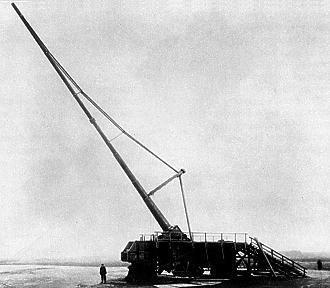
       Back here on Earth and in the real world,  the Kaiser Wilhelm gun (or “Paris Gun”, the Kaiser Wilhelm Geshutz) was
    http://farm4.static.flickr.com/3169/2951816593_c2d2e5c875_o.jpg


    a long-barreled, light shelled monster: its 92′ long barrel (plus a 20′ extension) launched a 94kg shell about 130 km, reaching a maximum height of 40km (about 25 miles) high. For all of its mass (the gun weighed 256 tons without the railway cars) the shell that it fired didn’t weight much at all….though the shell did reach an extreme height. (Ironically, the gun was built for attacking the deepest of the deep bunkers of the fortresses along the Maginot Line; it was never needed for that, as the Maginot Line was simply left behind in the Nazi assault on France.)  The British Ordnance BL 18 inch howitzer (below) was developedjust as WWI was enidng, but did not enter service until nearly two years after the war ended.

    File:BL 18 inch Howitzer Ashbury Station WWII.jpg

    The Schwerer Gustav was a 1350 ton beast which fired a 14,000 pound shell (!) about 20 miles. A  little later came the Nazi V-3 (the lesser known of the V-weapons), the Vergeltungsewaffe 3, a 130 metre (!) long, 150mm gun built alongthe side of a hill, launching a 140 kg shell. The Iraqi Big Babylon gun was sort of like this one, though never built–it was to have a 500′ barrel and would be supported by a hillside. Then there was the Nuclear Tube: the Atomic Annie (M65) cannon, which was another bruiser, being an enormous 85′ cannon that delivered the worst punch of all cannons, a nuclear warhead.  The weapon was test-fired in 1953 at Frenchman Flat at the Nevada Test Site and delivered a 15kt explosive device to a target seven miles away. There were 20 of these made, but given their diffiult-to-deploy-and-keep-secret status, and the nature of the shells, and the development of more sophisticated weapons, the M65 was obsolete almost as qickly as it was introduced, but was removed from the frontline only in 1963. 

    VWM240mmAtomicAnnie01.jpg

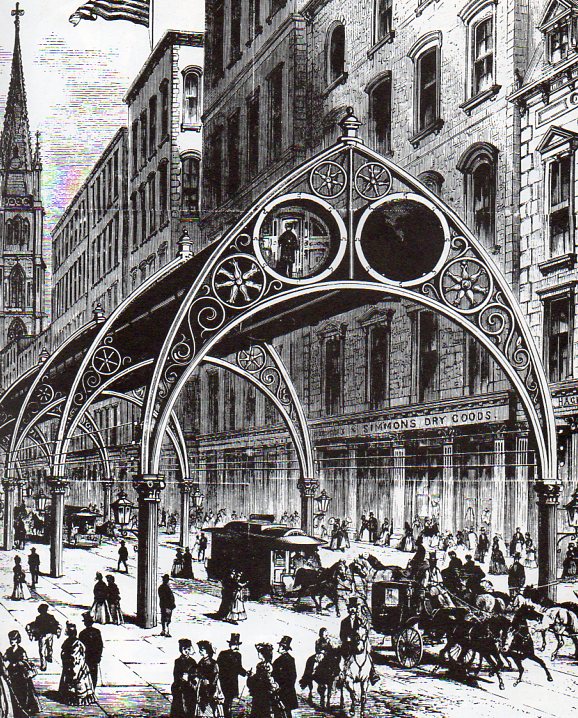
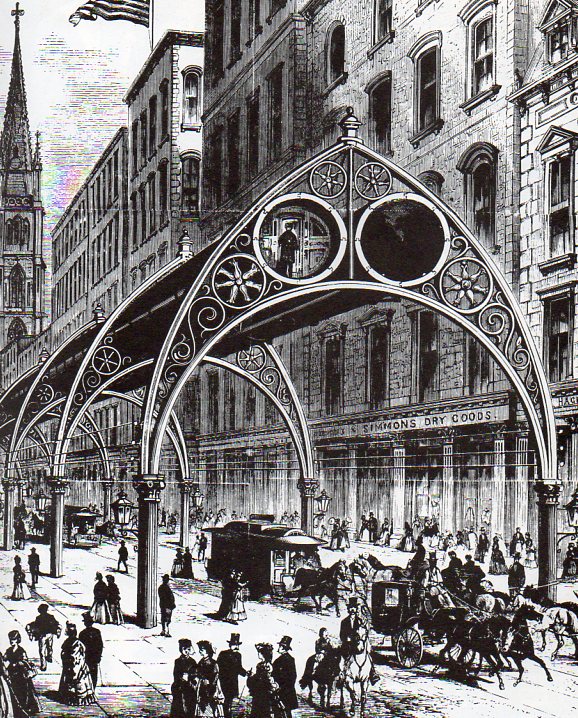
    I guess what people think of first though in regard to tubes in “The Tube” in London, though a more tubey tube was presented here in the pages of the Scientific American for the NewYork City subway:
    Tube nyc623

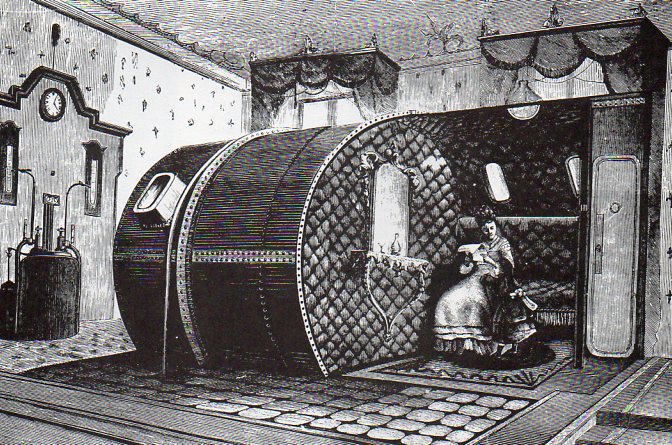
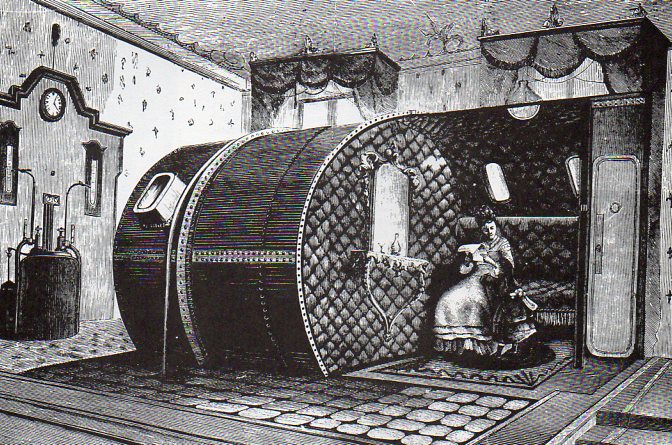
    Here’s yet another strange tube, this a tube-within-a-rectangle, an aerotheraphy device that was supposed to cure people of whatever they needed curing for, just like any other good quack device, though this may well have been the heaviest of them all.  Cushioned, well-appointed, and with a hint of luxury, this burst of fresh air was inteneded to render diseases and other complaints harmless–only for a lot more money than electro-shock or beer cures or massive purgatives or bleedings or copper amulets or whatever else you can come up with.  It does make a nice image, though:
    Tube aerotherapy625

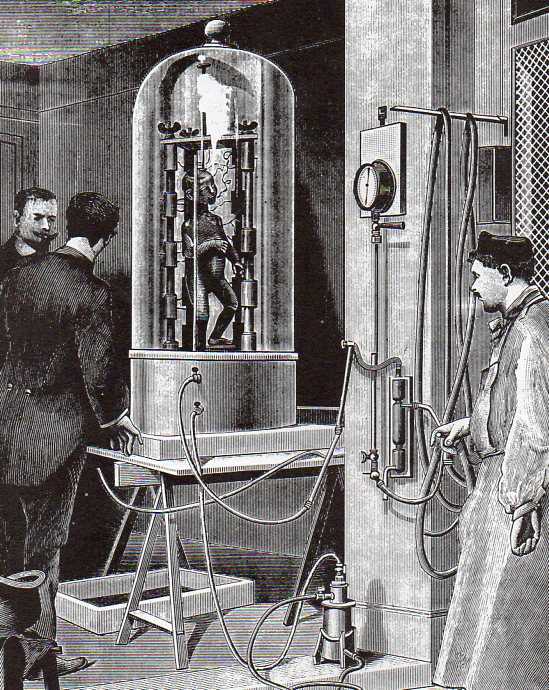
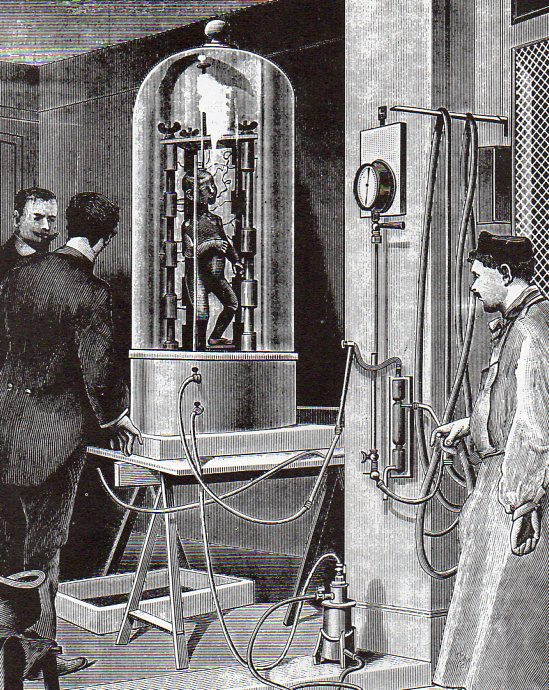
    The tube below may well have been the largest glass tube to hold the body of a dead person–and in this case, a dead child.  It was design for a practice that was evidently not practiced–electroplating the dead.  Someone thought it might make a good practice to deposit a one millimeter coating of copper on the skin of a cadaver, and published their success (and image) in the Scientific American for November, 1891.  The practice didn’t catch on.
    Tube test tube dead622

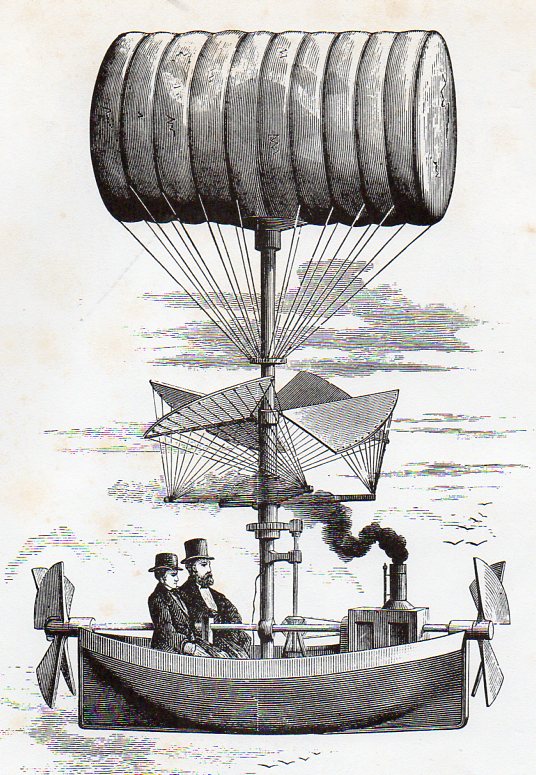
    Then of course there are submerged and flying tubes; submarines have certainly become a long-established part of the technological landscape, and the flying tubes, not. 
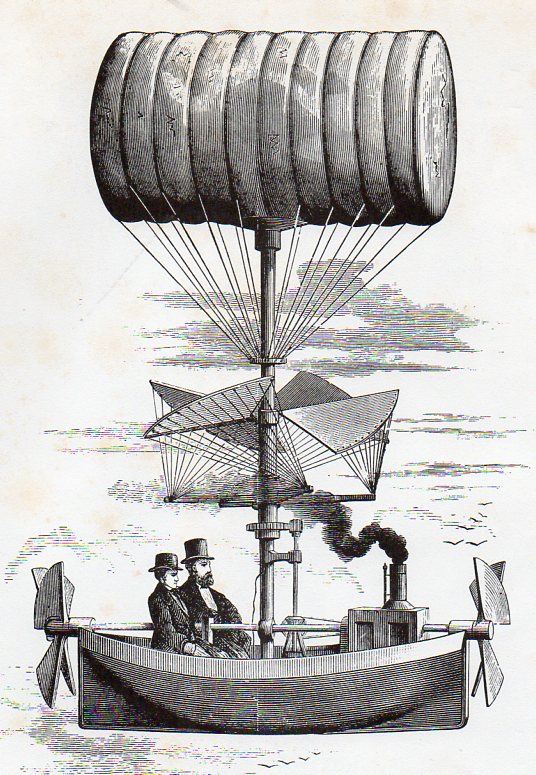
    Tube  flying620
    Still, the steam-driven helium-filled flying tube boat looks dignified and lovely, if impracticable.

    There were proposals in the late 19th and early 20th centuries for pneumatic railroads and pneumatic people movers (in one case in the 1930’s, for a plan to move individuals from New York to Philadelphia in chair-like objects in one of these tubes), but for all intents and purposes the closest that these plans came to fulfillment were pneumatic operations like thoe found in R.H. Macy in New York.  It was in the massive department store where you could find miles of pneumatic vacuum tubing that connected department tellers to a main counting office, where little cylinders were filled with cash and receipts and sent along for accounting.  The logical outocme of Macy’s tubular world for Terry Gilliam was seen in the director’s masterpiece dystopic flic, Brazil, where we see a world crowded with gargantuan and suffocating nothinness, filled with bazillions of miles of ductwork whose purpose is a mystery, making for a cold and disturbed world. 

    Brazil screen capture

    End part I of Making Tubes of out Holes–the History of Holes, Extended.

    Notes
    l. Edwin Abbott’s slender Flatland is perhaps one of the best books ever written on perception and dimensions, a beautifully insightful book that was quick and sharp, and in spite of all that was also a best-seller.  Written in 1884 when Abbott was 46 (Abbott would live another 46 years and enjoy the book’s popular reception), it introduces the reader to a two dimensional world with a social structure in which the more sides of your object equals power and esteem.  Thus the lowest class would be a triangle (three sides) while the highest (priestly) class would be mega-polygons whose shape would approach a circle.  Abbott’s magistry comes in explaining to the three-dimensional reader what it was like to be in a two-dimensional world.
  • Thinking Deep about St. Paul’s and the Eiffel Tower–Presenting the Depths of the Oceans in Plaster and Steel,1910

    JF Ptak Science Books   Post 1173

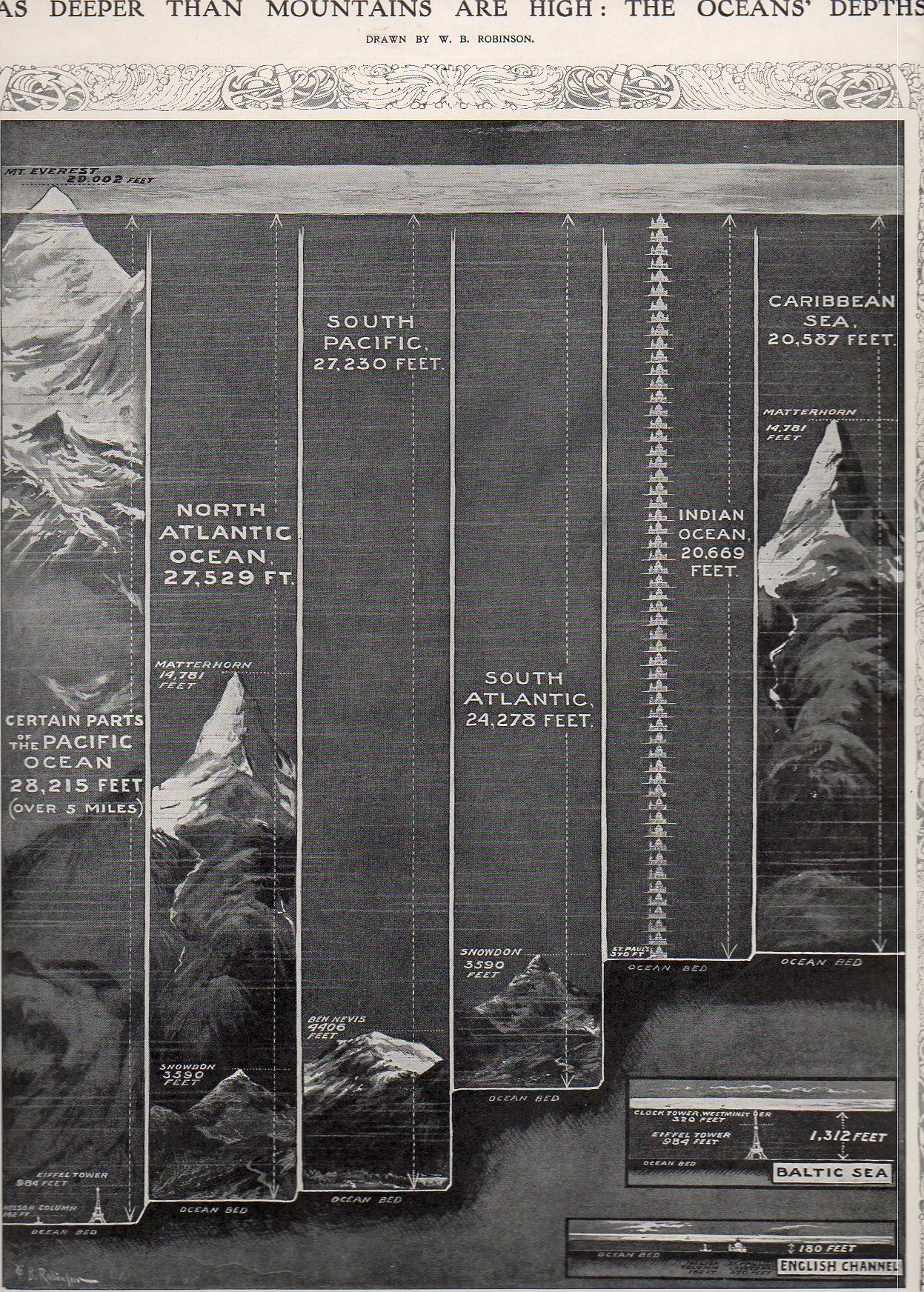
    Although maps showing the depths of the oceans existed from about the mid-19th century (through the pioneering work of the American father of oceanography, Virginia’s Matthew Fontaine Maury1) few casual readers would have ever seen a more approachable representation of information than what appeared in the Illustrated London News for 8 October 1910. Although Maury’s maps are elegant, they didn’t receive nearly as wide a distribution as this ILN image–also they weren’t nearly quite as relational as the 1910 version.

    Sea depths533

    Granted, the 1910 comparison chart only displays one statistic–the supposed greatest dept of five oceans, two seas and the English channel–it does so in such a way as to make those numbers immediately approachable to any reader, which is always an issue in relating scientific information to the general reader.

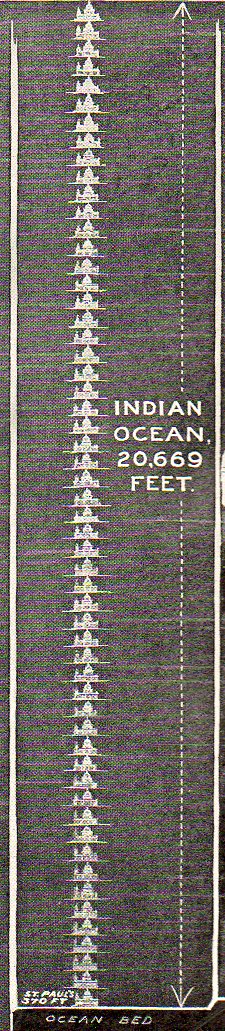
    Sea depths ist pauls537 {One of the standard unit of measurement for the purpose of this display was St. Paul’s Cathedral.]


     What W.B. Robinson presented was a way of looking at an invisible entity through very visible means–comparing depth to the heights of things that everybody in 1910 knew: the Eiffel Tower (relatively newly constructed out of 18,000 prefabricated highly-engineered pieces) and St. Paul’s Cathedral. So rather than stating that the Pacific Ocean is 28,000 feet deep, Robinson chose to replace feet with Nelson’s Column–174 of them. Or 29 Eiffel Towers. The 20,000-foot deep Indian Ocean was actually 56 St. Paul’s deep, while the Baltic Sea was deep enough to not quite cover one Eiffel Tower with one Westminster Bell Tower on top (ha!); and the English Channel at its deepest wouldn’t quite cover St. Paul’s.

    This is really the way to display data in my book, especially to kids.  This is one of the few ways of making the information accessible and understandable across almost all age ranges. 

    Notes:
    1.  Actually the work goes back a century before Maury with Buache, who produced this map of the English Channel in 1737–the data points are veyr numerous, but this is the very first time that such information was available on a map.

    Sea depths idouth pacific536 Sea depths indian535


    NOAA Photo Library Image - map00004

    And Maury again with this first map of an oceanic basin, published in 1853:

    NOAA Photo Library Image - map00001

     And in 1752, Philippe Buache produced this fantastic and first-of-its-kind map for the depths of the English Channel:

    NOAA Photo Library Image - map00186

    Here’s an extraordinary cross sectrion of a part of the ocean floor produced in 1857 by the HMS Cyclops in preparation for laying the Atlantic Cable:

    NOAA Photo Library Image - map00010


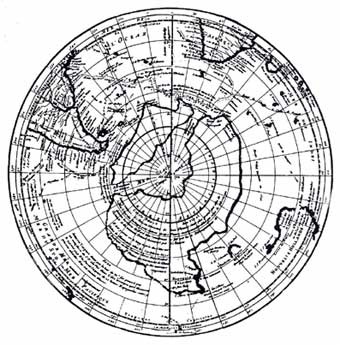
    Its also interesting to note here Buache’s work on this map of Antarctica, published in 1737.  Buache put together all of the known (to him) information about the mass in the South, bits taken from other maps, and accumulated them into what was the best-possible guess on what was down there in the Antiopode.  Pretty good detective work given the amount of material that he could work with.


  • Phantom in the Opera: Questions about Darwin and Einstein and Music

    JF Ptak  Science Books   Post 1170

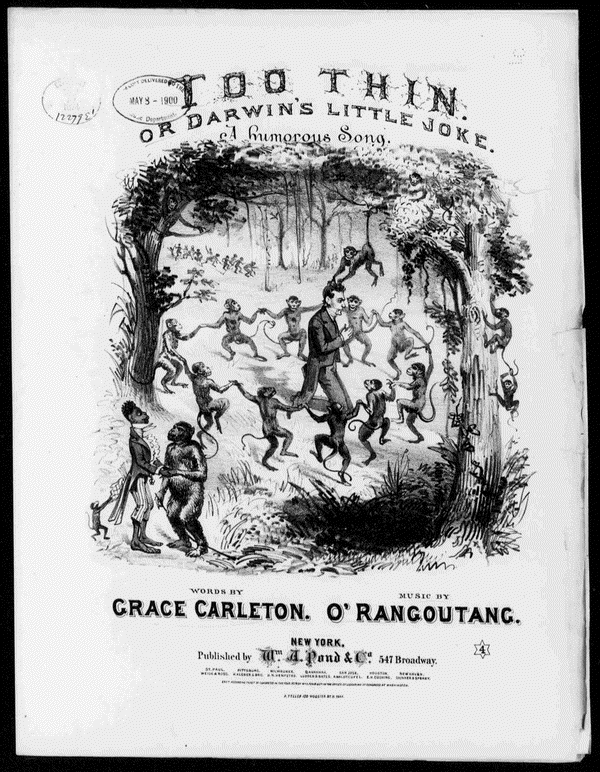
    There are unending missing pieces for me in the works of the greats (literal “phantoms” in the Latin phrase for their collected works, “opera”), one of which came bubbling up reading the excellent piece by Michael Barton (Dispersal of Darwin blog) on Darwin in caricature.  It  put me in mind of Darwin and music, or, really, Darwin caricature in music In the 19th century.  There doesn’t seem to be much to it, at least for the old stuff–there’s plenty of modern music, but it seems that there aren’t very many old notes.  There is this example that I found at the Library of Congress site, though:

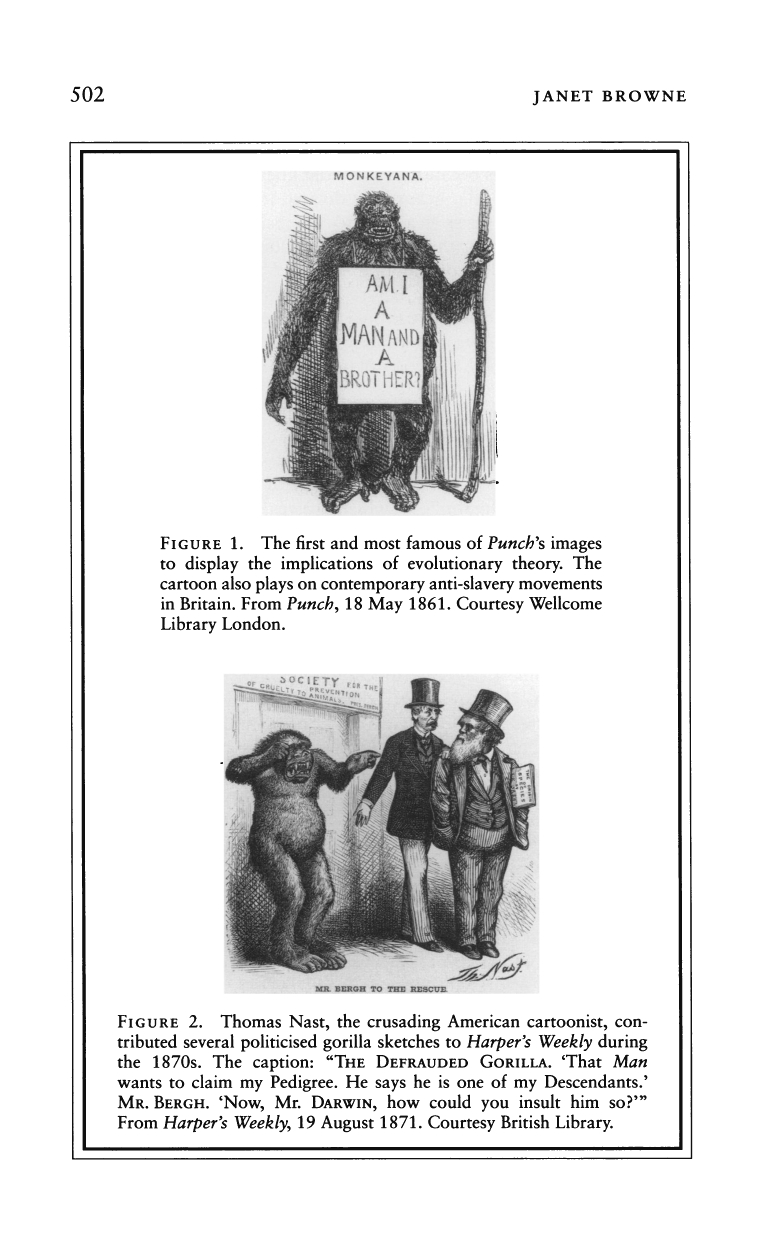
    “Too thin; or, Darwin’s little joke by O’Rangoutang”published in New York by William A. Pond, 1874, which came 13 years after the appearance of the first Darwin caricature (in London’s Punch magazine, 14 May 1861, seen below).

       Darwin sheet music

    This does bring up an interesting issue for me, though it is one frankly that I do not understand, about the relationship between Darwin and music. It is also somewhat related to an interest in Einstein and music, though for different reasons.  With Einstein, it has bothered me a bit that he was seemingly uninterested in any of the new forms of music that appeared in the revolutionary period of 1895-1925.  And, for that matter, Einstein’s artistic tastes were also quite classical and conservative.  Given the enormous changes in the fields of music and art and literature, and that all entered revolutionary periods during this time, and that Einstein brought his own revolution to bear on the world during the same period,  it is a little odd to me that his tastes were so restricted by an earlier time. 

    The issue with Darwin’s relationship to music is different, the tone-deaf Darwin applying his interest in music to the theory of sexual selection in animals and (perhaps) humans.  This idea seems to have first made an appearance in a posthumously-published 1844  (“The Essay of 1844″) work in Francis Darwin’s Foundations of the Origin of Species, published in 1903, but more specifically in his Descent of Man (1871):
               
    “The capacity and love for singing or music, though not a sexual character in man, must not here be passed over. Although the sounds emitted by animals of all kinds serve many purposes, a strong case can be made out, that the vocal organs were primarily used and perfected in relation to the propagation of the species. ” (Darwin, C. (1871) The Descent of Man . John Murray: London p. 587)

    “All these facts with respect to music and impassioned speech become intelligible to a certain extent, if we may assume that musical tones and rhythm were used by our half-human ancestors, during the season of courtship, when animals of all kinds are excited not only by love, but by the strong passions of jealousy, rivalry, and triumph. From the deeply-laid principle of inherited associations, musical notes in this case would be likely to call up vaguely and indefinitely the strong emotions of a long-past age. As we have every reason to suppose that articulate speech is one of the latest, as it certainly is the highest, of the arts acquired by man, and as the instinctive power of producing musical notes and rhythms is developed low down in the animal series, it would be altogether opposed to the principle of evolution, if we were to admit that man’s musical capacity has been developed from the tones used in impassioned speech. We must suppose that the rhythms and cadences or oratory are derived from previously developed musical powers. We can thus understand how it is that music, dancing, song, and poetry are such very ancient arts. We must go even further than this, and, as remarked in a former chapter, believe that musical sounds afforded one of the bases for the development of language.” (Darwin, C. (1871) The Descent of Man . John Murray: London p. 593)       

    As I said, I’m not sure at all about where music lives in the works of Darwin, or, for that matter, where it lived in his head.  It is interesting that music may play some role in the history of humans and animals, though it seems that Darwin had a distanced relationship with music itself.  He would certainly listen–his wife was an excellent player–though it seems as though Darwin didn’t have a musical sinew in his body.  I’m not saying that you have to be able to “bend” a soccer strike like Beckham in order to explain it; I’m just curious about the great man’s relationship to music.  I’m afraid I haven’t anything more than questions on this.

    Two interesting items for consideration:

    Charles Kivy, Charles Darwin and Music, Journal of the American Musicological Society
    Vol. 12, No. 1 (Spring, 1959), pp. 42-48

    Darwin in caricature: A study in the popularisation and dissemination of evolution
    Author: Browne, J. PROCEEDINGS OF THE AMERICAN PHILOSOPHICAL SOCIETY 12/2001 Volume 145 Issue 4 Pages 496 – 509
      

    And the first caricature (I think) from the London Punch

    Darwin punch 18 may 1861


  • The Kryha Cipher Machine. 1929 [Quick Post]

    JF Ptak Science Books  Post 1169

    [I wrote an earlier post on this blog on ciphers here: Books of Shadows—”Trithemius, Bacon, Porta, & Falconer vs. a Make-Believe Derrida on How to Make Something Unintelligible. Secret Writing and Ciphers”.]

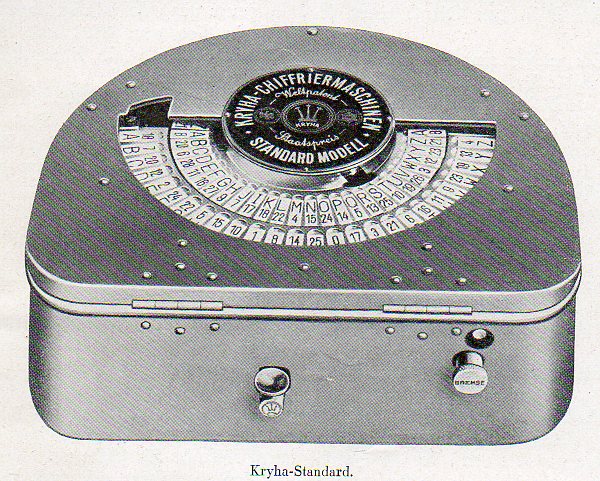
    The Kryha ciphering/enciphering machine was invented by Ukranian Alexander Kryha (d. 1955) and was capable of coding about 350 characters a minute.  It was used to enforce secrecy in business transactions, and was used in conjunction with (at least) Siemens telegraphic equipment.  I found these images (except for the patent drawings) of the Kryha machines in several issues of the Illustrirte Zeitung (Leipzig) for 1929, all of which are unusual and evidently not findable as good copies online–and so I’m simply reposting them here.

    Kryha big527

    Kryha  529


  • German Propaganda, 1929–a Call to Militarization

    JF Ptka Science Books  Post 1168

    [One of a long series of posts on propaganda–enter this term in the search box at left to see the listing.]

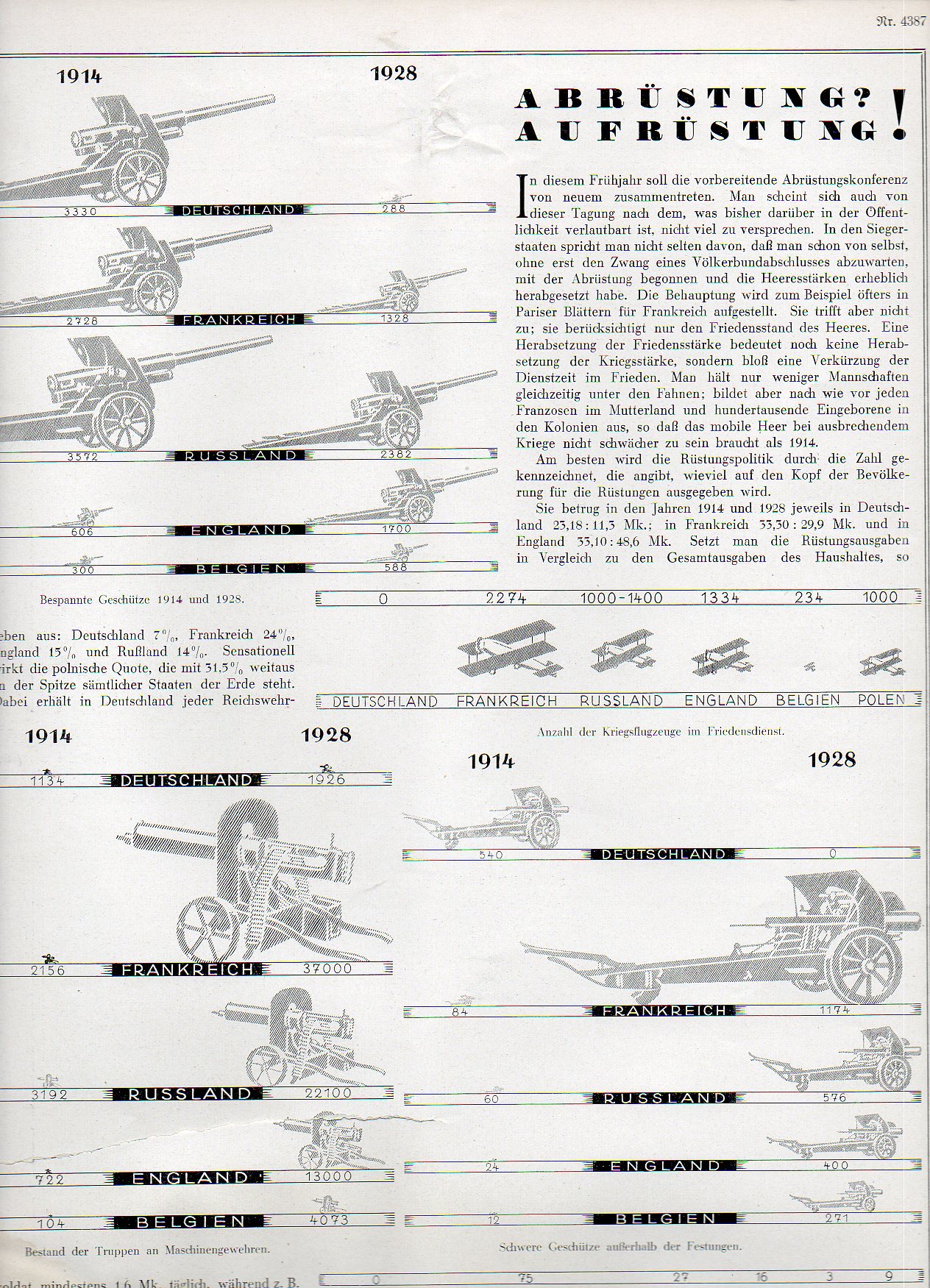
    Germany  1928 tanks det526

    Germany  1928 tanks525
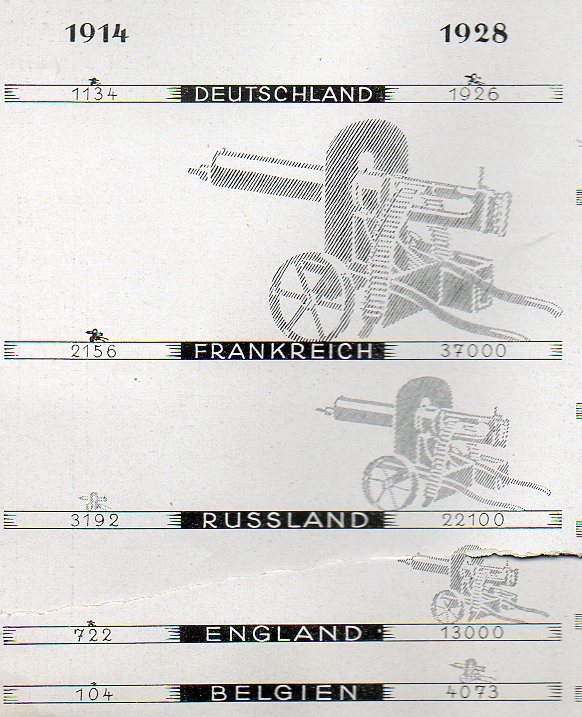
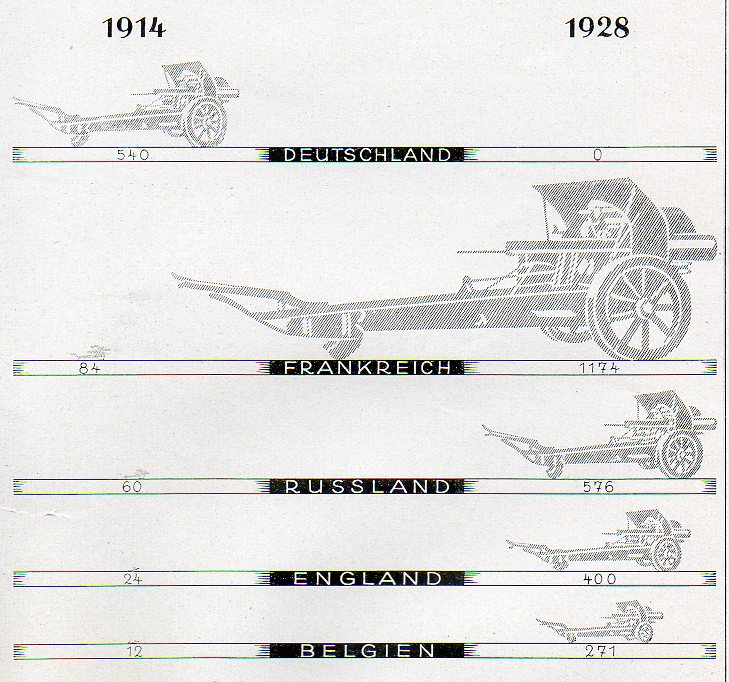
    In my “reading” of the Illustrirte Zeitung (Leipzig) I found this full-page illustrative representation of data (11 April 1929), one of the earliest propoagandist pieces (to my mind) in that magazine, showing the state–and great height–of militaristic weakeness in Germany, one of the lowest points that it reached in the breathing space between the two wars. It was really a picture of nothingness, a mention of the lost possibilities, and also what needed to be done–it was an early call to attention, to arms, to the reconsider of the Paris agreement, of doing “something”. Four years later the rearming business would be kicking into action, six years and five months later, the Second World War would start in earnest.

    Germany  1928  airforce523
    “Abruestung? Aufruestung!” is the name of the article-ette (roughly shouting Disarmament? ARMAMENT!, or Disarm? ARM!), basically stating that enough was enough, and that now was the time to start the process of having a military again.

    Every Germany (basically) would’ve known these facts, but seeing the representations of their zero-strength force of planes and tanks would’ve been an enormous blow.  And it was intended to be so.

    Germany  1928  cannons521
    Germany  1928  machine guns522
    Germany  1928 canon 2524
    Germany  1928520


  • One Upmanship–a Brief on the History of Ladders

    JF Ptak Science Books   Post 1165  Ladder jacob bath

    One morning Tim was rather full
    His head felt heavy which made him shake
    He fell off the ladder and he broke his skull
    And they carried him home, his corpse to wake
    Rolled him up in a nice, clean sheet
    laid him out upon the bed
    With a bottle of whiskey at his feet
    And a barrel of porter at his head–Tim Finnegan’s Wake, ca. 1850’s. 

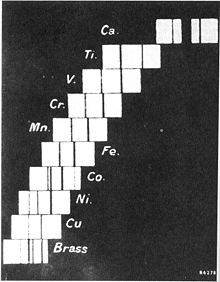
    The whole pursuit of ladders here today comes from looking at something described as a ladder but really isn’t one: Henry Moseley’s famous “ladder diagram” from a 1913 paper establishing the important Moseley’s Law (establishing the atomic number as a measurable experimental quantity). A more concrete ladder-like diagram is found (beginning about 1885) is the diagram used for displaying readouts from electrocardiograms.  On the other hand, the ladder from which Tim Finnegan fell in the 19th century Irish ballad (from which Mr. Joyce drew his inspiration for his last book from 1939, dropping the possessive apostrophe) was a real ladder, but neot necessarily nuts-and-bolts real.

    There are of course monster ladders–like the ones that reach 1300′ high inside transmission towers.  There were long ladders that reached up the sides of massive funnels of ocean-going ships, and short ones leading to the cockpits of fighter planes. There’s a very short ladder that reached down only eight feet or so, but that one was on the side of the LEM of the Apollo 11, and the LEM was on the Moon, which may be our furthest-away ladder. There were other 19th century versions of far-away ladders–these belonged to some of the early aeronauts and their balloons, some of which held some very large passenger cabins, some of which had two storeys, complete with ladders.

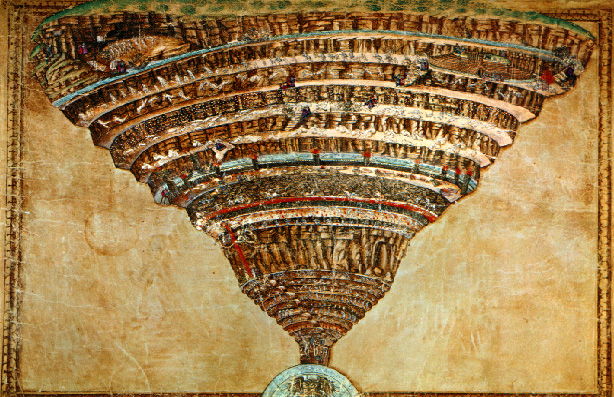
    The most famous of all ladders is probably Jacob’s ladder, an account of the patriarch’s dream of entering Heaven as found in Book of Genesis (28:11–19).  On the other hand, the image painted by Sandro Botticelli, led the other way, south, deep south, to Hell.  William Blake chose to represent another more beneficent ladder, again leading the aspirant to Heaven. And speaking of painters, the elder Brueghel included ladders in minor appearances in a number of his paintings (like “Big Fish Eat Little Fish”, and Hunters in the Snow”).

    William Shakespeare wrote of a gentleman’s knowledge of rope ladders, which of course could be found all over masted ships throughout history–and indeed the ladder stretches all the way back in human history, reaching back to cave paintings that dat from the 11th century BCE. 

    There are plenty of metaphorical ladders like “climbing the corporate ladder”, or hope for glory and success and victory in simple Chutes and Ladders.  And then of course, what better way to end a short look at ladders than with lovely lovely Ludwig (the other one):

    “My propositions are elucidatory in this way: he who understands me finally recognizes them as senseless, when he has climbed out through them, on them, over them. (He must so to speak throw away the ladder, after he has climbed up on it.) He must surmount these propositions; then he sees the world rightly.” –Ludwig Wittgenstein, Tractatus Logico-Philosophicus, 6.54

    Moseley’s Ladder:

    Ladder moseley

    Botticelli’s Hell:

    Ladder botticelli hell


  • Entombing St. Paul’s Cathedral with Masonry–Concretized Christo, 1909

    JF Ptak Science Books  Post 1160


    Admiralty harbor--2 monolith474

    The monumentality of the works of Christo and Jeanne-Claude is beyond doubt interesting for at least their fantastic visual impact–the philosophical impact and the statement of the work, the ‘revelation through concealment”, on the other hand, is completely unappetizing.  Generally I’m perfectly fine to see the works come and go, and, after a time, mostly the “go” part remains.  It is appropriate that there is no permanent full-scale representative of their work.  Cloud writers.  

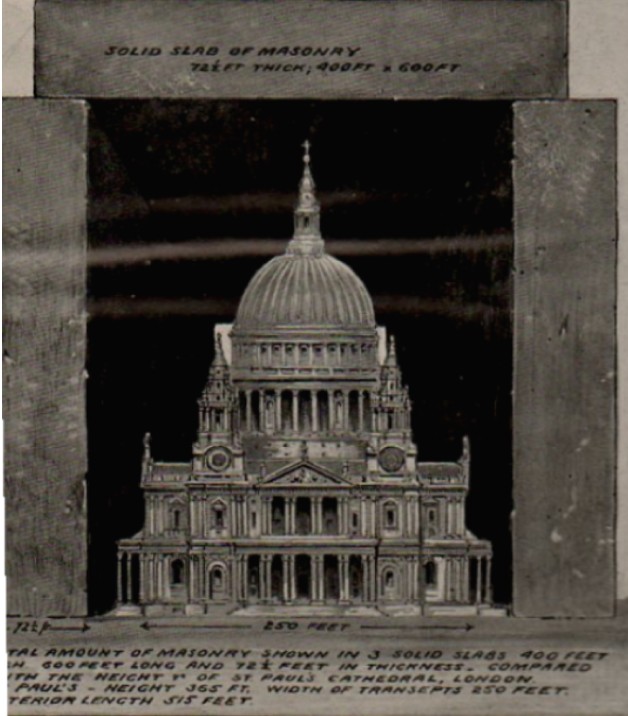
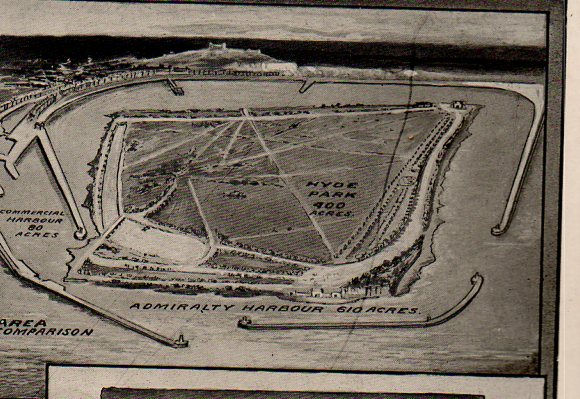
    In continuing a series on this blog on the artistic representation of comparative data I found an image that rivals the work of the two/one wrapping artists–the entombment of St. Paul’s Cathedral (London) with 2.5 million tons of masonry. 

    Admiralty harbor--1473

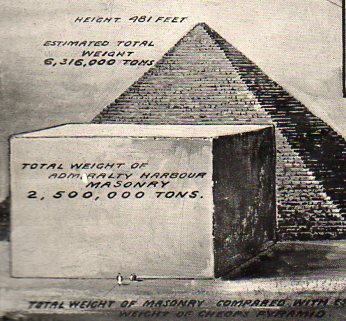
    The very striking image (from The Illustrated London News for 16 October 1909, page 545) was created to relate the massiveness of the newly-opened Admiralty Harbor (Dover) in 1909.  The harbor was a remarkable creation, enclosing more area of open sea than had ever been done before–as we can see, the created harbor was bigger than Hyde Park).  The artist, W.B. Robinson, gets the point of its size across very effectively with his six images–none more so than the St. Paul’s comparison.  Its true that the “tomb” is open on two sides, but the monoliths could have easily been made half of their width (each being 72.5 feet thick, by 400 feet long, by 600 feet high) so that they could’ve completely encapsulated the building. (Its an interesting thought–to build something beautiful and enormous, and then completely encase the thing in an enormous block that revealed nothing of its contents. Like place the pyramids in a cube.)

    Another remarkable image from this same series is the depiction of the weight of the harbor–a very tempting title for this post (“The Weight of a Harbor”) but the Christo one won out. 


    Admiralty harbor--4476